The Imperial Council (Divan-ı Hümayun) was the highest body of the Ottoman state, meeting in the sultan’s name and deciding the most important matters at the center. According to the TDV Encyclopedia of Islam, no Islamic state had a council of this caliber. In this article we describe the council’s origins, members, meetings, workings and decline on the basis of the sources.
Quick Summary
- The name means “the sultan’s council”; its roots go back to the Divan-ı Ala of the Great Seljuks.
- Mehmed II took the chairmanship of the council from the sultan and left it to the grand vizier.
- The principal members were the grand vizier, the Dome viziers, the kazaskers, the nişancı and the defterdars.
- In the sixteenth century it met four or five days a week, from the dawn prayer until noon.
- Anyone could apply with a complaint, regardless of religion, language or sex.
- It lost its function with the reforms of Mahmud II but survived ceremonially until the end of the state.
Contents
What Was the Imperial Council?
According to the TDV Encyclopedia of Islam, Divan-ı Hümayun means “the sultan’s council.” The word divan passed into Turkish through Persian and Arabic; its origin is considered to be Aramaic. In ancient Iran it was the name given to the registers in which financial records were kept and to the offices that kept them. In the first centuries of Islam it became the name of state offices such as the Diwan al-Barid, the Diwan al-Jund and the Diwan al-Khatam. The word also has other meanings, such as a poet’s collected poems and a sofa.
Among the Ottomans, divan was used in the sense of “meeting, council,” and it referred both to the meeting and to the meeting place. In a state governed with strict centralism, the Imperial Council consisted of the most important office holders at the center and made decisions in the sultan’s name. The encyclopedia counts it among the finest councils found in the advanced states of the early modern era.
Where Did the Council Tradition Come From?
According to the encyclopedia, even before Islam the Turks had councils in which they discussed affairs of state; in Mongolian these meetings were called kurultai. Having seen the palace councils of the Abbasids and the Diwan al-Mazalim, which was open to complaints, the Turks combined them with their own traditions. The first developed Turkish-Islamic council resembling the Ottoman council was the Divan-ı Ala of the Great Seljuks.
This tradition continued among the Anatolian Seljuks and the beyliks. Because there are no reliable sources on the development of institutions before the mid-fifteenth century, this process is difficult to trace. According to the encyclopedia, the council began to take on the character of the Imperial Council especially in the reign of Murad II, and in Edirne it sometimes met under the chairmanship of the sultan. The institution acquired its fully developed form in the time of Mehmed II.
The law code attributed to Mehmed II regulated the council along with the principal offices of the state. Mehmed II’s greatest innovation was to abolish the sultan’s chairmanship of the council for good and to leave this task to the grand vizier. From then on, when the sultan wished, he could listen to the discussions from behind a latticed window.
Members of the Imperial Council and Their Duties
According to the encyclopedia, the principal members of the institution were the grand vizier, the Dome viziers (Kubbealtı vezirleri), whose number usually varied between three and seven, the kazaskers of Rumelia and Anatolia, the nişancı, and the defterdars of Rumelia and Anatolia. When he was in Istanbul, the beylerbeyi of Rumelia also joined the members. The agha of the Janissaries and the grand admiral (kaptan-ı derya) became principal members when they rose to the rank of vizier. Administrators of vizierial rank who were at the center on some business and dismissed beylerbeyis were also required to attend the meetings.
Who Did What?
The grand vizier was the sultan’s deputy and presided over the council. The kazaskers heard cases under sharia, and the defterdars were responsible for the state’s financial affairs. The nişancı was the high-ranking member who drew the sultan’s tughra, and he knew customary law well. The Dome viziers, who had no specific duties, dealt with certain matters when necessary.
According to the encyclopedia, the nişancı also appears in the sources under the names tuğrai, tuğrakeş-i ahkam, muvakki‘ and tevkii. The tuğrai among the Great and Anatolian Seljuks, the katib al-sirr among the Mamluks and the uluğ bitigçi among the Ilkhanids performed similar duties. The title defterdar was likewise taken from the Ilkhanid term “defterdari-i memalik.” Among the Seljuks this office was called müstevfi.
The most important assistant, who directed the meetings though he was not a member, was the reisülküttab (chief scribe). The scribes who handled correspondence other than finance were attached, under his direction, to the nişancı. He prepared the agenda of the meeting. He was also the head of the beylik, tahvil and ruus offices, which drafted, dispatched and preserved the council’s decisions. According to the encyclopedia, the name of this office was changed to the Ministry of Foreign Affairs (Hariciye Nezareti) in 1836.
The şeyhülislam, although he headed one of the most important units of the central organization, was not a member of the Imperial Council. According to the encyclopedia, the reason was that he had no specific administrative or judicial duty.
How Were the Meetings of the Imperial Council Held?
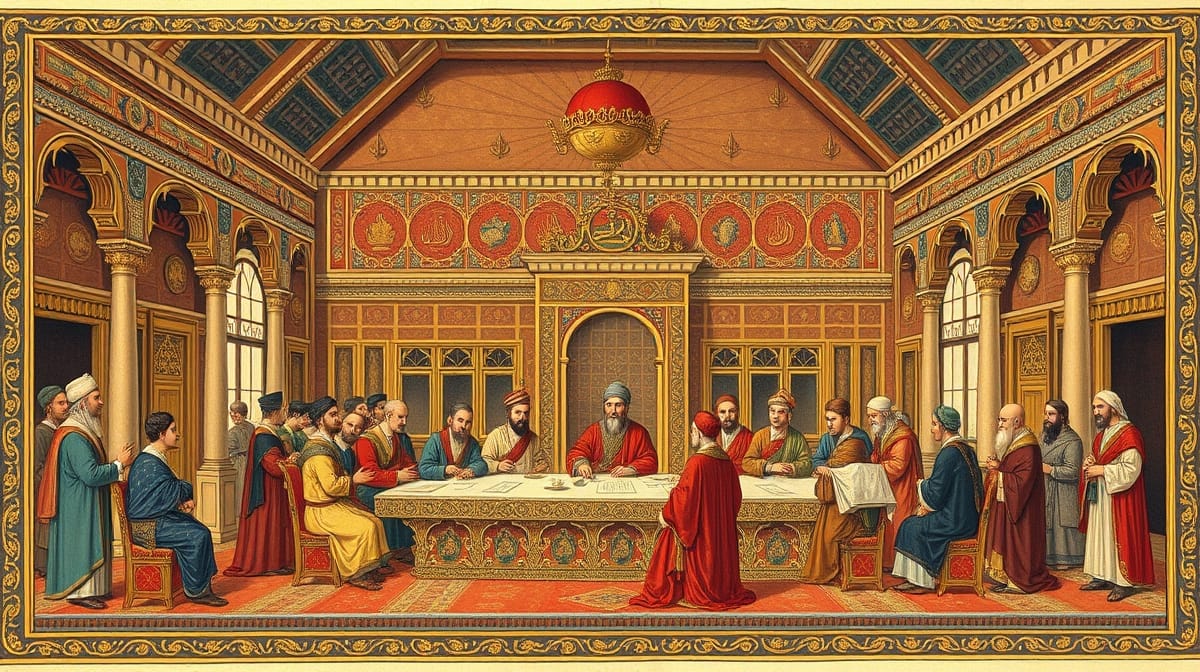
The meetings were held wherever the sultan was. Since the sultan usually resided in Istanbul, the classical meeting place was the Dome Chamber (Kubbealtı) in the second courtyard of Topkapı Palace, adjoining the Harem. There was also a dome chamber in the Edirne Palace.
According to the encyclopedia, in the sixteenth century the council met four or five days a week. At the beginning of the seventeenth century the meetings dropped to two a week, and after the beginning of the eighteenth century they became much rarer. The meeting began after the dawn prayer and, under normal circumstances, lasted until the noon call to prayer.
The principal members sat carefully in their assigned places, while the assistants served standing. Political and administrative matters were discussed first on the agenda. Matters that did not require the sultan’s approval were decided at once, and the draft decisions were handed to the nişancı to be written out in fair copy.

Submitting Matters to the Sultan
Some matters were not finalized without being presented to the sultan; this was called arza çıkmak. When the meeting ended, the members went before the sultan in turn and informed him about the matters discussed. If the sultan approved, the decisions were considered final. The grand vizier could not hear a sharia case on his own, but the council was competent in this field too thanks to the kazaskers. According to the encyclopedia, in its developed period the Imperial Council should be regarded as the most authoritative body after the sultan.
A High Court Open to All
According to the encyclopedia, the aspect of the council that aroused the admiration of Western observers was its judicial work. Anyone could apply to it in writing or in person, regardless of social rank, age, religion, language or sex. The members were obliged to listen to every complaint.

There was no concept of appeal in Islamic law, and the kadı’s judgment was considered final. Even so, the kadıs’ judgments were also examined in the council, and those found unjust were overturned and sent back to the kadı for a new decision. In customary matters, the nişancı, the grand vizier and the other viziers made the decisions. We described how the kadıs worked in our article on the Ottoman kadı.
According to the entry “Mahkeme” (Court), when the council worked as a high court, the kazasker of Rumelia conducted the trial and the kazasker of Anatolia attended as an observer. If cases piled up, the kazasker of Anatolia also took part in the trials at the grand vizier’s request. Because the sultan could listen from behind the lattice, the members acted with extreme caution. According to the encyclopedia, it was known that the punishment for the slightest injustice could go as far as execution by sultanic decree (siyaseten katl).
Why Did the Imperial Council Lose Its Importance?
According to the encyclopedia, from the early sixteenth century to the late seventeenth century the council held the most important place in the state after the sultan. From then on its powers gradually passed to the grand vizier’s afternoon council (ikindi divanı). In the mid-eighteenth century, with the development of the Bab-ı Asafi (the grand vizier’s office), it became a place of ceremony and display.
The grand viziers, as the sultan’s deputies, had no sympathy for this institution, which restricted their freedom of action. They tried to increase the powers of their own afternoon councils and fully succeeded in the eighteenth century. Mahmud II’s reform of the central organization marked the end of both the Imperial Council and the grand vizier’s council, and the cabinet system was adopted.
The encyclopedia sees the most important reason for the decline in the absence of even a simple representative character in the council. In the West, some councils developed once representatives from outside the bureaucracy entered them. The Imperial Council, by contrast, consisted only of members bound to the absolute authority of the sultan. According to the encyclopedia, consultative assemblies (meşveret), which were not institutionalized and met only from time to time, could not remedy this shortcoming. The institution was nevertheless preserved ceremonially until the end of the state.
There were other councils in the state as well. The Friday council, which met on Fridays at the grand vizier’s residence and was attended only by the kazaskers, heard sharia cases; the Wednesday council was of a similar nature. In the provinces, provincial councils, small copies of the afternoon council, worked under the chairmanship of the governor. We discussed the sultans’ approach to government in our article on the sultans and state administration.
Frequently Asked Questions
Where did the Imperial Council meet?
It met wherever the sultan was; in the classical period the Dome Chamber in the second courtyard of Topkapı Palace was used.
Who presided over the Imperial Council?
From Mehmed II onward the grand vizier presided; the sultan could listen to the discussions from behind a lattice.
Was the şeyhülislam a member of the council?
No. According to the TDV Encyclopedia of Islam, he was not a member because he had no specific administrative or judicial duty.
Could ordinary people apply to the council?
Yes. Anyone could apply in writing or in person, regardless of religion, language, sex or rank. The members were obliged to listen to every complaint.
When did the council lose its function?
It weakened in the eighteenth century with the rise of the afternoon council; with the reforms of Mahmud II the cabinet system was adopted.
Conclusion
The Imperial Council was a powerful body that combined the Turkish kurultai tradition with the Seljuk heritage and Ottoman centralism. Meeting under the chairmanship of the grand vizier after Mehmed II, the council took political decisions and worked like a high court open to all. Its lack of a representative character and the rise of the afternoon council, however, gradually turned it into a ceremonial institution. The Dome Chamber in Topkapı Palace is today the most important place that preserves the memory of this council.





7 thoughts on “What Was the Imperial Council? How the Ottoman State Was Governed”