The Conquest of Constantinople was a major historical turning point that ended the Byzantine Empire in 1453 and transformed the Ottoman state from a regional principality into a world empire, permanently reshaping European diplomacy, Mediterranean trade, military technology, and the understanding of political leadership in the Islamic world.
Contents
- The Historical Background of the Conquest
- The Conquest of Constantinople and Military Genius
- The End of Byzantium, the Rise of the Ottomans
- World Trade Routes and the Economy
- The Political Impact on Europe
- Symbolic Meaning in the Islamic World
- Conclusion
The Historical Background of the Conquest
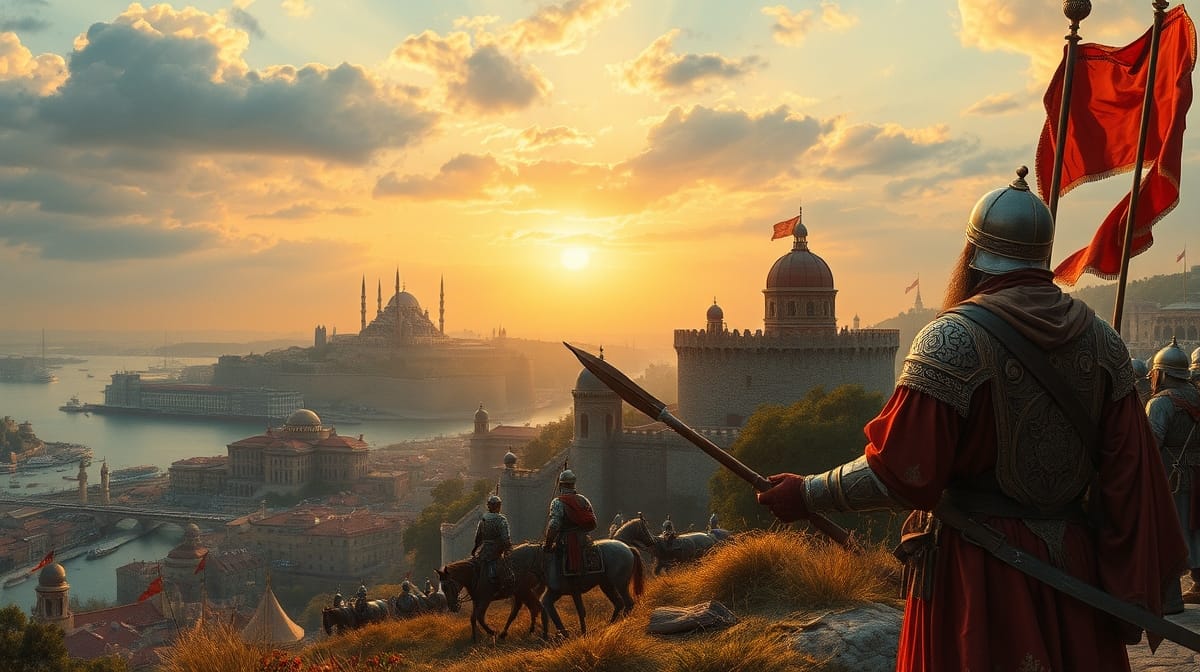
By 1453, Constantinople no longer possessed the vast resources of its former Roman and Byzantine glory; yet the city remained unique because of its strategic position, walls, harbors, and symbolic value. The Bosporus, the key passage between the Black Sea and the Mediterranean, was vital for both trade and military movement. For the Ottomans, the city appeared as a powerful fortress standing between their Anatolian and Rumelian territories.
Ottoman interest in Constantinople did not begin only in the reign of Mehmed II. During the reign of Bayezid I, the city had been subjected to a serious siege, but the consequences of the Battle of Ankara temporarily halted Ottoman expansion. To understand this context, assessments of Bayezid I and the Battle of Ankara are important for explaining the rupture at the beginning of the fifteenth century.
The relative stability achieved in the Balkans and Anatolia during the reign of Murad II left the young Mehmed II a stronger political inheritance. The Reign of Murad II and the Battle of Varna had demonstrated the Ottomans’ military capacity against Europe. Therefore, the Conquest of Constantinople was not a sudden adventure, but the planned and strategic outcome of roughly a century and a half of Ottoman expansion.
The Conquest of Constantinople and Military Genius
The Conquest of Constantinople was one of the last great examples of medieval siege warfare, while also heralding early modern military technology. Before beginning the siege, Mehmed II built Rumeli Hisarı to bring Bosporus traffic under control. In this way, Byzantium’s ability to receive aid through the Black Sea was largely restricted.
The role of cannons during the Conquest of Constantinople
The great cannons used in the conquest showed the growing importance of firearms in siege warfare. The heavy guns produced by the cannon founder known as Urban created both psychological and physical pressure, especially on the Theodosian Walls. Of course, the walls were not brought down by cannons alone; continuous bombardment, trench operations, land assaults, and naval pressure worked together to produce the result.
According to Halil İnalcık, Mehmed II’s success should be explained not only by military courage, but also by political calculation, logistical planning, and an imperial vision. For this reason, the conquest was far more than the capture of a simple fortress: it was an imperial move in which Ottoman military organization, engineering, and the power of central administration came together. In this respect, knowing the structure of the Ottoman army helps one better understand the success of the siege.
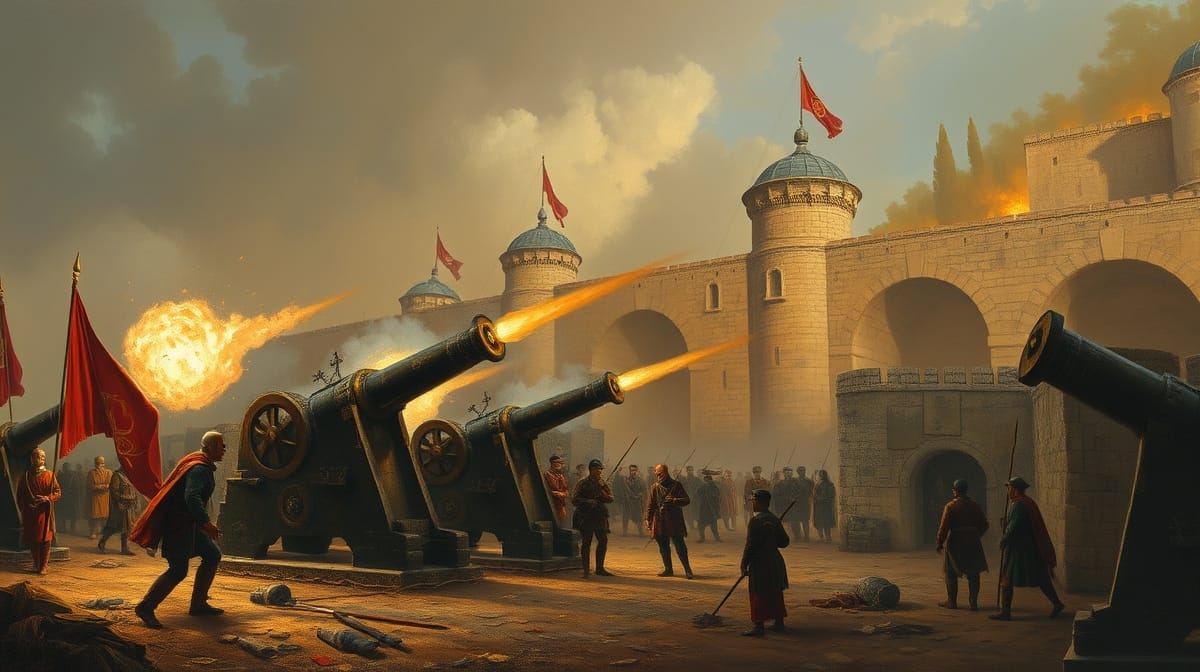
The Conquest of Constantinople and the lowering of the fleet into the Golden Horn
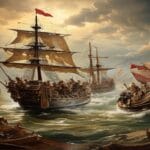
One of the most famous moves of the siege was the transport of Ottoman ships overland into the Golden Horn. This maneuver threatened one of the areas in which the Byzantine defense placed the greatest confidence. The chain across the Golden Horn prevented direct entry by sea; however, the Ottomans overcame this geographical obstacle and changed the direction of the siege.
This event is remembered in military history not merely as a bold move, but also as an example of strategic imagination. Throughout the siege, the Ottomans used land power, naval force, engineering, and psychological pressure together. When the city fell on the morning of May 29, 1453, Byzantium’s political existence came to an end and a new age began for the Ottomans.
The End of Byzantium, the Rise of the Ottomans
The Conquest of Constantinople meant the effective and symbolic end of the Byzantine Empire, which had a history of more than a thousand years. Although Byzantium had become a small city-state by the fifteenth century, it was still the bearer of the Roman legacy. For this reason, the fall of the city caused a great shock in Europe. For the Latin Christian world, the loss of Constantinople was not only a military defeat, but also the collapse of historical memory.
For the Ottomans, this event changed the character of the state. Mehmed II was no longer merely a sultan, but an imperial ruler who claimed the title Kayser-i Rûm, Caesar of Rome. Istanbul replaced Edirne as the capital and became the administrative, military, economic, and cultural center of the state. This transition is one of the strongest signs marking the beginning of the Ottoman period of rise; for the broader framework, the characteristics of the Ottoman period of rise may also be examined.
İsmail Hakkı Uzunçarşılı’s assessments of Ottoman institutions show that the state center grew stronger after the conquest. The palace, imperial council, madrasas, waqfs, and military institutions acquired a new Istanbul-centered order. Thus, the city ceased to be merely a conquered place and became the administrative laboratory of the empire.
World Trade Routes and the Economy
The Conquest of Constantinople had a direct impact on Mediterranean and Black Sea trade. By strengthening their control over the Straits, the Ottomans turned the Black Sea largely into an Ottoman economic sphere. Italian trading powers such as Genoa and Venice now had to conduct their relations with Ottoman political authority more carefully.
This change also affected Europe’s calculations regarding eastern trade routes. The conquest was not the sole cause of the Age of Exploration; there were many factors, including maritime technology in Europe, capital accumulation, the desire for the spice trade, and competition. However, because the Conquest of Constantinople increased Ottoman weight in the eastern Mediterranean, it is regarded as one of the factors that accelerated European powers’ search for alternative routes. This connection becomes clearer when considered together with the impact of the Age of Exploration on the Ottomans.
According to the economic-historical approach of Halil İnalcık and Donald Quataert, Ottoman power should be explained not only through conquests, but also through taxation, trade, urbanization, and production networks. For this reason, making Istanbul the capital, increasing its population through settlement policies, and reviving trade were critically important. Mehmed the Conqueror aimed to transform Istanbul once again into a great imperial metropolis by settling different religious and professional groups in the city.
1453 was not merely the transfer of a city from one ruler to another; it was the redefinition of political sovereignty, commercial security, and the imperial center in the eastern Mediterranean.
The Political Impact on Europe
The Conquest of Constantinople made the Ottoman question a permanent item on the agenda of European diplomacy. The Papacy, Venice, Genoa, Hungary, and other European powers were now forced to see Ottoman expansion not as a temporary border problem, but as a political reality on a continental scale. This situation increased the search for crusading alliances and diplomatic contacts.
The conquest also influenced military thought in Europe. Medieval urban defense based on thick walls began to be reconsidered in the face of cannon technology. This process later laid the groundwork for the development of early modern fortresses, star-shaped defense systems, and artillery-centered armies. In this respect, the Conquest of Constantinople is a striking example of how military technology could change politics.
On the other hand, the migration of Byzantine scholars to Italy is frequently mentioned in discussions of the Renaissance. Care is needed here: the Renaissance did not begin only after 1453; its roots were older. Yet the transfer of the Byzantine intellectual legacy to Western Europe is considered one of the important effects of the post-conquest period in terms of the circulation of Greek texts and growing interest in classical sources.
Symbolic Meaning in the Islamic World
The Conquest of Constantinople also carried deep symbolic meaning in the Islamic world. Reports attributed to the Prophet Muhammad concerning the conquest of Constantinople had increased the city’s spiritual value among Muslim societies. For this reason, Mehmed II’s success became a great source of prestige not only for the Ottoman dynasty, but also for the wider Islamic world.
Mehmed the Conqueror’s imperial vision after the Conquest of Constantinople
After the conquest, Mehmed the Conqueror did not leave the city as a devastated spoil of war; on the contrary, he rebuilt it as the new imperial capital. The conversion of Hagia Sophia into a mosque, permission for the patriarchate to continue its existence, the establishment of waqfs, and the settlement of different communities were all parts of this vision. On this subject, the life of Mehmed the Conqueror and the Conquest of Constantinople is a useful complement for understanding the ruler’s personal goals.
As Caroline Finkel also emphasizes in her assessments of Ottoman history, the conquest was an event that strengthened the legitimacy of the Ottoman dynasty. Mehmed II positioned himself both as an Islamic ruler and as the new heir to the Roman legacy. Thus, Ottoman politics began to be shaped not only by the ideal of ghaza, but also by imperial inheritance, law, bureaucracy, and urban administration.
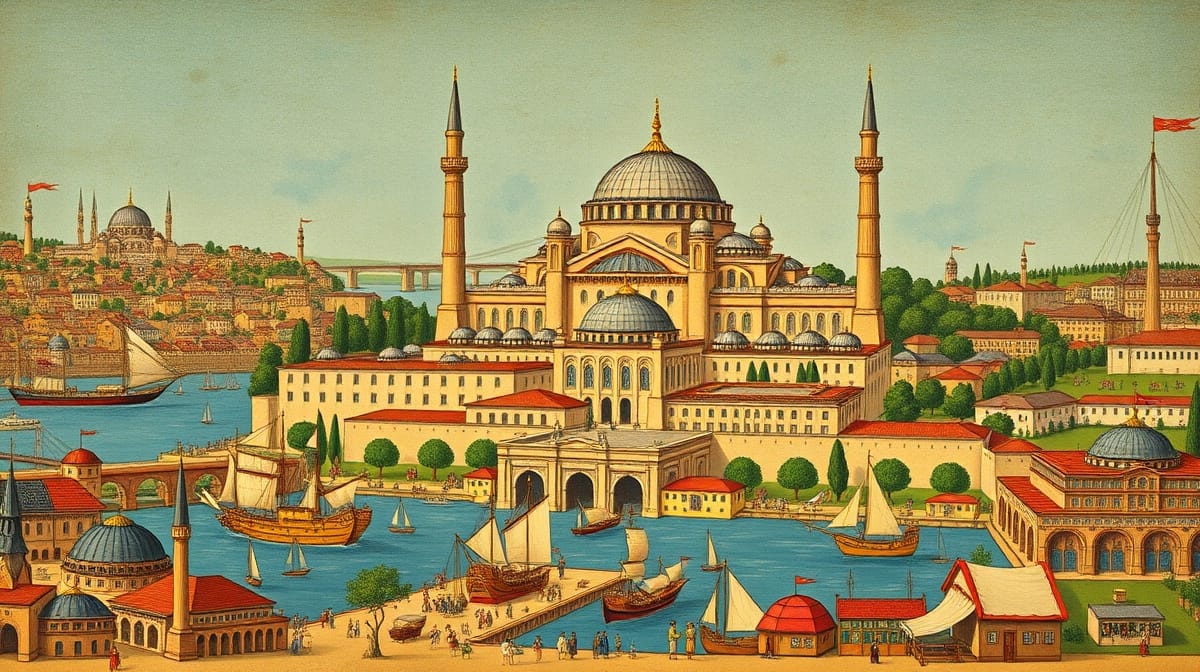
Cultural and Architectural Transformation
After the conquest, Istanbul became the center of Ottoman art and architecture. The palace, mosques, madrasas, bazaars, baths, and soup kitchens formed the city’s new identity. Buildings such as the Fatih Complex were not merely religious spaces, but centers of education, charity, law, and social life. This transformation also occupies an important place within the characteristics of Ottoman art and architecture.
The presence of Greek Orthodox, Armenian, Jewish, Muslim, and Latin communities in the city made Istanbul a multilayered capital. Rather than eliminating this diversity entirely, the Ottoman administration tried to place it within its own administrative order. This approach demonstrates the pragmatic character of imperial governance. After the conquest, Istanbul became not only the symbol of a military victory, but also the stage for a long-lived urban civilization.
Conclusion
In conclusion, the Conquest of Constantinople ended one empire on May 29, 1453, and carried another empire into the center of world politics; it left lasting effects on military technology, Mediterranean trade, European diplomacy, the claim to leadership in the Islamic world, and Ottoman urban civilization.
Sources
- Halil İnalcık, Devlet-i Aliyye.
- İsmail Hakkı Uzunçarşılı, Osmanlı Tarihi.
- Caroline Finkel, Osman’s Dream.
- Halil İnalcık & Donald Quataert, An Economic and Social History of the Ottoman Empire.
- TDV Encyclopedia of Islam, entries on Istanbul and Mehmed II.