The Crimean War (1853–1856) was a major European war in which the Ottoman state fought against Russia together with Britain, France and Piedmont. With the Treaty of Paris of 30 March 1856, which ended the war, the Ottoman state was accepted as an equal member of the European state system, even if only on paper. The same war also brought the first foreign loan and the intervention of the Western powers in matters of reform.
Quick Summary
- The Ottoman state declared war on Russia on 4 October 1853; Britain and France entered the war on 27 and 28 March 1854.
- At the root of the crisis lay the question of the holy places in Jerusalem and Russia’s demand for an official right of protection over the Orthodox.
- The main battles of the Crimean War were fought along the Danube, before Sevastopol and around Kars.
- The first foreign loan agreement to cover the costs of the war was concluded on 24 August 1854.
- With the Treaty of Paris, the Ottoman state “was accepted, on paper, as an equal member of the European state system”.
- The mention of the Reform Edict in the treaty paved the way for Western intervention in Ottoman reform.
Contents
- Why did the Crimean War break out?
- The Ottomans’ allies
- Fronts and key events
- The first foreign loan
- The Treaty of Paris and the “equal member” provision
- How were the Ottomans bound to European politics?
- Frequently asked questions
Why Did the Crimean War Break Out?
According to the TDV Encyclopedia of Islam, Russia had held the upper hand over the Ottoman state since the 1774 Treaty of Küçük Kaynarca, and in Europe since the Congress of Vienna of 1815. In 1853 Tsar Nicholas I would describe the Ottoman state as “a sick man whose death is expected at any moment”.
The dispute over the holy places in Jerusalem
The dispute first arose as the question of the “holy places”. In Jerusalem there was constant rivalry over the sites that Christians held sacred, between those attached to the Latin church on one side and the Greek and Armenian churches on the other. France had long supported the Latins. According to the Abdülmecid entry, when France applied to take the Catholics of Jerusalem under its protection, Russia also went into action, claiming to defend the rights of the Orthodox.
Foreign Minister Fuad Efendi, for his part, leaned towards the French on this question. While Russia was told that the status quo would be preserved, a note given to the French embassy stated that the key to the great door of the Church of Bethlehem would be handed over to the Latins. This provoked a strong reaction against Fuad Efendi in Russia. According to Kemal Beydilli, domestic politics also played a part in France’s wish to extend its influence in the East. Napoleon III had to repay the Catholic Church, which had backed his election as emperor.
Menshikov’s demands and Russia’s real aim
Tsar Nicholas I sent Prince Alexander Menshikov to Istanbul as envoy extraordinary. Menshikov arrived on 28 February 1853 and, in breach of protocol, did not call on Fuad Efendi, who thereupon resigned. According to the entry on the Treaty of Paris, Russia’s real aim was to be granted, by an official deed, the right to protect the roughly 10 million Orthodox Christians living in the Ottoman state. Such a deed would be binding under international law. A redefinition and confirmation of the existing privileges of the Christian population did not satisfy Russia.
According to the Russia entry, this demand rested on an arbitrary interpretation of the 1774 Treaty of Küçük Kaynarca. Mustafa Reşid Pasha, who was appointed foreign minister on 14 May 1853, was the main factor behind the rejection of the Russian proposals.
The occupation of Wallachia and Moldavia and the declaration of war
When the Ottoman government refused, Russian troops occupied Wallachia and Moldavia. According to the Abdülmecid entry, war was then declared on Russia on 4 October 1853. The entry on the Treaty of Paris likewise writes that the war began in October 1853. The entry on Crimea (Kırım), however, refers to it as an Ottoman-Russian war “that began on 22 June 1853”. This is why the starting date may be given differently in the sources.
Why Did Britain and France Fight on the Ottoman Side?
According to the Abdülmecid entry, Britain, France and Piedmont sided with the Ottoman state in this war, while Austria and Prussia remained neutral. Britain and France declared war on Russia on 27 and 28 March 1854. According to the Russia entry, once these two powers actually took the Ottoman side, the conflict turned into a general European war.
There was more than one reason for this choice. According to Kemal Beydilli, the wish to eliminate Russia, which had established its supremacy in Europe, played an important part, and the rivalry in the East was seen as an opportunity to do so. Beydilli also writes that Stratford de Redcliffe, the British ambassador in Istanbul, exploited this rivalry to the point of war. The authors of the entry on the Düyûn-ı Umûmiyye (the Ottoman Public Debt Administration), for their part, note that Britain and France were wary of Russia taking over Mediterranean trade.
European public opinion also offered favourable ground. The refusal to hand over the Hungarian and Polish refugees who had taken shelter in the Ottoman state in 1848 had created a pro-Turkish mood in Europe. This mood made it easier for Britain and France to enter the war on the Ottoman side. On the eve of the Crimean War, Abdülmecid also began to accept foreign ambassadors’ requests for political talks.
Austria, for its part, did not actually take part in the war. With its military threat, however, it forced Russia to evacuate Wallachia and Moldavia. In 1854 the Ottoman state in turn consented to an Austrian occupation of the two principalities, on condition that Austria protect them until the end of the war.
Fronts of the Crimean War: From the Danube to Kars
The Crimean War was not confined to the peninsula from which it takes its name. According to the entry on the Treaty of Paris, Russian ports in the Baltic and the Pacific were also bombarded and blockaded. The telegraph, military railways, and steam-powered and armoured ships were used in this war. In this respect Beydilli regards the Crimean War as a war that gave the first examples of the wars to come.
The Danube front and the defence of Silistra
In the first phase the Ottoman army fought along the Danube under the command of Ömer Lutfi Pasha. Thanks to a telegraph link that carried information to headquarters from every point on the river, the pasha directed the operations successfully. He defeated the Russians first at Oltenița (5 November 1853) and then at Çatana (Cetate) near Calafat (5 January 1854). After these successes he was given the title “serdâr-ı ekrem” (commander-in-chief), which was used mostly for grand viziers.
The Russians besieged Silistra between 15 May and 25 June 1854. The city was successfully defended under the command of Selanikli Musa Hulusi Pasha. This defence inspired Namık Kemal’s famous play Vatan yahut Silistre (The Homeland, or Silistra). When the Russian forces evacuated Wallachia and Moldavia, the Danube front closed.
The raid on Sinop
In the first months of the war, the Ottoman fleet lying in the harbour of Sinop was hit by a Russian raid. More than 2,000 soldiers were killed in this naval battle, and twelve Turkish ships were sunk. According to an official document, seven small mosques (mescit), two schools, 247 houses and 170 shops also burned down in the town.

The siege of Sevastopol
In September 1854 the allied forces landed in the Crimea, and the main front, which would decide the outcome of the war, opened there. On 17 February 1855 Ömer Lutfi Pasha inflicted a heavy defeat on the Russians who attacked Eupatoria (Gözleve). After a long siege marked by heavy losses, Sevastopol fell on 8 September 1855. This development brought the parties closer to peace.
The Caucasian front and Kars
After Sevastopol, the Russian advance continued on the Caucasian front. Britain considered a Russian defeat here, too, important for the security of India. To relieve Kars, Ömer Lutfi Pasha landed at Sukhumi (Sohum) and on 7 November 1855 defeated a Russian army on the banks of the Inguri River. Because of the weather, however, he could not prevent the fall of the fortress; Kars passed into Russian hands on 26 November 1855.
The First Foreign Loan: How Did the War Tie Ottoman Finances to Europe?
Ottoman statesmen had long avoided borrowing abroad. Even a loan agreement signed in the 1850–1851 fiscal year had not been ratified, and the treasury had paid 2,200,000 liras in compensation. The Crimean War, however, shook the finances even further. Ottoman administrators accepted the credit offers of Britain and France, which were supporting them with their armies, and signed the first loan contract on 24 August 1854.
According to the Düyûn-ı Umûmiyye entry, this is how the era of foreign borrowing began. When the first loan fell short of the costs of the war, a second agreement was signed on 27 June 1855. The Egyptian tribute and the revenues of the Syrian and İzmir customs were pledged as security for the two loans. According to the Abdülmecid entry, these were followed by the loans of 1858 and 1860, and important sources of revenue were mortgaged for each loan.
Borrowing soon became a habit. Between 1854 and 1874 fifteen foreign loan agreements were signed. The state borrowed 238,773,272 liras in principal but actually received only 127,120,220 liras. The entry on the Treaty of Paris likewise writes that the state fell into “a great quagmire of debt” brought on by the war.
In the end the treasury went bankrupt, and payments were suspended in April 1876. The Decree of Muharrem of 20 December 1881 set up the Council of the Ottoman Public Debt Administration (Düyûn-ı Umûmiyye Meclisi), made up of representatives of the creditors. We explained how the debts became intertwined with customs revenues and commercial privileges in our article on the capitulations.
The Treaty of Paris (1856): Was the Ottoman State Recognized as European?
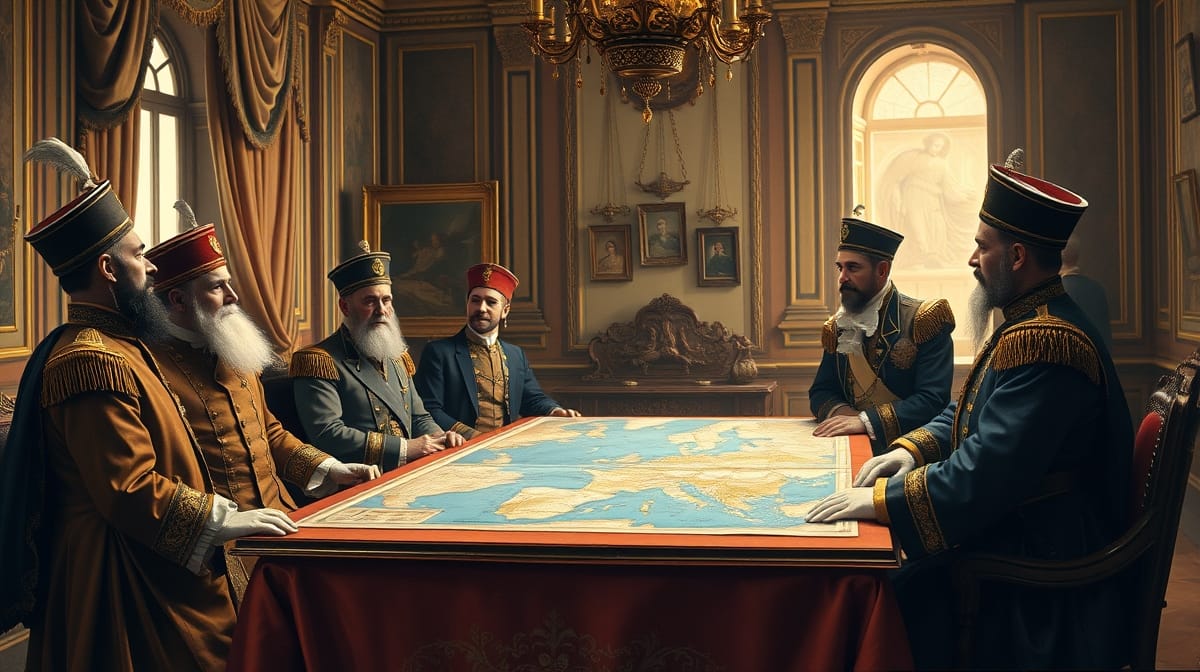
From the end of 1855, Russia had been left completely isolated politically. Its poor military and financial situation forced it to accept the peace proposal on 16 January 1856. The talks that were to end the Crimean War opened in Paris on 25 February 1856. The Ottoman state was represented by Grand Vizier Mehmed Emin Âli Pasha and its ambassador in Paris, Mehmed Cemil Bey.
The treaty was signed on 30 March 1856 and consisted of thirty-four articles. According to Beydilli, the Sublime Porte expected no territory from the peace. It knew that its share in the victory was smaller and that it had not taken a sufficient part in the operations on the peninsula.
Main provisions of the Treaty of Paris
- The signatory powers regarded the guarantee of the Sublime Porte’s independence and territorial integrity as “an integral part of the general interest”.
- The Black Sea was neutralized and demilitarized.
- The Russian protectorate over Wallachia and Moldavia ended; the two principalities kept their former status, with the privileges granted by the Sublime Porte.
- Free navigation on the Danube was entrusted to a permanent commission made up of representatives of the riparian states.
- Kars was returned to the Ottoman state; its return was tied to the territorial bargaining over Bessarabia.
- The 1774 Treaty of Küçük Kaynarca ceased to be in force; the Straits settlement of 13 July 1841 was modified.
The ninth article of the treaty also mentioned the Reform Edict (Islahat Fermanı), which had been proclaimed shortly before the congress. The capitulations, on the other hand, which Âli Pasha raised on 25 March, were not abolished.

How was the Ottoman state admitted to the European state system?
In Kemal Beydilli’s words, as a result of the Treaty of Paris the Ottoman state “was accepted, on paper, as an equal member of the European state system and was enabled to benefit from European law”. According to Beydilli, the treaty proclaimed that the state had been included “in the community of the European family” and ushered it into a new political era.
Yet the qualification “on paper” was not there for nothing. It soon became clear that the promises and guarantees given were not working. The Ottoman-Russian War of 1877–1878 showed that the guarantee of territorial integrity meant nothing. As Beydilli relates, at the Congress of Berlin in 1878 Bismarck rebuked the Ottoman delegates who wished to rely on this law with the words “That law is not for you”.
How Did the Crimean War Bind the Ottomans to European Politics?
The ties forged by the Crimean War can be seen in three areas: diplomacy, finance and domestic reform. In diplomacy, Ottoman territorial integrity was made dependent on the guarantee of the other powers. Through foreign debt the finances became tied to European capital, while domestic reform entered Europe’s agenda.
The Reform Edict and the door to intervention
The allies, who had helped with their armies in the war, succeeded in obtaining a reform edict from the sultan. The edict was proclaimed on 18 February 1856, before the Congress of Paris began. According to the Abdülmecid entry, the mention of the edict in the Treaty of Paris gave the Western powers a right to intervene in matters of reform.
Yet it had been thought that the final part of the ninth article, drafted through the efforts of Âli Pasha, would prevent intervention. But in October 1859 the five great powers presented a note claiming that the reforms had not been carried out. We examined the content of the edict and the debate over the ninth article in our article on the Reform Edict.
Pro-British and pro-French factions
The war also tied Ottoman domestic politics to the rivalry of the great powers. According to Kemal Beydilli, the policies of Britain and France were given weight in order to keep Russia harmless. As a result, pro-British and pro-French leanings grew steadily among the statesmen. The Abdülmecid entry likewise writes that the intervention of the European powers increased after the Tanzimat.
Mustafa Reşid Pasha was pro-British, while Âli and Fuad Pashas were pro-French. The sultan brought one or the other of these groups to power according to the pressure of the ambassadors. During and after the Crimean War, French influence grew markedly. Indeed, when Reşid Pasha’s opposition to the Suez Canal project drew France’s displeasure, he was dismissed from the grand vizierate on 2 May 1855. The tendency to lean on one great power turned in time into factionalism and lasted until the final years of the empire.
Russia and the end of the Paris order
According to the Russia entry, by the time the war ended Russia had suffered a heavy defeat. The Russian supremacy in Europe that had lasted since 1815 was over, and from 1856 onwards Russia was forced to turn its expansion towards Asia. Defeat in the Crimean War also strengthened Russian nationalism around the goal of Pan-Slavism.
The Franco-Prussian War of 1870–1871, however, gave Russia a chance to escape the grip of the Treaty of Paris. On 31 October 1870 Russia declared that it would no longer abide by the articles concerning the Black Sea. According to Beydilli, this step was the first sign of a major Ottoman-Russian war that would soon break out. We described the course of that war in our article on the Ottoman-Russian wars.
Frequently Asked Questions
When did the Crimean War begin and when did it end?
When Russian troops occupied Wallachia and Moldavia, the Ottoman state declared war on Russia on 4 October 1853. The war ended with the Treaty of Paris, signed on 30 March 1856.
Who were the Ottomans’ allies in the Crimean War?
Britain, France and Piedmont fought on the side of the Ottoman state. Austria and Prussia remained neutral.
When was the Ottoman state considered a European state?
According to the TDV Encyclopedia of Islam, this recognition came with the Treaty of Paris of 30 March 1856, which ended the Crimean War. Under the treaty the Ottoman state “was accepted, on paper, as an equal member of the European state system and was enabled to benefit from European law”. It soon became clear, however, that the guarantees were not working.
When did the Ottomans take their first foreign loan?
The first foreign loan agreement was concluded on 24 August 1854 to meet the costs of the war. It was followed by a second loan on 27 June 1855.
Who won the Crimean War?
The Ottoman state and its allies won; Russia suffered a heavy defeat. The Sublime Porte expected no territory from the peace, but Kars, which the Russians had taken, was returned.
Conclusion
The dispute that began with the question of the holy places soon turned into a general European war. The Ottoman state ended the Crimean War on the winning side and, with the Treaty of Paris, was accepted as an equal member of the European state system. This acceptance, however, remained on paper: the guarantees did not work in the war of 1877–1878.
At the same time, the same war tied the finances to European capital through the first foreign loan, and domestic reform to Europe’s agenda through the Reform Edict. For this reason the Crimean War can be regarded as the beginning of the period in which the Ottoman state became bound to European politics, both with gains and at a heavy price.
Sources
- TDV Encyclopedia of Islam, entry “Paris Antlaşması” (Treaty of Paris)
- TDV Encyclopedia of Islam, entry “Abdülmecid”
- TDV Encyclopedia of Islam, entry “Rusya” (Russia)
- TDV Encyclopedia of Islam, entry “Düyûn-ı Umûmiyye” (Ottoman Public Debt Administration)
- TDV Encyclopedia of Islam, entry “Ömer Lutfi Paşa”
- TDV Encyclopedia of Islam, entry “Kırım” (Crimea)