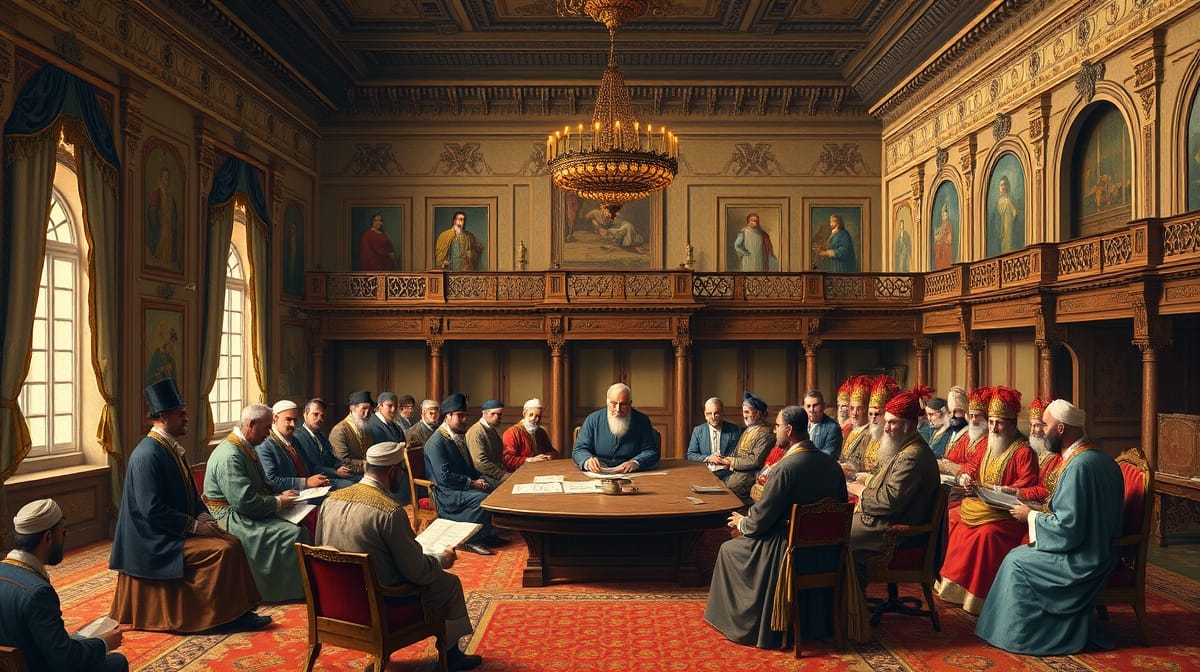
The Imperial Reform Edict of 1856 was an important reform document with political, legal, and social consequences, proclaimed by the Ottoman Empire to expand the rights of its non-Muslim subjects, manage European pressure, strengthen the idea of equal citizenship within the empire, bind the Tanzimat reforms to more concrete rules, and reduce the risk of the state’s disintegration.
Quick Summary
- The edict was proclaimed on February 18, 1856, amid diplomatic pressures.
- It aimed to strengthen the legal status and public rights of non-Muslims.
- European states played an open and influential role in the reform process.
- Debates over equality between Muslims and non-Muslims deepened markedly.
- It created a new and important foundation for the idea of Ottomanism.
- Its political consequences remained influential until the Constitutional period.
Contents
- What Was the Imperial Reform Edict?
- The Proclamation Process and the Context of the Crimean War
- The Edict’s Main Provisions
- The Equality Debate in the Ottoman Empire
- Political and Social Effects
- Conclusion
What Was the Imperial Reform Edict?
This edict was a comprehensive reform text proclaimed during the reign of Sultan Abdülmecid. The document expanded the path set out by the Tanzimat Edict. It also defined the rights of non-Muslim subjects more clearly. In this respect, it is regarded as a critical stage in Ottoman modernization.
The edict’s main aim was to keep the empire’s different religious communities under a shared political framework. The Ottoman administration tried to establish this goal through the language of equality. In practice, however, the process did not arise solely from domestic needs. Pressure from European states also clearly shaped it.
Which period produced the Imperial Reform Edict?
The Imperial Reform Edict should be understood as part of the continuation of the Tanzimat period. The Tanzimat Edict of 1839 had emphasized the security of life, property, and honor. The 1856 text, however, addressed the rights of non-Muslims in greater detail. For this reason, the two documents should be read together.
For this context, the article Tanzimat and Reform Edicts in the Ottoman Empire is a useful complement. The impact of reforms on state administration can also be viewed more broadly under Democratization Movements in the Ottoman State.
The Proclamation Process and the Context of the Crimean War
The edict was proclaimed on February 18, 1856, amid diplomatic pressures. This date is closely connected to the diplomatic climate in which the Crimean War came to an end. In the war, the Ottoman Empire fought on the same side as Britain and France. As a result, its relations with European diplomacy entered a new phase.
After the Crimean War, the Treaty of Paris came onto the agenda. The Ottoman administration wanted to sit at the treaty table with a declared will for reform. In this way, the empire’s position within the European state system would be strengthened. The edict became an important part of this diplomatic calculation.

Why was European pressure decisive?
European states closely monitored the condition of Christian communities in the Ottoman Empire. Russia in particular turned its claim to protect the Orthodox into a tool of political pressure. Britain and France, meanwhile, supported the reforms for different strategic reasons. This situation produced complex consequences for Ottoman sovereignty.
According to Halil İnalcık, the Tanzimat period cannot be read merely as imitative Westernization. The state used reforms to strengthen centralization. Nevertheless, external pressure affected both the language and the timing of the reforms. This document carries both dimensions at the same time.
For this connection with the Crimean War, the article How Did the Crimean War Connect the Ottomans to European Politics? is useful. To understand tensions with Russia, the content What You Need to Know About the Ottoman-Russian Wars may also be read.
The Edict’s Main Provisions
The Imperial Reform Edict reaffirmed earlier promises of rights. In addition, it expanded the participation of non-Muslim subjects in public life. Areas such as admission to schools, government service, and testimony in courts came to the fore. These provisions stood at the center of the equality debate.
The document called for avoiding degrading expressions based on differences of religion and sect. It also aimed to facilitate the repair of institutions such as places of worship, schools, and hospitals. Taxation and military service regulations were also among the important issues. Different financial obligations in place of the jizya were discussed.
How did the Imperial Reform Edict affect non-Muslim rights?
This edict increased the legal visibility of non-Muslims before the state. It expanded their ability to testify in courts and enter public office. It also outlined a more equal framework for access to educational institutions. Yet these rights were not implemented at the same speed everywhere.
Suraiya Faroqhi emphasizes that Ottoman society was not uniform. For this reason, the effects of the reforms differed by region. Change became more visible in major cities. In the provinces, however, local balances often slowed implementation.
The most controversial aspect of the edict was the distance between its legal promise of equality and prevailing social habits.
The Equality Debate in the Ottoman Empire
The Imperial Reform Edict made the idea of equality more visible in Ottoman society. Yet this idea was not received in the same way by everyone. Some Muslim circles believed that their former superior position was being weakened. Non-Muslim communities, meanwhile, waited for the promises to be put into practice.
On the other hand, equality was connected to the modern idea of citizenship. The state wanted to establish an idea of Ottoman belonging that transcended religious identities. This idea aimed to hold the empire together without fragmentation. Yet nationalist movements challenged this policy.
How was the Imperial Reform Edict received by Muslim society?
This text created unease in some Muslim circles. In the classical order, Muslims had occupied a superior political and legal position. The edict used language that reduced this distinction. For this reason, equality appeared to some as a loss of rights.
Ahmed Cevdet Pasha drew attention to this tension when recounting the debates of the period. In his view, the reforms were not always compatible with society’s mental preparedness. Even so, the state was seeking a new bond to prevent disintegration. That bond increasingly came to be called Ottomanism.
This intellectual world can be followed more broadly in the article Ottoman Intellectual Currents. The tension among Ottomanism, Islamism, and nationalism becomes especially important here.
What were the expectations of non-Muslims?
Non-Muslim communities watched the edict carefully for the new opportunities it offered. Government service, education, and equality in the courts increased these expectations. However, the communities’ own internal structures also came under pressure to change. Patriarchates and local communal councils faced new regulations.
Kemal Karpat notes that issues of population, representation, and identity became politicized during this period. This situation did not leave the equality debate solely within the legal sphere. Questions such as representation, taxation, and military service also came onto the agenda. In this way, reform entered everyday life.
Political and Social Effects
This edict strengthened the Ottoman Empire’s relations with Europe in the short term. After the Treaty of Paris, the state was regarded as part of the European system. However, this did not fully resolve questions of sovereignty. European states could use the reform provisions as a pretext for intervention.
In addition, the edict enabled the central state to intervene more extensively in the provinces. Mixed councils, courts, and new administrative regulations supported this process. Yet local powers did not always comply with the expectations of the center. As a result, tensions frequently emerged in practice.

How did the Imperial Reform Edict nourish the idea of Ottomanism?
This document aimed to unite different religious communities around the idea of common citizenship. This goal became one of the important foundations of Ottomanist thought. The state wanted to see everyone as equal subjects loyal to the sultan. However, nationalist movements in the Balkans weakened this objective.
Caroline Finkel interprets nineteenth-century reforms as initiatives that developed amid continuous crisis. This perspective makes it easier to understand the edict’s contradiction. The reforms sought to strengthen the state. Yet the same process also enlarged new political demands.
What results appeared in the long term?
The edict brought the language of legal equality to the center of Ottoman politics. This language laid the groundwork for the Ottoman Constitution of 1876 and debates over constitutional government. The representational demands of communities also became more visible. As a result, the reform became one of the sources nourishing constitutional thought.
However, the edict could not prevent the empire’s disintegration on its own. Economic dependence, wars, and nationalist movements increased the pressure. The Balkan crises clearly exposed this weakness. For this long process of dissolution, the article When and Why Did the Ottoman State Collapse? is important.
Conclusion
The Imperial Reform Edict is a foundational document that brought together debates over equality, sovereignty, and reform on the same ground in Ottoman modernization. It expanded non-Muslim rights, sought to manage European pressure, and provided a legal basis for the idea of Ottomanism. Nevertheless, the tensions in implementation could not fully resolve the empire’s multilayered crises.
Sources
- Halil İnalcık, The Ottoman Empire: The Classical Age.
- Ahmed Cevdet Pasha, Tarih-i Cevdet.
- Caroline Finkel, Osman’s Dream.
- Suraiya Faroqhi, Subjects of the Sultan: Culture and Daily Life in the Ottoman Empire.
- TDV Encyclopedia of Islam, Imperial Reform Edict entry.









14 thoughts on “What Was the Imperial Reform Edict? Equality Debate and Its Effects in the Ottoman Empire”