The Janissary Corps was abolished by Mahmud II in 1826 because it had lost its military effectiveness, interfered in politics, and obstructed reforms; the Auspicious Incident was an Ottoman central government initiative to rebuild the army and modernize the state.
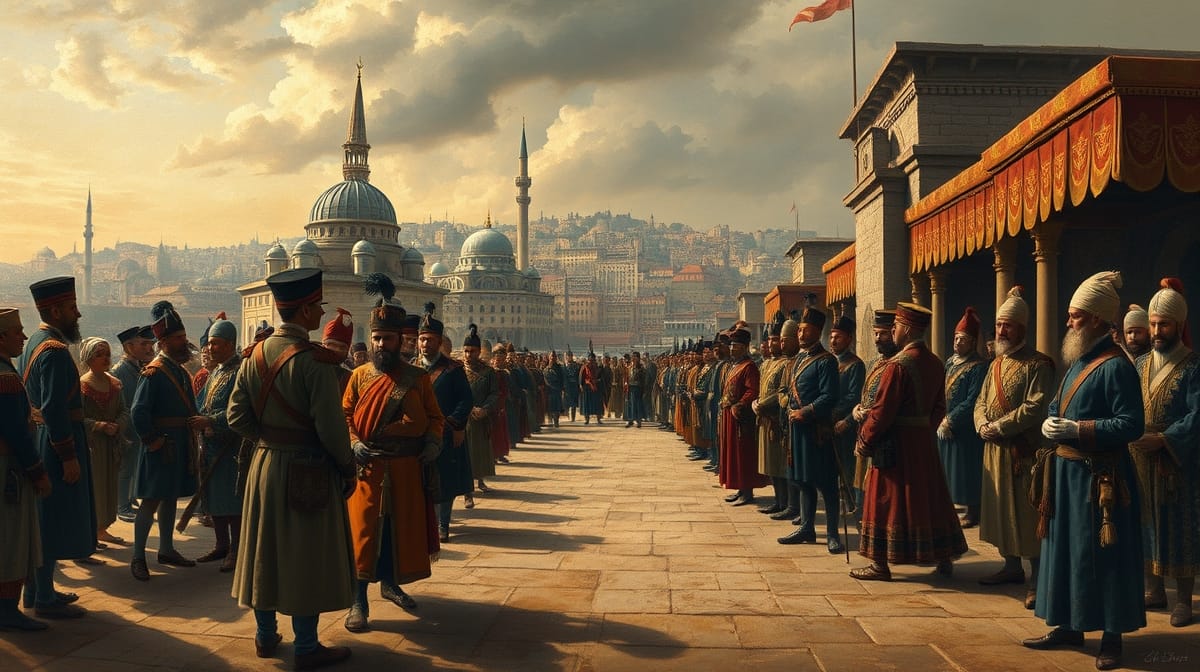
Quick Summary
- Over time, the Janissaries largely lost their military discipline.
- The corps frequently reacted harshly to reform attempts.
- Mahmud II wanted to strengthen central authority.
- In 1826, the revolt was suppressed and the corps was abolished.
- It was replaced by the Asâkir-i Mansûre-i Muhammediyye army.
Contents
- Why Was the Janissary Corps Important?
- The Roots of Decline
- Resistance to Reforms and Political Pressure
- Mahmud II’s Preparations
- How Did the Auspicious Incident Unfold?
- The Consequences of Abolition
- Conclusion
Why Was the Janissary Corps Important?
The Janissary Corps was one of the most influential military institutions of the Ottoman classical age. It stood at the center of the Kapıkulu army and served directly under the sultan. Especially during the age of conquests, it came to the fore as a disciplined infantry force.
The early success of this institution was closely linked to the centralized structure of the state. The basic structure of Ottoman military organization is important for understanding the role of the Janissaries. This is because the corps was not merely a fighting force. It was also deeply intertwined with the palace, the capital, and state authority.
According to İsmail Hakkı Uzunçarşılı, in its early period the corps operated with strict rules and a strong hierarchy. Over the centuries, however, this structure changed. The Janissary Corps gradually ceased to be a purely military institution and turned into a powerful actor in urban life.
The Janissary Corps and the classical order
In the classical period, the Janissaries were salaried standing soldiers. This feature distinguished them from many contemporary armies. Their attachment to the sultan also strengthened central authority.
The devshirme system was also an important part of this order. The Ottoman devshirme system and child selection are among the fundamental subjects that explain the early Janissary structure. Over time, however, this system loosened. Irregular enrollments into the corps began.
The Roots of Decline
The answer to the question of why the Janissary Corps was abolished cannot be given by looking only at the year 1826. The roots of the problem became visible from the late sixteenth century onward. Long wars, financial crises, and technological changes put pressure on the corps.
First, the rules of recruitment into the corps were relaxed. Janissary status began to be seen almost as a profession passed from father to son. This weakened the disciplined military structure. In addition, shopkeepers, artisans, and urban groups became intertwined with the corps.
Meanwhile, European armies were changing in the fields of drill, artillery power, and logistics. The Ottoman administration also noticed these developments. Nevertheless, the Janissary Corps resisted regular drill and new techniques for a long time.
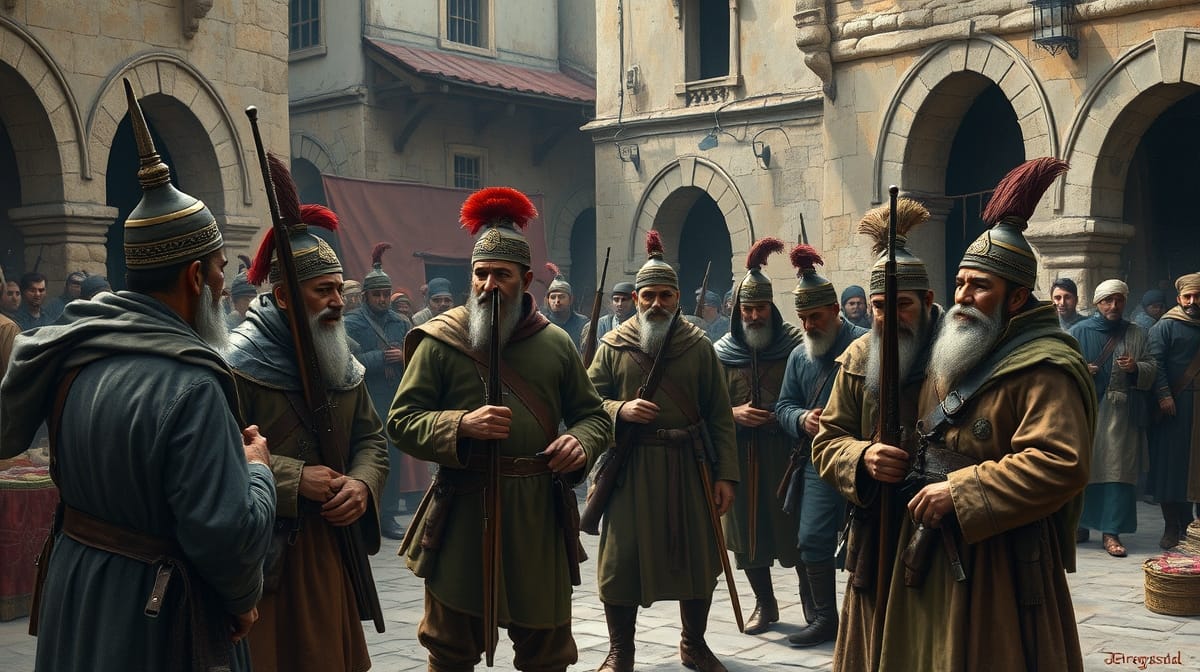
The Janissary Corps and military decline
Military decline cannot be explained by the Janissaries alone. Yet the corps became a major obstacle to renewal. In discussing Ottoman transformation, Halil İnalcık emphasizes the connection between the fiscal structure, central authority, and the military order.
In the seventeenth and eighteenth centuries, the cost of wars increased. The state began searching for more regular taxation and a more effective army. In this process, the search for the first regular army in the Ottoman Empire was directly related to the Janissary question.
The corps also did not always fulfill its duties on the battlefield. Demands for pay, ulufe stipends, and privileges increased. For this reason, the military problem gradually turned into a political and economic crisis.
Resistance to Reforms and Political Pressure
Over time, the Janissary Corps turned into a power that exerted pressure on sultans and statesmen. Janissary revolts were not merely acts of military disobedience. They also amounted to direct intervention in palace politics.
The killing of Osman II in 1622 is a striking example in this respect. The young sultan wanted to reorganize the army. Yet the Janissary reaction cost him his life. This event left a deep mark on the memory of later sultans.
In the eighteenth century, the need for reform became more evident. Selim III attempted a new military order by establishing the Nizâm-ı Cedîd army. However, the Janissary Corps and the circles that supported it saw this reform as a threat.
The Auspicious Incident was less a sudden outburst of anger than the final link in a long conflict over reform.
The Kabakçı Mustafa Revolt of 1807 destroyed Selim III’s reforms. This event became a clear lesson for Mahmud II. The sultan saw that he had to act carefully before directly confronting the Janissaries.
Mahmud II’s Preparations
When Mahmud II ascended the throne in 1808, he inherited a very difficult legacy. With the support of Alemdar Mustafa Pasha, he tried to strengthen central authority. Yet Alemdar’s death showed that reforms could not be carried out in haste.
For this reason, Mahmud II waited for a long time. First, he tried to balance the power of the provincial notables. Then he gathered the bureaucracy, the support of the ulema, and the palace circles into a more solid line.
The sultan also attached importance to public support. The Janissary Corps was not merely a military institution. It had ties with Istanbul’s tradesmen and religious circles. For this reason, the sultan carefully prepared the ground of legitimacy.
The search for legitimacy against the Janissary Corps
Mahmud II wanted the new army to appear religiously legitimate. This preference is clearly visible in the name Asâkir-i Mansûre-i Muhammediyye. The name means “the victorious soldiers of Muhammad.”
Ahmed Cevdet Pasha, in describing this process, particularly emphasizes the importance of support from the ulema. This was because the sultan did not want the struggle against the Janissary Corps to be portrayed as a movement against religion. On the contrary, he presented it as a duty to restore order.
In addition, the administration closely monitored discontent within the corps. The experiment with a new drilled unit called the Eşkinci Corps accelerated the final confrontation. The Janissaries regarded this initiative as a threat to their own existence.
How Did the Auspicious Incident Unfold?
The Auspicious Incident took place in June 1826. The Janissaries revolted against the new drill system. In response, Mahmud II brought out the Sacred Standard and rallied the people and loyal troops to his side.
This move changed the course of events. Artillery units and forces loyal to the sultan targeted the Janissary barracks. The clashes around Etmeydanı quickly intensified. The resistance of the corps was harshly suppressed.
As a result, the Janissary Corps was officially abolished. The state referred to this event as the Vaka-i Hayriye, meaning the “Auspicious Incident.” This designation shows how the official perspective was constructed.
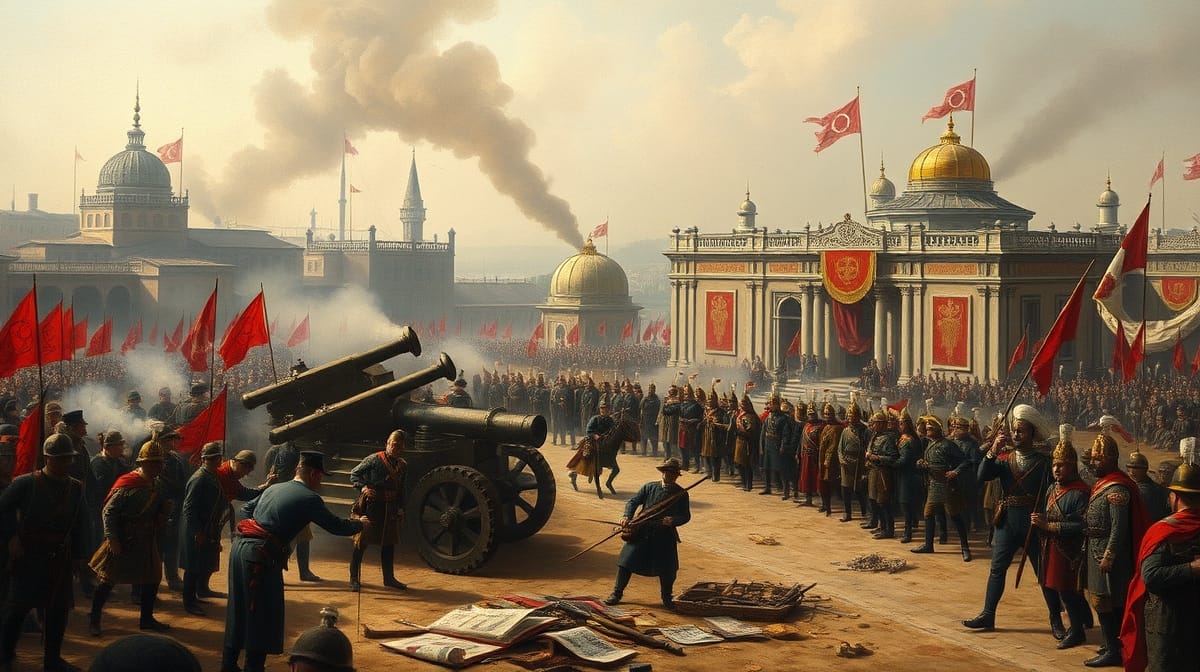
There is an important point here. The event was not merely a military purge. Interventions against Bektashi lodges also occurred in the same process. This was because the corps had historical ties with Bektashi circles.
The Consequences of Abolition
After the Janissary Corps was abolished, the Ottoman army was reorganized. The Asâkir-i Mansûre-i Muhammediyye was established, and drilled units came to the fore. This structure aimed at a more centralized army tied to the sultan.
However, the results were not immediately perfect. The training, equipment, and command structure of the new army required time. The state also faced social and economic problems while dismantling the old corps networks.
Nevertheless, the Auspicious Incident is regarded as a turning point in Ottoman modernization. This is because the central administration eliminated such a deeply rooted military institution for the first time. Central decision-making mechanisms in Ottoman state governance provide a useful background for understanding this transformation.
The state and society after the Janissary Corps
When the corps was abolished, the balance of power in Istanbul changed. The ties the Janissaries had established with the tradesmen weakened. The state began to act more directly in matters of security and control.
On the other hand, the reform process was not limited to the army alone. Mahmud II took new steps in dress, bureaucracy, education, and administration. This line prepared the way for the Tanzimat period.
Caroline Finkel evaluates Ottoman history within long-term transformations. From this perspective, the Auspicious Incident was not the single moment when the old order ended completely. Yet it was a powerful rupture that clearly demonstrated the state’s will to renew itself.
From Military Decline to Modernization
The question of the Janissary Corps is one of the most difficult topics in Ottoman modernization. This is because the issue was not merely the liquidation of a backward military class. The state’s relationship with legitimacy, power, and society was redefined.
The presence of the Janissaries among the people also made the issue more complex. Some Janissaries worked as shopkeepers and took part in the urban economy. For this reason, the purge also affected the society of the capital.
Suraiya Faroqhi’s social history approach suggests reading Ottoman institutions together with everyday life. From this perspective, the corps was influential not only on battlefields but also in the streets of Istanbul. Its abolition therefore opened a new period in the urban order as well.
Finally, the language of the Auspicious Incident is also noteworthy. By calling the event “auspicious,” the state sent a political message. This message strengthened the idea that reform was legitimate and necessary.
Conclusion
In conclusion, the Janissary Corps was abolished because it had lost its military effectiveness, obstructed reforms, and challenged central authority. The Auspicious Incident became the Ottoman State’s harshest step in its effort to eliminate old centers of power and build a modern army and centralized administration.
Sources
- İsmail Hakkı Uzunçarşılı, Osmanlı Devleti Teşkilâtından Kapukulu Ocakları.
- Ahmed Cevdet Paşa, Tarih-i Cevdet.
- Halil İnalcık, Devlet-i Aliyye.
- Caroline Finkel, Osman’s Dream.
- TDV Encyclopedia of Islam, Janissary entry.