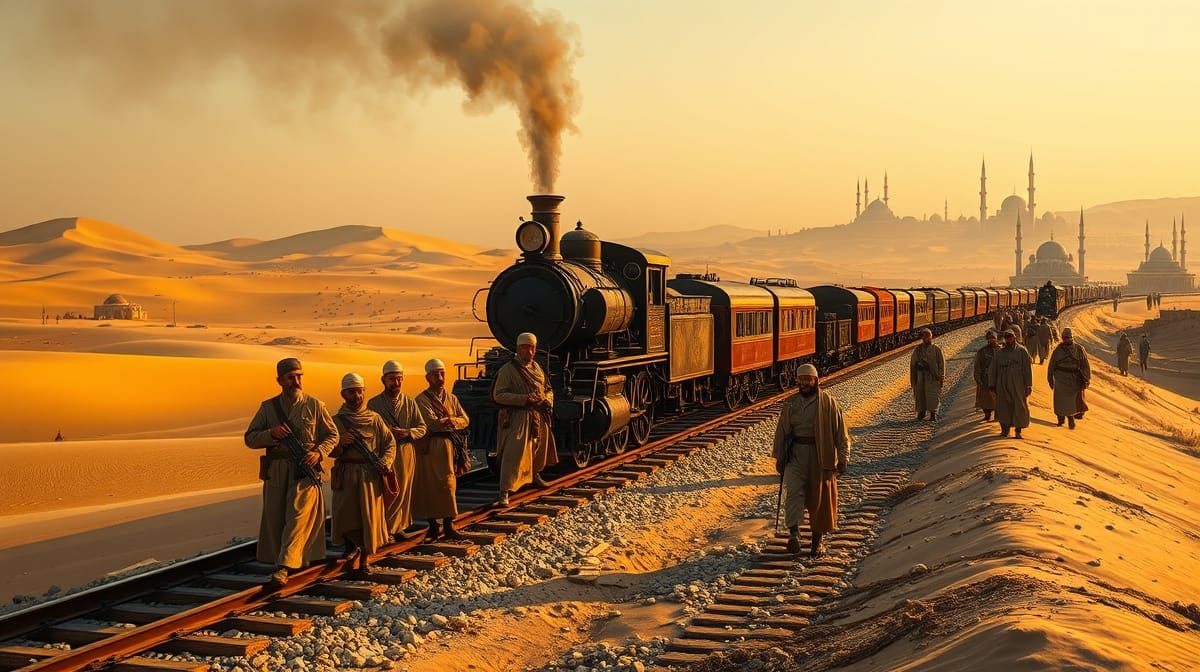
The Hejaz Railway was a strategic transportation project built during the reign of Abdul Hamid II to make the pilgrimage route safer and faster, strengthen Ottoman authority in the Arab provinces, and increase caliphate-centered political loyalty across the Islamic world.
Quick Summary
- The line was planned to speed up the pilgrimage journey.
- The Ottomans wanted to strengthen central authority in the Hejaz.
- The railway carried strategic value for military transport.
- The project became one of the visible symbols of caliphate politics.
- Donation campaigns gathered strong support among Muslims.
Contents
- Why Was the Hejaz Railway Built?
- The Pilgrimage Route and the Question of Transportation
- Its Strategic and Military Importance
- Political and Religious Dimensions
- Economic Effects and Modernization
- Conclusion
Why Was the Hejaz Railway Built?
The Hejaz Railway was one of the most ambitious modernization projects of the late Ottoman Empire. The project was not merely a technical undertaking made up of rails and stations. It was also a broad state initiative that brought together politics, religion, security, and transportation.
Abdul Hamid II conceived this line as a backbone extending from Damascus to Medina. In theory, the line was to continue as far as Mecca. In practice, however, Medina became the last major stop. Even this did not diminish the project’s impact.
The first aim was to make the pilgrimage journey easier. Ottoman pilgrims reached the Hejaz from Anatolia, Syria, Iraq, and the Balkans by long and difficult routes. The journey took weeks, sometimes months. The railway aimed to shorten this period significantly.
The state also wanted to bind the Hejaz and the surrounding distant regions more firmly to the center. This goal had a distinct place within Ottoman reform movements and modernization efforts. That is because the railway increased the state’s ability to reach the provinces quickly.
The Hejaz Railway and Abdul Hamid II’s Understanding of the State
During the reign of Abdul Hamid II, transportation networks were regarded as one of the tools that kept the empire standing. Telegraphs, railways, and administrative reforms were considered together. For this reason, the Hejaz line should not be seen merely as an investment in transportation.
Kemal Karpat’s assessments of Ottoman modernization show that population, communication, and state control were addressed together in this period. The Hamidian administration wanted faster communication between the center and distant provinces. The railway was the practical counterpart of this policy on the ground.
By contrast, the project carried a different meaning from other lines based on European capital. The Hejaz line was supported largely by donations from Muslims. In this way, the state presented the project as a shared service to the Islamic world.
The Pilgrimage Route and the Question of Transportation
In the Ottoman world, the pilgrimage was not only an individual act of worship. It was also a major organization that made the state’s legitimacy in the Islamic world visible. For this reason, the security of the pilgrimage routes carried political importance.
For a long time, pilgrimage caravans set out from centers such as Damascus, Cairo, and Baghdad. Along the route, problems arose with water, provisions, lodging, and security. Desert crossings in particular posed a major risk for pilgrims.
The Hejaz Railway was planned to reduce these problems. Thanks to the line, transportation from Damascus to Medina would become faster and more regular. In this way, pilgrims would be better protected against heat, thirst, bandit attacks, and the costs of prolonged stopovers.
How Did the Hejaz Railway Change the Pilgrimage Journey?
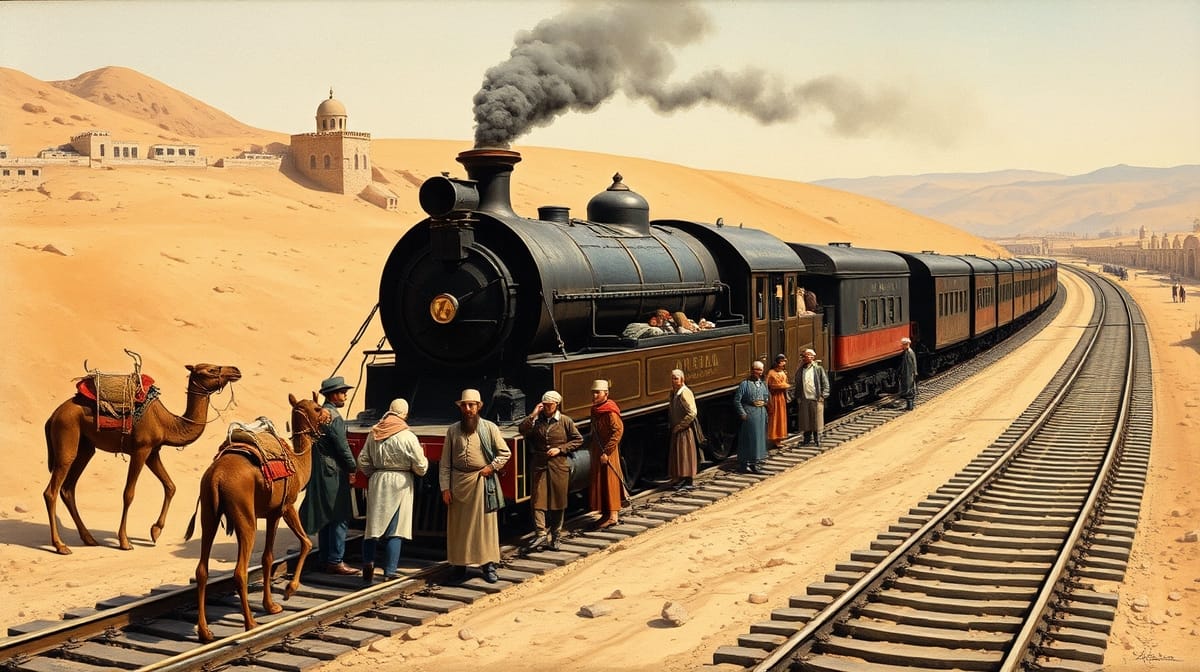
The railway promised a major transformation in the pilgrimage journey in terms of time and security. Under the traditional caravan system, travel was extremely arduous. By contrast, the train offered the possibility of more organized movement.
Suraiya Faroqhi’s studies on pilgrimage and the Ottoman provinces show that the pilgrimage organization formed a broad social network. By regulating this network, the state strengthened its own authority. The Hejaz line combined this regulatory power with modern transportation technology.
In addition, the railway also affected the pilgrimage economy. New activity emerged around the stations. Passenger transport, provisions, and local trade gained a new rhythm. Yet not every region benefited from this transformation to the same extent.
For the Ottomans, the Hejaz line was a means of transportation that shortened the pilgrimage route. At the same time, however, it was a political symbol showing the state’s responsibility over the holy cities.
Its Strategic and Military Importance
The Hejaz Railway also provided a strong military advantage for the Ottoman administration. The state wanted to respond more quickly to problems arising in the Arab provinces. For this reason, the line stood at the center of security policy.
Military transport became especially important along the Syria, Jordan, and Hejaz line. Moving troops through desert regions had previously been slow and expensive. The railway aimed to reduce this cost and accelerate intervention.
This was also important in terms of the structure of the Ottoman army and the organization of military transport. Modern transportation increased the army’s mobility. As a result, the state became more visible in distant regions.
The Hejaz Railway and Security Policy
The Ottoman administration maintained delicate relations with the tribes around the Hejaz. At times, the state chose the path of agreement. At other times, it increased military measures to ensure security.
The Hejaz Railway became a new factor in this balance. Because the line strengthened central authority, it restricted the room for maneuver of some local powers. Even so, the state did not present the line merely as an instrument of coercion. The emphasis on pilgrimage service was especially brought to the fore.
Caroline Finkel notes that reform, centralization, and external pressures became intertwined in the last century of the Ottoman Empire. The Hejaz line fits this picture exactly, because the project represented both modernization and political defense.
Political and Religious Dimensions
The Hejaz Railway held a special place in Abdul Hamid II’s caliphate-centered politics. The Ottoman sultan did not present himself only as the ruler of the empire. He also emphasized his identity as the caliph of the world’s Muslims.
For this reason, the project attracted interest across a wide geography, from India to Egypt. Muslim communities took part in donation campaigns. In this way, the railway strengthened the symbolic bond that the Ottoman center established with the Islamic world.
The Ottoman sultans’ claim to leadership in the Islamic world took concrete form in this project. Serving the Hejaz was not merely an administrative duty. It was also the visible expression of religious legitimacy.
Pan-Islamism and the Hejaz Railway
Pan-Islamism became one of the important instruments of Ottoman diplomacy during the reign of Abdul Hamid II. The state sought to strengthen the loyalty of Muslim communities. The Hejaz line was regarded as one of the most effective symbols of this policy.
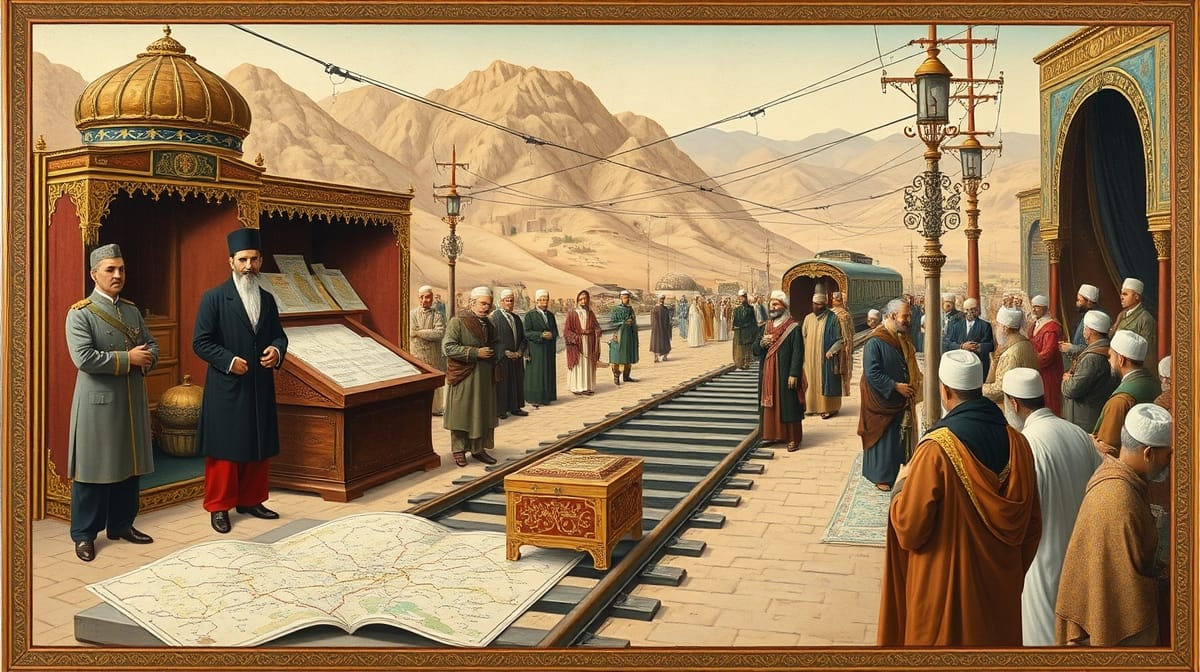
Donation registers, ceremonies, and public announcements introduced the project to broad audiences. This method enabled the public to feel a sense of spiritual partnership in the project. It also sent a symbolic message of independence to the European powers.
On the other hand, the project was not merely a romantic idea of unity. The Ottoman administration had to retain control of the Hejaz militarily and administratively. For this reason, religious discourse and strategic calculation advanced together.
Economic Effects and Modernization
The Hejaz Railway is also noteworthy in terms of its economic effects. The line aimed to revive trade routes and bring local markets closer together. Nevertheless, the project’s economic returns remained more limited than its political and religious value.
Railway construction required a major organization in terms of materials, labor, and engineering. Rails, bridges, stations, and water facilities were built under desert conditions. For this reason, the project became an important indicator of Ottoman technical capacity.
Halil İnalcık and Donald Quataert’s studies on Ottoman economic history emphasize the role of transportation networks in economic transformation. Railways connected production centers and markets more tightly. The Hejaz line, however, was an example of this general transformation in which religious and political aspects predominated.
Financing and Muslim Donations
One of the most striking aspects of the project was its method of financing. The Hejaz line was supported largely by donations collected from Muslims. Civil servants, soldiers, tradesmen, and Muslims in distant geographies made contributions.
This campaign strengthened a sense of common purpose in Ottoman society. The state also tried to reduce the perception of foreign debt and foreign concessions. This situation forms a meaningful contrast within the problems of the Ottoman Empire in its final period.
Financing, however, was not entirely problem-free. Construction costs were heavy and technical needs were extensive. Despite this, the project succeeded in combining the state’s propaganda power with social support.
Regional Consequences and Legacy
The Hejaz line quickly became one of the visible symbols of Ottoman rule. Stations, telegraph lines, and military points brought a new order to the region. This order made the state’s presence in the provinces more pronounced.
Yet the railway’s fate changed during the First World War. The Arab Revolt and wartime conditions weakened the security of the line. Sabotage, logistical disruptions, and military pressures undermined its regular operation.
Nevertheless, the Hejaz Railway was remembered as one of the strongest symbols of Ottoman modernization. Today, this line is not merely a historical transportation project. It is also a trace of one of the empire’s last great visions.
Conclusion
In conclusion, the Hejaz Railway shows the great connection the Ottoman Empire established among pilgrimage service, central authority, military security, and caliphate politics. In the empire’s final period, the line represented both the desire for modernization and the claim to protect the holy cities.
Sources
- Halil İnalcık and Donald Quataert, An Economic and Social History of the Ottoman Empire.
- Caroline Finkel, Osman’s Dream.
- Kemal Karpat, The Politicization of Islam.
- Suraiya Faroqhi, Pilgrims and Sultans.
- TDV Encyclopedia of Islam, Hejaz Railway entry.