Coffee culture was a vibrant everyday practice that spread in Ottoman society from the 16th century onward along the Yemen-Istanbul route, transforming conversation, trade, political gossip, and urban life; yet over time, coffeehouses faced bans because of concerns over supervision, morality, and public order.
Contents
- The Arrival of Coffee in the Ottoman Empire and the First Reactions
- Coffee Culture and Ottoman Urban Life
- Why Were Coffeehouses Banned?
- How Were the Bans Enforced?
- The Social Legacy of Coffeehouses
- Conclusion
The Arrival of Coffee in the Ottoman Empire and the First Reactions
The introduction of coffee into the Ottoman world is generally associated with the mid-16th century. Arriving via Yemen, Cairo, and the Hejaz, coffee became known especially through pilgrimage routes, merchants, and Sufi circles. In the Islamic world, the earliest spread of coffee is also linked in accounts to dervishes who wished to stay awake during nighttime worship. In Istanbul, the well-known popularization of coffee dates to the reign of Suleiman the Magnificent.
As Suraiya Faroqhi emphasizes in her studies of Ottoman everyday life, urban culture consisted not only of the palace, mosque, and bazaar; the intermediate spaces where people gathered also shaped social life. In this respect, the coffeehouse created a new urban stage. While coffee was initially an expensive and intriguing beverage, it soon became part of the daily habits of tradesmen, artisans, soldiers, madrasa students, and urban men.
How Did Coffee Culture Take Root in Istanbul?
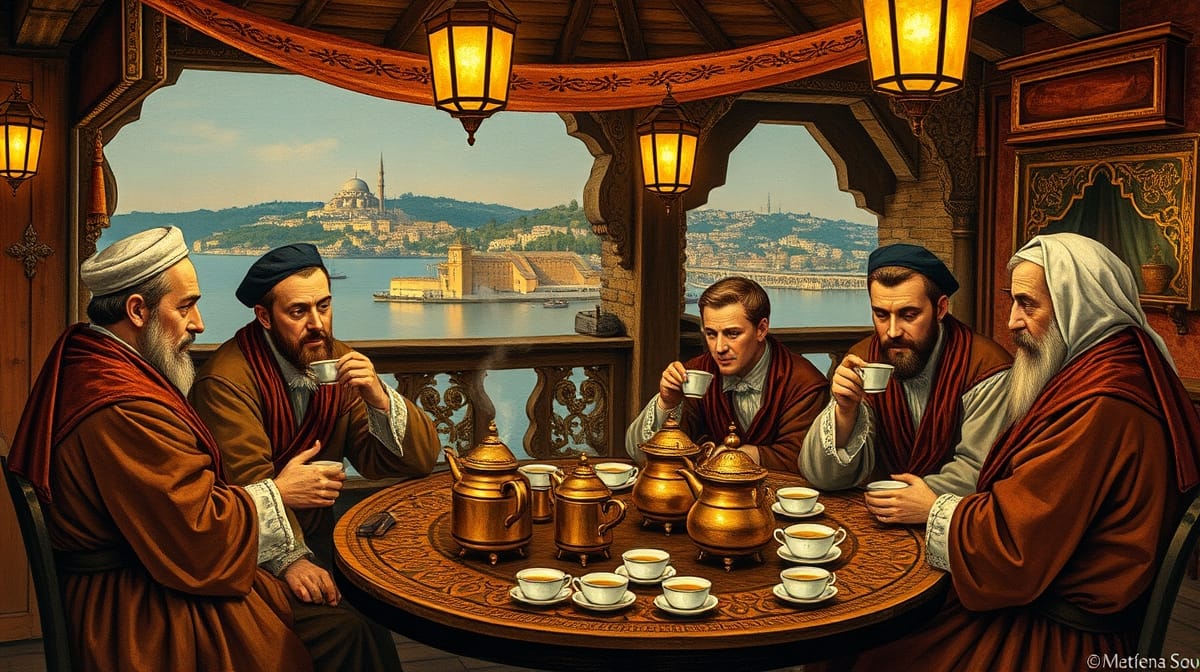
Coffee culture first took root in elite circles in Istanbul and then in bazaar and neighborhood life. Sources mention the first coffeehouses opened around Tahtakale in the 1550s. Because this district was close to the port, trade routes, and the movement of craftsmen and merchants, it was well suited to the spread of coffee. In a short time, coffeehouses became not merely shops where beverages were sold, but centers of conversation, communication, games, poetry, and discussions of current affairs.
This rapid rise of coffee was also connected with other institutions in the Ottoman urban fabric. Like mosques, madrasas, caravanserais, baths, and bazaars, coffeehouses were part of social circulation. Therefore, to understand the structure of Ottoman society, it is necessary to consider not only the social structure of the Ottoman Empire, but also everyday meeting places.
Coffee Culture and Ottoman Urban Life
The coffeehouse gave rise to a new public space in Ottoman cities. There, people received news, listened to poetry, watched performances by meddahs, played chess or backgammon, commented on affairs of state, and discussed neighborhood matters. In this sense, although coffeehouses did not function as newspapers or clubs in the modern sense, they were important centers where news entered oral circulation.
Halil İnalcık’s assessments of Ottoman social structure clearly show the importance the state attached to maintaining order in cities. From the perspective of the Ottoman administration, uncontrolled gatherings of crowds were a matter that required close attention. At precisely this point, coffeehouses became both attractive and problematic places: they brought people together, but at the same time created fertile ground for the spread of rumor and oppositional talk.
Coffee Culture and Oral Communication
Coffee culture contributed to the strengthening of oral communication, especially in periods when literacy was limited. News from the palace, army, market, port, and distant provinces was retold in coffeehouse conversations. These accounts were sometimes accurate information, sometimes exaggeration, and sometimes political gossip. This was one reason statesmen viewed coffeehouses with suspicion.
In the Ottoman central administration, decision-making processes operated through official institutions. To understand this framework, the role of the Imperial Council in state administration is important. Yet coffeehouses made visible the interpretations of urban dwellers that remained outside official politics. For the administration, the problem was not so much coffee itself as the uncontrollable spread of these interpretations.

Why Were Coffeehouses Banned?
The banning of coffeehouses cannot be explained by a single cause. Religious concerns, moral debates, public order, the danger of fire, the gathering of idle and unemployed groups, indiscipline among military classes, and political rumors all formed part of the background to these bans. For this reason, it would be incomplete to see anti-coffee measures in the Ottoman Empire merely as a “beverage ban.”
Religious Debates and Coffee Culture
Some of the earliest debates about coffee culture took shape around religious rulings. Questions were raised over whether coffee was intoxicating, what effect it had on the body, whether it disrupted communal religious life, and whether the time spent in coffeehouses could be considered morally appropriate. Some scholars adopted a more moderate approach, stating that coffee was not intoxicating like wine; others, however, regarded the coffeehouse environment as objectionable.
As can also be seen in the entries on coffee and coffeehouses in the TDV Encyclopedia of Islam, the debate was often concerned less with the chemical effect of the beverage than with the setting in which coffee was consumed. In other words, the target of the bans was not only the coffee in the cup, but the social togetherness that formed in coffeehouses.
Political Gossip and Concerns over Public Order
The Ottoman administration feared the disruption of order, especially in large cities. Discussions in coffeehouses about the sultan, viziers, military campaigns, taxes, prices, and military failures attracted the state’s attention. Such conversations sometimes remained at the level of ordinary complaint, but at other times turned into rumors capable of creating an atmosphere of rebellion.
In the 17th-century Ottoman world, the Celali rebellions, janissary mobility, price fluctuations, and tensions in center-province relations made the policing of coffeehouses more sensitive. To understand this environment, it is useful to examine the causes of rebellions in the Ottoman Empire. Although coffeehouses were not institutions that directly caused rebellions, they could be perceived as places where unrest was discussed and spread.
For the Ottoman administration, coffeehouses were both an indispensable part of urban life and crowded spaces that needed to be controlled.
Morality, Wasted Time, and Social Discipline
Another justification for the bans was the perception of coffeehouses as places of “idle sitting” and “neglect of work.” Tradesmen leaving their work to spend time in coffeehouses, young people turning to games and entertainment, and gambling or improper behavior seen in some coffeehouses increased the reaction of officials. In the Ottoman understanding of morality, productivity, communal order, and neighborhood supervision were important; coffeehouses opened up a new free space outside this order.
At this point, a similar language of control was sometimes used for coffeehouses and taverns. Yet coffee occupied a different position from wine in debates over what was lawful or unlawful. The state’s main concern was often not coffee itself, but the behavior of crowds that gathered under the pretext of drinking coffee.
How Were the Bans Enforced?
In Ottoman history, bans on coffeehouses periodically became stricter or more relaxed. During the reigns of some sultans, coffeehouses were closed; in other periods, their reopening was tolerated. The continuity of the bans was not the same everywhere; practices in Istanbul could differ from those in the provinces.
The reigns of Murad III and Murad IV are remembered for strict measures against coffeehouses. Accounts of the severe enforcement of bans on tobacco, alcohol, and coffeehouses are especially famous for the reign of Murad IV. Historians such as Ahmed Cevdet Pasha help us understand the mentality behind such practices when describing how public order measures came to the fore during periods in which the Ottoman sense of order was thought to be deteriorating.
Closure, Inspection, and Punishments
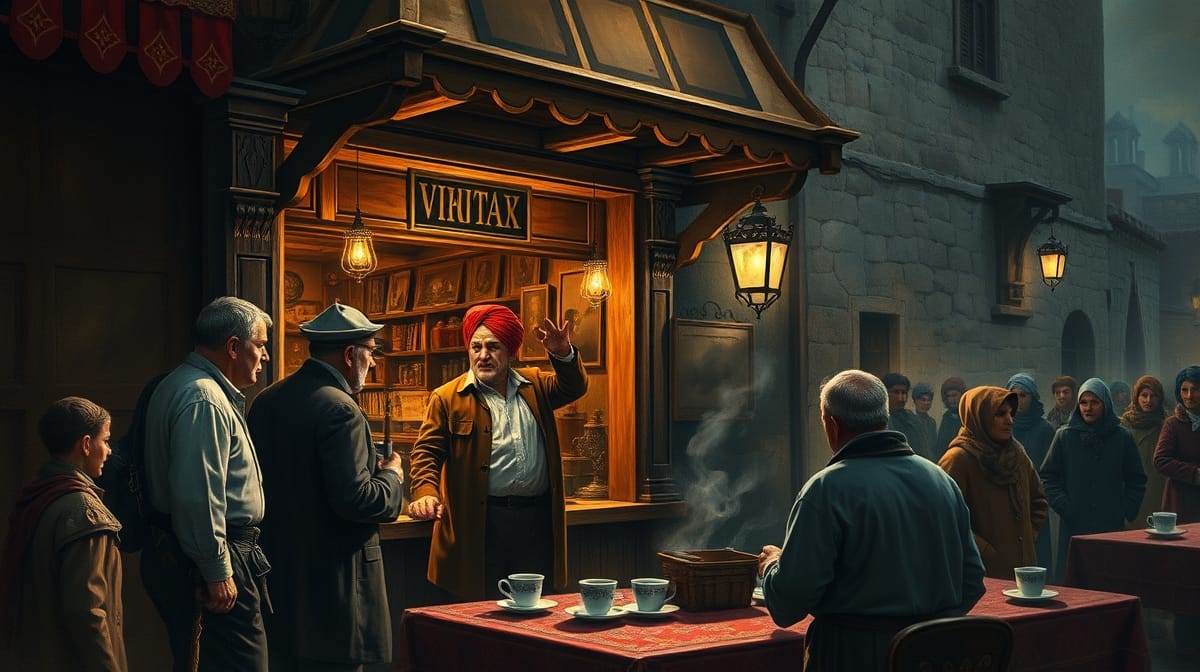
Coffeehouse bans were often enforced through the closing of shops, the confiscation of coffee equipment, the punishment of coffeehouse keepers, or the prevention of gatherings in certain places. Yet enforcement did not always bring complete success, because coffee consumption had already become firmly rooted in urban life. When the bans were relaxed, coffeehouses reopened, sometimes continuing to exist under other names or through more cautious modes of operation.
Information on exile and execution punishments in the Ottoman Empire also provides context for understanding the Ottoman state’s penal and exile practices. Although coffeehouses were usually the subject of administrative controls rather than severe punishments, harsher interventions could be seen especially in periods when public order deteriorated.
The Social Legacy of Coffeehouses
Despite the bans, coffee culture did not disappear from Ottoman society. On the contrary, coffeehouses gradually became more established, more varied, and more institutionalized spaces. Neighborhood coffeehouses, tradesmen’s coffeehouses, janissary coffeehouses, coffeehouses where meddahs performed, and places where literary conversations were held assumed different social functions.
Caroline Finkel’s approach, which treats Ottoman history within long-term transformations, shows that such everyday institutions were as important as the empire’s political history. Coffeehouses may not be as visible as the sultans’ campaigns or major treaties, but they profoundly influenced the ways urban Ottoman people received news, entertained themselves, debated, and constructed identity.
Literature, Meddahs, and the Tradition of Conversation
Coffeehouses were also stages for oral culture. Meddahs told stories, poets recited couplets, and listeners evaluated current events through humor and criticism. In this respect, coffeehouses contributed to Ottoman literary and cultural life. Especially in Istanbul, coffeehouses became spaces where men from different classes encountered one another and where language and humor were produced in lively ways.
When considering the Ottoman artistic and cultural legacy, it is necessary to take into account not only palace architecture but also the everyday aesthetic practices of the people. For this reason, topics such as the characteristics of Ottoman art and architecture can be read together with decoration, storytelling, and urban taste in coffeehouses.
Janissaries and Their Relationship with Coffeehouses
Some coffeehouses were associated with janissaries or particular groups of tradesmen. As the influence of the janissaries in the urban economy and neighborhood life increased, coffeehouses could also become one of the meeting places of these groups. This increased the state’s suspicion. The uncontrolled gathering of members of the military class could mean not only everyday conversation, but also potential political pressure.
To grasp this relationship more clearly, it is necessary to know about the role of the janissaries in Ottoman society. Although the impact of janissary coffeehouses on the banning of coffeehouses was not the same in every period, especially in the 17th and 18th centuries this connection was regarded by the administration as an important security issue.
Conclusion
Coffee culture in the Ottoman Empire was not merely the adoption of a new beverage, but a transformation of urban life. Coffeehouses strengthened conversation, news, humor, and social encounters; for the same reason, however, they became targets of religious debate, moral criticism, and concerns over state security. The bans could not eliminate coffee; on the contrary, they revealed its enduring place in Ottoman everyday life.
Sources
- Halil İnalcık, Devlet-i Aliyye.
- Suraiya Faroqhi, Subjects of the Sultan: Culture and Daily Life in the Ottoman Empire.
- Caroline Finkel, Osman’s Dream.
- TDV Encyclopedia of Islam, entries on Coffee and Coffeehouse.
- Ahmed Cevdet Pasha, Tarih-i Cevdet.