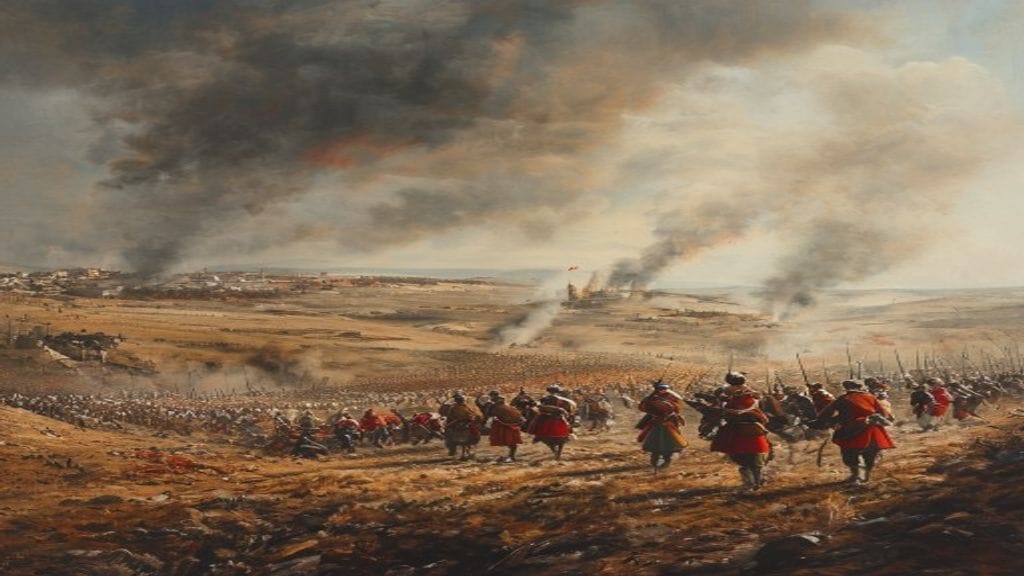
The foundation of the Ottoman Empire is a process intertwined with both legends and historical records, having long been a subject of academic debate. Born in the late 13th century as a small frontier beylik and destined to last more than six centuries, the empire traces its origins to the Kayı tribe under Osman Gazi’s leadership around Söğüt. However, much of what we know about its earliest years comes from chronicles compiled by historians who lived a century or more after the events. In this article we examine the most well-known legends, the academic debates, and the historical evidence we have regarding the foundation of the Ottoman Empire.
The Founding Legend of Söğüt: Osman Gazi’s Dream
The most famous founding narrative of Ottoman history is “Osman Gazi’s Dream,” recorded in the 15th-century chronicles of Aşıkpaşazade and Neşri. According to the account, the young Osman was a guest at the home of the Ahi sheikh Edebali when he had a vivid dream. In the dream, a moon emerged from Edebali’s chest and entered Osman’s; from his navel grew a great plane tree whose branches covered the world. The next morning Osman shared the dream with the sheikh, who interpreted it as a sign that “a great state will arise from your line.” Edebali then gave his daughter Mal Hatun in marriage to Osman. This story has been retold for centuries as the symbolic legend that grounded both the spiritual and political legitimacy of the dynasty.
Modern historiography does not treat the dream as a literal historical event but as a later founding myth. Scholars such as Halil İnalcık and Cemal Kafadar emphasize that the narrative was first written down at least 150 years after the events, and that even the marriage between Osman Gazi and Sheikh Edebali’s daughter is debated. Still, the dream motif appears frequently in Islamic tradition (echoing the influence of the Sura of Yusuf) and in Türkmen mythology. Among the legends surrounding the foundation of the Ottoman Empire, this story remains the most powerful symbolic narrative, projecting the dynasty’s later three-continent grandeur back onto its modest origins.
The Kayı Tribe and Ertuğrul Gazi: Historical Realities and Debates
According to traditional accounts, the Ottoman dynasty descended from the Kayı tribe of the Bozok branch of the Oğuz Turks. Fleeing the Mongol invasion, the Kayıs are said to have moved into Anatolia—first around Ahlat and Erzurum, then near Konya, and finally settling along the Söğüt-Domaniç line under the auspices of the Seljuk sultan. Their leader, Ertuğrul Gazi, is reported to have led an aşiret of roughly 400-500 tents in the region. He is said to have received the duty of guarding the Byzantine frontier in the Sultanöyüğü (modern Eskişehir) and Söğüt area during the reign of Seljuk Sultan Gıyaseddin Mesud II. Yet contemporary sources for Ertuğrul are extremely scarce; the earliest concrete evidence comes from copper coins minted under his grandson Orhan Bey and from Aşıkpaşazade’s chronicle.
A central academic debate revolves around whether the Ottomans truly descended from the Kayı tribe. In the 1930s, Paul Wittek argued that the Kayı emphasis was a later construction designed in the time of Murad II. Other historians such as Rudi Paul Lindner have argued that the early Ottomans were a mixed tribal confederation including Türkmen, Greek, and Armenian elements. Halil İnalcık partially defended the traditional view, citing early coins and tribal markings as supporting evidence. The debate is not purely academic; in modern Turkey, popular productions like “Diriliş Ertuğrul” have brought it back into public consciousness and shaped how the foundation of the Ottoman Empire is remembered today.
The Year 1299: Foundation or Independence?
The date 1299, taught in textbooks as the founding year of the Ottoman state, is in fact academically contested. The date originates in 19th-century works by the Ottoman historian Hayrullah Efendi and the Austrian Orientalist Hammer, based on Osman Gazi’s conquest of Karacahisar and the reading of the khutbah in his name. However, no contemporary source records 1299 as a definitive event. Historians like Cemal Kafadar emphasize that the “founding” was not a single moment but a process spread between 1280 and 1320.
Alternative dates include 1281 (Ertuğrul’s death and Osman’s assumption of leadership), 1302 (Osman’s victory over Byzantine forces at the Battle of Bapheus), and 1324 (Orhan Gazi’s accession and Osman’s death). Bapheus is especially significant: in his contemporary account, the Byzantine historian Pachymeres explicitly describes Osman acting as an independent leader against Byzantine forces—the first event in which the Ottomans appear in contemporary sources beyond doubt. For this reason, many modern historians prefer to date the symbolic foundation of the Ottoman Empire not to 1299 but to the 1302 victory at Bapheus.
Byzantine-Ottoman Relations: Neighborhood in the Early Period
A common cliché about early Ottoman history is that the Turks were in constant jihad against Byzantium; in fact, the sources show a far more complex picture. The Ottomans around Söğüt sometimes fought, sometimes allied with, and sometimes intermarried with Byzantine tekfurs. Köse Mihal, founding ancestor of the famous Mihaloğulları family, was the lord of Harmankaya before joining Osman Gazi and converting to Islam. Likewise, Orhan Gazi married Theodora, the daughter of the Byzantine emperor John VI Kantakouzenos, in 1346. This marriage facilitated the movement of Ottoman troops into Europe during the Byzantine civil wars.
The conquests of Bilecik, Yarhisar, İnegöl, and Yenişehir were not single dramatic events but processes of siege and negotiation extending over years. Bursa’s fall in 1326 to Orhan Gazi marked the transition of an economically rich trade center to Ottoman control and signaled the closure of the founding period. The victory at Bapheus (1302) provided military legitimacy, the conquest of Bursa (1326) administrative legitimacy, and the conquest of İznik (1331) theological legitimacy. These three milestones mark the concrete maturation of the foundation of the Ottoman Empire.
Wittek’s Ghaza Thesis and Its Academic Critiques
The Austrian historian Paul Wittek, in his 1938 work “The Rise of the Ottoman Empire,” explained the rapid Ottoman ascent through what became known as the “ghaza thesis.” For Wittek, the Ottomans were a frontier beylik whose Muslim warriors waged jihad (ghaza) along the Byzantine border with religious-ideological motivation; this ideological energy, he argued, was the source of their military superiority and political cohesion. The thesis rested largely on the verses of the 14th-century Ottoman poet-historian Ahmedi’s “Iskendername,” which emphasized ghaza, and on the inscription “ghazi son of ghazi” found on a mosque in Bursa.
Beginning in the 1980s, the ghaza thesis came under serious critical scrutiny. In “Nomads and Ottomans in Medieval Anatolia,” Rudi Paul Lindner showed that the early Ottomans operated through pragmatic tribal calculations rather than religious ideology and frequently allied with non-Muslims. In “Between Two Worlds: The Construction of the Ottoman State,” Cemal Kafadar argued that the term ghaza was elastic and porous in this period, with the boundary between warrior and Christian neighbor far less rigid than later imagined. In “The Nature of the Early Ottoman State,” Heath Lowry argued that the real driving force behind early Ottoman expansion was a plunder economy. Together, these critiques showed that the foundation of the Ottoman Empire cannot be reduced to a single ideological motif.
From Söğüt to Bursa: Early Conquests and Capital Changes
Major conquests during Osman Gazi’s reign include Karacahisar (around 1288), Bilecik, Yarhisar, İnegöl, and Yenişehir. Yenişehir served as the administrative center of the founding period but did not yet have the status of a true capital. Osman Gazi’s last great undertaking was the siege of Bursa, completed posthumously by his son Orhan Gazi on 6 April 1326. Bursa’s capture gave the Ottomans an economically vibrant center and accelerated the dynasty’s transformation from a tribal aşiret into an organized state.
Capital changes reveal the trajectory of Ottoman expansion. Bursa (1326-1365) served as an economic hub, Edirne (1365-1453) as a gateway to Europe, and Constantinople (after 1453) as the center of an empire commanding the Mediterranean basin. Each shift reflects a change in geographic and political priorities. The Söğüt-Yenişehir-Bursa axis thus forms the geographical core of the foundation of the Ottoman Empire; the official Ertuğrul Gazi commemorations held annually at Söğüt have, since the 1980s, been recognized as state ceremonies.
Founding Myths and Modern Historiography
In modern Turkey, the Ottoman foundation has been shaped less by academic historiography than by popular cultural narratives. Productions such as “Diriliş: Ertuğrul” (premiered 2014) and its sequel “Kuruluş: Osman” have brought emphases on the Kayı tribe, ghaza ideology, and the mystique of Söğüt to a mass audience. These productions are not historical documents, but they play an important role in shaping collective memory. Indeed, visitor numbers at Ertuğrul Gazi’s tomb in Söğüt have multiplied in the last decade, turning the town into a major destination for historical tourism.
The academic world takes a more cautious stance. The classic studies of Halil İnalcık, the structural analyses of Cemal Kafadar, the revisionist arguments of Heath Lowry, the critical readings of Colin Imber, and the contributions of newer historians such as Selim Karahasanoğlu and Tijana Krstić show that there is no single correct narrative regarding the foundation of the Ottoman Empire; rather, source gaps, retrospectively constructed myths, and competing interpretive frameworks intertwine in a complex field. Hence, there is no single definitive answer to the question “How was the Ottoman Empire founded?”; the more productive questions are “What does each source actually say, and when was each myth produced?”
Frequently Asked Questions
When was the Ottoman Empire founded?
The traditional date for the founding of the Ottoman Empire is 1299, attributed to Osman Gazi. However, modern historiography treats this date as symbolic; in academic terms the founding spans a process between 1280 and 1326. The first event in which the Ottomans appear in contemporary sources is the Battle of Bapheus in 1302. According to Pachymeres’ contemporary account, with this victory Osman Gazi emerged as an independent political force against Byzantine troops.
Did Osman Gazi’s dream really happen?
The story of the dream at Sheikh Edebali’s house was first written down in the 15th century in Aşıkpaşazade’s “Tevarih-i Âl-i Osman,” roughly 150 years after the events. The vast majority of modern historians consider it not a literal event but a founding myth that retrospectively legitimized the dynasty. Nonetheless, the story remains one of the most powerful legends in Ottoman collective memory.
Did the Ottomans really descend from the Kayı tribe?
This is academically debated. Halil İnalcık argued that the Kayı emphasis is reflected in early Ottoman coins and tribal markings. By contrast, Paul Wittek and Rudi Paul Lindner argued that the Kayı identity was constructed retrospectively in the time of Murad II, and that the early Ottomans were in fact a mixed tribal confederation. Historians like Cemal Kafadar caution against treating the Kayı question as the sole determining factor of the founding process.
What was the first Ottoman capital?
Yenişehir is generally regarded as the Ottomans’ first administrative center, but it never became a true capital. The first real capital was Bursa, conquered by Orhan Gazi in 1326. Bursa held this role for roughly 40 years until Edirne became the capital in 1365. With the conquest of Constantinople in 1453, the capital moved to Istanbul, where it remained until the empire’s dissolution.
What is the “ghaza thesis,” and is it still accepted?
The ghaza thesis, developed by Paul Wittek in 1938, attributes the rapid rise of the Ottomans to a religious ideology of jihad. The thesis was the dominant paradigm for most of the 20th century, but since the 1980s it has been substantially questioned by Lindner, Kafadar, Lowry, and others. Today the ghaza thesis is no longer considered sufficient on its own; the plunder economy, tribal structure, and Byzantine-Ottoman alliances are now seen as equally important factors.




1 thought on “Foundation of the Ottoman Empire: Legends and Facts”