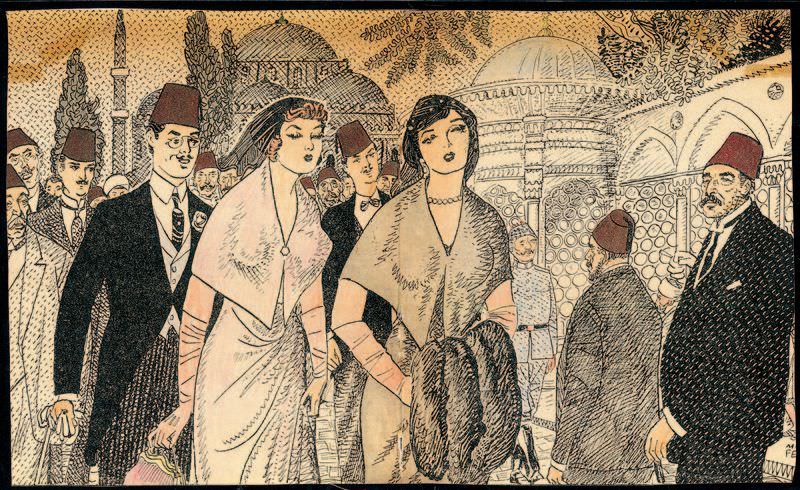
The first Ottoman law regulating marriage and divorce was the Law of Family Rights (Hukuk-ı Aile Kararnamesi) of 25 October 1917. According to the TDV Encyclopedia of Islam, this decree is regarded as the first example of its kind in family law in both Islamic and Ottoman legal history. It remained in force for about a year and a half and was repealed on 19 June 1919.
Quick Summary
- The decree was issued as a provisional law on 25 October 1917, in the reign of Mehmed V Reşad.
- Its text was prepared by the Family Law Commission chaired by Mahmud Esad Efendi.
- Full capacity to marry required the age of 18 for men and 17 for women.
- At the time of the marriage contract, a woman could stipulate that her husband would not take a second wife.
- The decree was repealed on 19 June 1919.
Contents
- Which was the first law?
- Why was the decree issued?
- The changing place of women
- Who prepared the decree?
- The age of marriage
- The marriage contract and the monogamy clause
- What changed in divorce?
- Provisions for non-Muslims
- Why was the decree repealed?
- Frequently asked questions
Which Was the First Ottoman Law Regulating Marriage and Divorce?
This law was the Law of Family Rights. According to the TDV Encyclopedia of Islam, it was one of the last products of the codification movement that began after the Tanzimat. The decree remained in force only briefly in the Ottoman state. It was, however, applied for much longer in countries such as Syria, Jordan, Lebanon and Palestine.
According to the encyclopedia, the decree consists of 157 articles arranged in two books, nine chapters and twenty sections. Three articles are devoted to betrothal and nine to the capacity to marry. Later laws on marriage and divorce drafted in other Islamic countries took this text as a model.
Why Was the Decree Issued?
According to the TDV Encyclopedia of Islam, the most important legal reason was that family law, including the rules on marriage and divorce, had not yet been codified. With the Land Code of 1858 and the Mecelle, a large part of civil law had been put into written form, but family law had not yet had its turn. Kadis also struggled to find the rulings they needed in the classical books of jurisprudence (fiqh).
Another reason was the difficulty that the strict application of the Hanafi school created in matters of marriage and divorce. According to the encyclopedia, divorce at a woman’s request was accepted only in very limited cases. Two imperial decrees (irade-i seniyye) issued in 1916 opened the way to drawing on other schools of law. According to the encyclopedia, the decree of 5 March 1916 allowed the wives of husbands who disappeared without leaving maintenance to obtain a divorce under the Shafii school. The decree of 23 March 1916 opened the path to divorce for a woman whose husband had contracted a dangerous disease.
The wounds of war also played a part. According to the encyclopedia, the wives of soldiers who had gone to the front and never returned, but whose deaths had not been reported, could not remarry. This problem awaited a more comprehensive solution. In politics, meanwhile, the Committee of Union and Progress government wanted to achieve a unified judiciary.
The Changing Place of Women
According to the encyclopedia, in the nineteenth century the extended mansion household gradually began to give way to the family of husband and wife. During the war years women worked in many jobs, from factories to street cleaning. From 1858 onward, various schools for girls had opened in Istanbul. Magazines such as “Kadın,” “Kadınlar Dünyası” (Women’s World) and “Mehâsin” also defended women’s rights. According to the encyclopedia, women also entered the civil service with the First World War.
According to the encyclopedia, the Islamic Society for the Employment of Ottoman Women, founded on Enver Pasha’s initiative, helped women find work during the war years. Labor battalions made up of women also tried to fill the labor shortage in rear-area services.

Westernists, Islamists and Turkists proposed different solutions to the questions of marriage and divorce. According to the encyclopedia, the Westernists strongly opposed polygamy and wanted divorce to take place only by court decision. The Turkists also opposed polygamy but did not approve of blindly imitating the West. We described women’s place in society in our article on the place of women in the Ottoman period.
Who Prepared the Decree?
The decree was prepared not by the office of the şeyhülislam but by a commission. According to the TDV Encyclopedia of Islam, the Family Law Commission, chaired by Mahmud Esad Efendi, deputy for Isparta, included jurists such as Mansurizade Said Bey. Because it was expected to cause great controversy, the bill was not sent to parliament. It was issued as a provisional law on the basis of Article 36 of the Ottoman Constitution (Kanun-i Esasi).
According to the encyclopedia, the decree was later brought before parliament and, after a heated debate, referred to the Justice Committee. No work by the committee on the matter is known, however, up to the decree’s repeal.
According to the encyclopedia, the content of the decree mainly reflected the views of the Islamists. Demands such as banning polygamy and allowing divorce only by a judge’s decision did not make it into the text. On the other hand, the decree drew on schools of law other than the Hanafi; this eclectic method is its most important feature. The Mecelle, by contrast, had been based on the Hanafi school alone.
What Age Was Set for Marriage?
The decree divided those wishing to marry into three groups. According to the TDV Encyclopedia of Islam, men who had completed eighteen years and women who had completed seventeen had full capacity. If the woman’s guardian had a justified objection, however, the judge would not grant permission. This provision drew on the Maliki school.
The second group consisted of young people between the limits of puberty. They could marry if the judge accepted that they had reached puberty; girls also had to obtain their guardians’ consent. The third group was minors who had not reached the age of puberty at all. According to the encyclopedia, they could be married neither of their own will nor by their guardians. Marrying off the mentally ill was also prohibited except in cases of necessity.
The Marriage Contract and the Monogamy Clause
According to the encyclopedia, the decree made the tradition of concluding marriages under state supervision more orderly. What was new was the advance announcement of marriages. According to the encyclopedia, the marriage contract was to be made with explicit words such as “tezvic” and “tenkih” (giving in marriage). According to the entry on nikah (marriage), the principle of registering marriages also came with this decree.
Marriage and divorce under coercion were declared invalid. According to the encyclopedia, such marriages had previously been considered valid under the Hanafi view. This had caused serious problems, especially in cases of bride abduction.
The most striking innovation concerned polygamy. According to the TDV Encyclopedia of Islam, Article 38 allowed a woman, at the time of the marriage contract, to stipulate that her husband would not take a second wife. This clause was binding, and if it was violated the marriage was deemed dissolved. By adopting the Hanbali view, polygamy was thus restricted indirectly.
What Changed in Divorce?
The decree widened the path for a woman to obtain a divorce by court decision. According to the encyclopedia, leprosy, leukoderma, venereal diseases and mental illness in a spouse were accepted as grounds for divorce. A husband’s disappearance without leaving maintenance was also a ground for divorce. If the husband disappeared after leaving maintenance, a wait of four years was required. For those missing in war, at least one year was to be waited after the return of the prisoners of war.
In cases of marital discord, an arbitration panel chosen from both families would first try to mediate. According to the encyclopedia, if the panel failed, it could rule for divorce according to fault. A divorce pronounced while drunk was also declared invalid. These provisions on marriage and divorce drew on the Shafii and Maliki schools.
Provisions for Non-Muslims
The decree covered not only Muslims but also Jews and Christians. According to the TDV Encyclopedia of Islam, until then non-Muslims had been able to turn to their own community courts in matters of family law. Article 156 of the decree abolished the jurisdiction of these courts and placed all subjects under the sharia courts. For the sake of freedom of religion and conscience, however, special provisions were included for Jews and Christians. According to the encyclopedia, legal pluralism in family law was thus preserved to some extent.
We described the history of the community courts in our article on the Ottoman millet system. For how the sharia courts worked, see also our article What did an Ottoman kadi do?.
Why Was the Decree Repealed?
According to the TDV Encyclopedia of Islam, the decree was repealed by a provisional law dated 19 June 1919 that bore the signature of Şeyhülislam Mustafa Sabri Efendi. The heads of the non-Muslim communities had objected to the closure of their community courts. According to the encyclopedia, however, the main reason was the criticism some Islamists directed at the provisions taken from other schools of law. Sadreddin, a professor at the Darülfünun (Istanbul University), criticized these provisions in some twenty articles in the journal “Sebilürreşad.” Because these provisions were numerous, the law was repealed in its entirety.
According to the encyclopedia, the decree was not a complete family code either; matters such as lineage, guardianship and the marital property regime were not regulated. Even so, despite its short life, this law on marriage and divorce left an important mark on the history of Islamic law. We discussed the broader process of which this reform was part in our article on Ottoman sultans and reform movements.
Frequently Asked Questions
Which was the first Ottoman law regulating marriage and divorce?
It was the Law of Family Rights of 25 October 1917.
What was the age of marriage in the Law of Family Rights?
Full capacity required the age of 18 for men and 17 for women. Marrying off minors was prohibited.
In whose reign was the decree issued?
It was issued in the reign of Mehmed V Reşad. The Committee of Union and Progress government, however, played the decisive role in its preparation.
How long did the decree remain in force?
It remained in force in the Ottoman state for about a year and a half and was repealed on 19 June 1919.
Could women obtain a divorce?
Yes. The decree widened the grounds on which a woman could obtain a divorce by court decision.
Conclusion
The first Ottoman law regulating marriage and divorce was the Law of Family Rights of 1917. The decree set the age of marriage, declared forced marriages invalid and gave women the right to stipulate monogamy. It widened women’s access to divorce through the courts and aimed at a unified judiciary. Despite its short life, it served as a model for the family laws of later Islamic countries.