Communication in the Ottoman Empire relied on an official network of couriers and post stations that carried the state’s orders to the provinces and news from the provinces back to the capital. This network was called the menzil system. Couriers changed horses at menzil stations set up along the roads and so delivered the news quickly. In this article we explain how the system was set up, how it worked, who staffed it and why it gave way to the postal service.
Quick Summary
- Official news was carried by couriers, who changed horses at menzil stations along the road.
- The system was re-established in 1539 by Grand Vizier Lutfi Pasha.
- The roads started in Istanbul and split into three main branches each in Anatolia and Rumelia.
- The distance between menzil stations ranged from 3 to 28 hours depending on road conditions.
- Private letters could not be sent through the menzil network; ordinary people used caravans.
- The menzil system was abolished in 1839, when the postal organization was founded.
Contents
- Short answer
- Couriers and the “courier tyranny”
- The 1539 reform: Lutfi Pasha’s order
- How was the menzil network built?
- How was news carried on the road?
- Did the menzil stations carry only news?
- Why did the system decline?
- From the menzil to the post
- Frequently asked questions
How Did Communication Work in the Ottoman Empire? A Short Answer
The word “menzil” comes from a root meaning “to dismount, to stop for the night”. In the Ottoman state it became the name of the system of stations and relays that carried official communications. It was built on earlier models: the berîd of medieval Islamic states and the yam of the Mongols. The place where couriers and postmen were based was also called a çaparhâne; the word passed into Persian as an equivalent of “post office”.
The principle was simple. A courier travelling on state business left his tired horse at a station on the road and took a fresh one. In this way the news could travel for days without a break, without depending on the strength of a single horse. Thanks to this fast relay, the menzil system linked a vast territory together.
Couriers and the “Courier Tyranny”
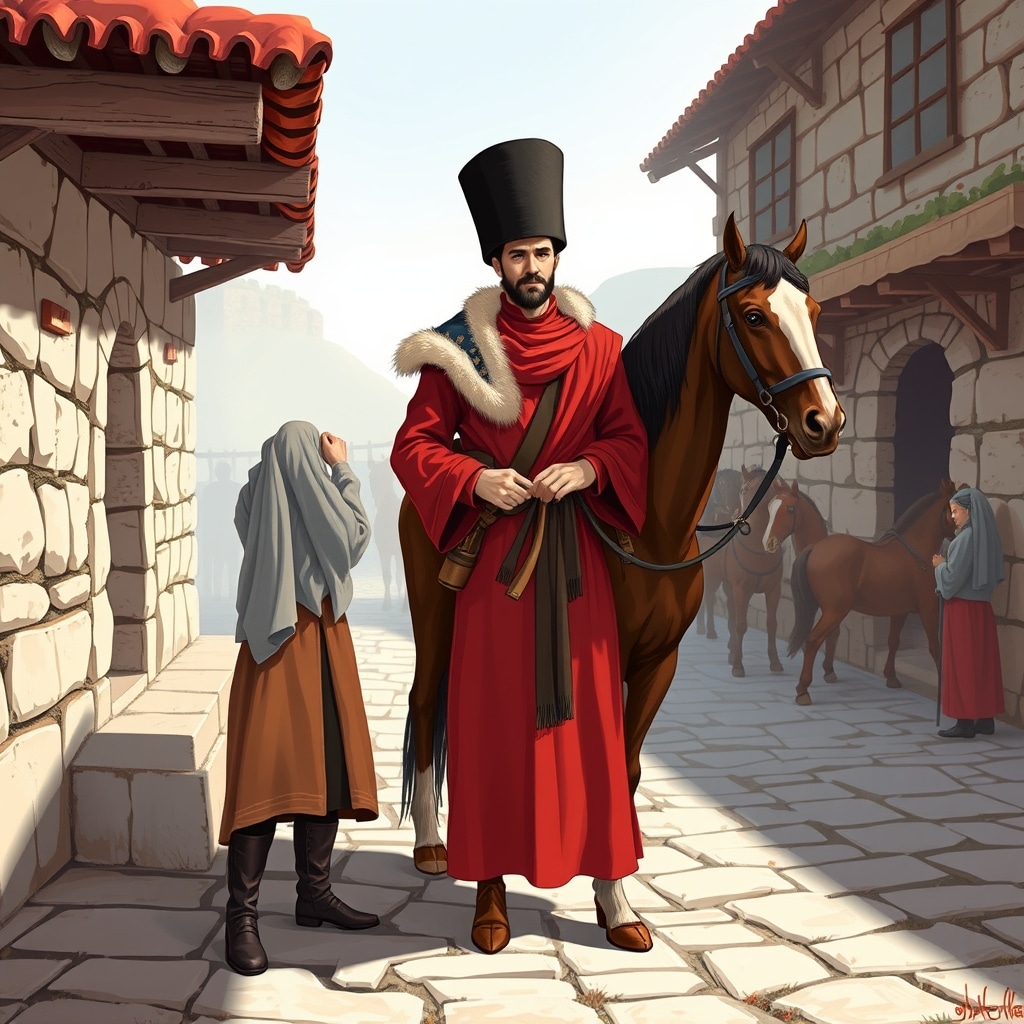
The word ulak appears in Old Turkic as “ulağ”. Mahmud al-Kashgari defines it as the horse ridden by a messenger sent on the bey’s orders until he finds a new horse. The idea of travelling by changing horses thus lies at the very root of the word. Kashgari also records that stones called “ula” were set up along the roads to show the direction of travel; this word most likely comes from the same root.
At first, communication in the Ottoman Empire ran on a document called the “ulak hükmü”, the courier order. Its bearer could take any horse he wanted from the people on the road and demand that his needs be met. Over time, viziers, treasurers, governors-general, district governors and kadıs also began to issue courier orders.
This broad authority was soon abused. Couriers left their exhausted horses behind and seized the horses of people they met on the road. The documents call this behavior “ulak zulmü”, the tyranny of couriers. The oldest surviving courier order is a document issued by Bayezid II in Edirne in 1482.
A decree of 1530 stated openly that the people were tired of the excessive number of couriers. It ordered that couriers be sent only on important state business and that no more than two be dispatched. Even so, during Suleiman the Magnificent’s campaign of the Two Iraqs, 700 horses ridden by couriers were reportedly lost between Baghdad and Nusaybin in winter.
The 1539 Reform: Lutfi Pasha’s Order
Suleiman the Magnificent asked Lutfi Pasha, whom he had appointed grand vizier, to solve this problem. In 1539 Lutfi Pasha abolished the courier-order system and re-established the menzil organization. Stations were opened at fixed points, and the people living nearby were assigned to serve in them.
The courier order was replaced by a warrant called the “in‘âm hükmü”. It recorded the courier’s name, his office, the reason for his journey, on whose orders he was travelling and whether he was going out or returning. The names of the first and final stations and of the drivers were also written in it. No one without such a warrant was given a horse. Communication in the Ottoman Empire thus gained a recorded order in which it was clear who was travelling, on what business and along which route.
For the place of this reform in the wider structure of the period, see our article on how the Ottoman state changed under Suleiman I.
How Was the Menzil Network Built?
Roads and branches
The roads reaching every corner of the empire all began in Istanbul. They split into three main branches each towards Anatolia and Rumelia, and these branches were linked to one another by secondary roads. The menzil stations were not set up at equal intervals. Geography, security and places where supplies could be found were all taken into account.
For this reason, the distance between two stations was planned at 3 to 28 hours, in a way that let news arrive quickly. In places that had no station but where couriers had to stop, the local people were obliged to meet the courier’s needs.
Who worked at a menzil station?
The official who ran a station was called the menzil emini. The emin was proposed by the district’s notable, kadı or deputy judge and appointed with the approval of the capital. The villagers or townspeople who provided the service were called “menzilkeş” or “menzilci”. In return for their service they were exempted from the avârız and nüzul taxes.
The stations also had a steward, a stable steward, grooms, room attendants, drivers and cooks. The district’s kadı, deputy judge and muhtesip inspected how the station worked and how clean its rooms were. In the 18th century this inspection began to be carried out by officials sent from the capital. For the kadıs’ wide range of duties in the provinces, see our article on the Ottoman kadı.
How were the costs covered?
The menzil system was expensive. Each horse at a station cost an average of 147.5 kuruş a year, and this cost doubled in times of war. In 1712 the total expenditure of all the stations reached 244,028.5 kuruş.
Part of the costs came from the treasury, part from couriers’ fees and part from the taxes of the people who served at the stations. When this was not enough, especially in wartime, an extra tax called “imdâdiyye” was collected. After 1697 couriers paid 10 akçes per hour for each horse they took. For example, of the annual expenditure of 2,212.5 kuruş at the Aydos station, which had fifteen horses, 1,125 kuruş came from couriers’ fees.
How Was News Carried on the Road?
Ordinary news was passed on from station to station. For very important and secret news, however, a single courier was used, and the message was carried by the same person from its point of departure to its destination. Such a messenger was called a “courier sent by special order”.
Couriers usually travelled on horseback; those carrying an order with the sultan’s tuğra were also given a carriage. Couriers arriving from the frontiers could take horses from every station even without a warrant. An order of 1699 commanded that no fee be asked between Edirne and Istanbul from couriers bringing important news from Austria.
Couriers were also chosen with care. Preference went to honest men and good riders able to endure the hardships of the road, who had served for a long time in the viziers’ households. Under Abdülhamid I (1774–1789), couriers were organized into a corps called the Tatarân Ocağı. Members of the corps received a distinctive kalpak and uniform, and anyone who wore this dress without permission was punished.
Did the Menzil Stations Carry Only News?
The stations were first set up to report information from the provinces and the frontiers to the capital and to deliver the government’s orders where they were needed. For how the center that issued these orders worked, see our article on the Imperial Council (Divan-ı Hümayun). Over time the menzil network took on wider duties.
- Supplying the army: The most important function was military. Before a campaign, the army’s halting places were fixed and kadıs were ordered to prepare provisions.
- Lodging envoys: Foreign envoys could stay at the stations on Ottoman territory, and the state paid their expenses.
- Travel of officials: State dignitaries and officials sent on duty also made use of the stations.
The army’s campaign routes and the communication stations were often not the same. The menzil stations were usually in settlements, and these places were not suitable, in terms of water and terrain, for large armies to camp.
Sending private letters by this route was in fact forbidden. Ordinary people usually communicated through caravans. Our article on Ottoman military organization also gives an idea of the army’s campaign routes.
Why Did the Menzil System Decline?
Frequent campaigns and abuses by officials wore the system down over time. Some couriers altered their warrants or travelled again and again with undated documents. For this reason, station staff in Bolu, Tosya and Merzifon asked the courts to mark the decrees whose dates were clear. Some couriers carried merchants’ goods on station horses, and these horses, which were not pack animals, died as a result.
A memorandum written under Mahmud II gives a striking example. Ten or fifteen tatars, eager to be the first to deliver news of an appointment and collect a reward, raced each other on station horses without permission. According to the memorandum, within six months hardly a sound horse was left at one menzil station.
Reforms after the defeat at Vienna
In the troubled years that followed the defeat at Vienna, the system was given a new order in 1691. As the pressure of war continued, the stations were reorganized once more in 1697. Couriers were given warrants showing how many horses they could take from which station, and the fee for each horse was fixed at 10 akçes per hour.
Weighed down by heavy taxes, the people who served at the stations began to abandon their homes. The stations were then leased out; the leasing method was applied mainly from 1777 onwards. In this period a person called the kiracıbaşı, the chief leaseholder, ran the station instead of the menzil emini. Couriers paid for their horses in advance and covered their own fodder and food.
For a time the stations were also farmed out as tax farms (iltizam). A town notable approved by the kadı, the notables and the mufti took over a station for a year, and the people of the region paid the cost in two installments. However, demands for money beyond the fixed cost, under names such as “bonus” or the price of a dead horse, led to constant complaints. Under Grand Vizier Galib Pasha, between 1824 and 1829, the leasing method was applied once again. In a sense, the menzil system was thus privatized.
From the Menzil to the Post
When reform efforts failed, steps were taken in 1834 to switch to a postal system. As a trial, a post road was opened from Üsküdar to İzmit, and Mahmud II travelled along it by phaeton as far as Kartal. Post offices were built along the road, and numbered posts showing the distance were set up at every quarter of an hour’s journey.
When the carriage road fell into disrepair, the old system was used again for a while. In 1839, when the postal organization was founded, the menzil system was abolished completely. Communication in the Ottoman Empire thus passed from the age of mounted couriers to the modern postal era.
Frequently Asked Questions
Which organization handled communication in the Ottoman Empire?
Official communication was handled by the menzil organization. Couriers carried the state’s orders and news by changing horses at stations along the road.
Were the ulak and the tatar the same in the menzil system?
In the sources the word ulak is also used to mean tatar, berîd and post. Officials who carried official news were also called tatars; under Abdülhamid I they were organized into the Tatarân Ocağı.
When was the menzil system abolished?
The menzil system was abolished in 1839, when the postal organization was founded. Earlier, in 1834, a trial post road had been opened between Üsküdar and İzmit.
Conclusion
Communication in the Ottoman Empire rested on couriers who changed horses and on the network of menzil stations that supported them. Organized by the reform of 1539, this network carried not only news but also the army’s provisions and state officials. Abuses and heavy costs wore the system down, and the postal organization founded in 1839 brought this long tradition to an end.
Sources
- TDV Encyclopedia of Islam, entry “Menzil” (Ottoman)
- TDV Encyclopedia of Islam, entry “Ulak”
- Yusuf Halaçoğlu, Osmanlılarda Ulaşım ve Haberleşme (Menziller).