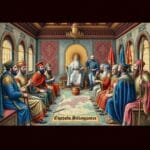
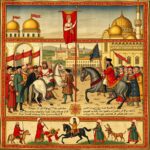
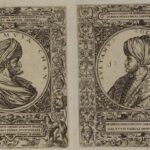
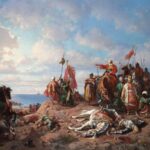
Under Suleiman I, the Ottoman Empire went through a major transformation: military conquests accelerated, central administration grew stronger, the legal order became more systematic, the state turned into a decisive force in Mediterranean and Central European politics, trade routes and tax sources came under tighter control, and architectural and cultural production visibly represented the imperial identity.
Quick Summary
- The Ottomans expanded their military influence in Central Europe and the Mediterranean.
- Central administration worked more regularly through land surveys (tahrir) and law codes (kanunname).
- Naval power gained a strategic advantage under Barbaros Hayreddin Pasha.
- The works of Mimar Sinan carried imperial splendor into the fabric of the city.
- Dynastic politics made the power relations around the palace more visible.
Contents
- The General Framework of Suleiman I’s Reign
- Military and Diplomatic Expansion
- Central Administration and Law
- Economy, Taxation and Trade
- Society, Palace and Dynasty
- Architecture, Culture and the Imperial Image
- Long-Term Effects
The General Framework of Suleiman I’s Reign
When Suleiman I ascended the throne in 1520, the state was an empire already enlarged by the eastern and southern campaigns of Selim I. The new sultan did not merely preserve this legacy. He pursued a more ambitious policy on the European, Mediterranean and eastern frontiers. His reign thus became a period in which expansion and institution-building advanced together.
This era is often called the “classical age” or the “golden age.” Yet the label does not mean that there were no problems. Revolts in Anatolia, tax pressures and tensions within the dynasty revealed the fragile sides of the order. As Halil İnalcık’s studies also emphasize, Ottoman power rested as much on institutional capacity as on military success.
Why Was Suleiman I a Transformative Ruler?
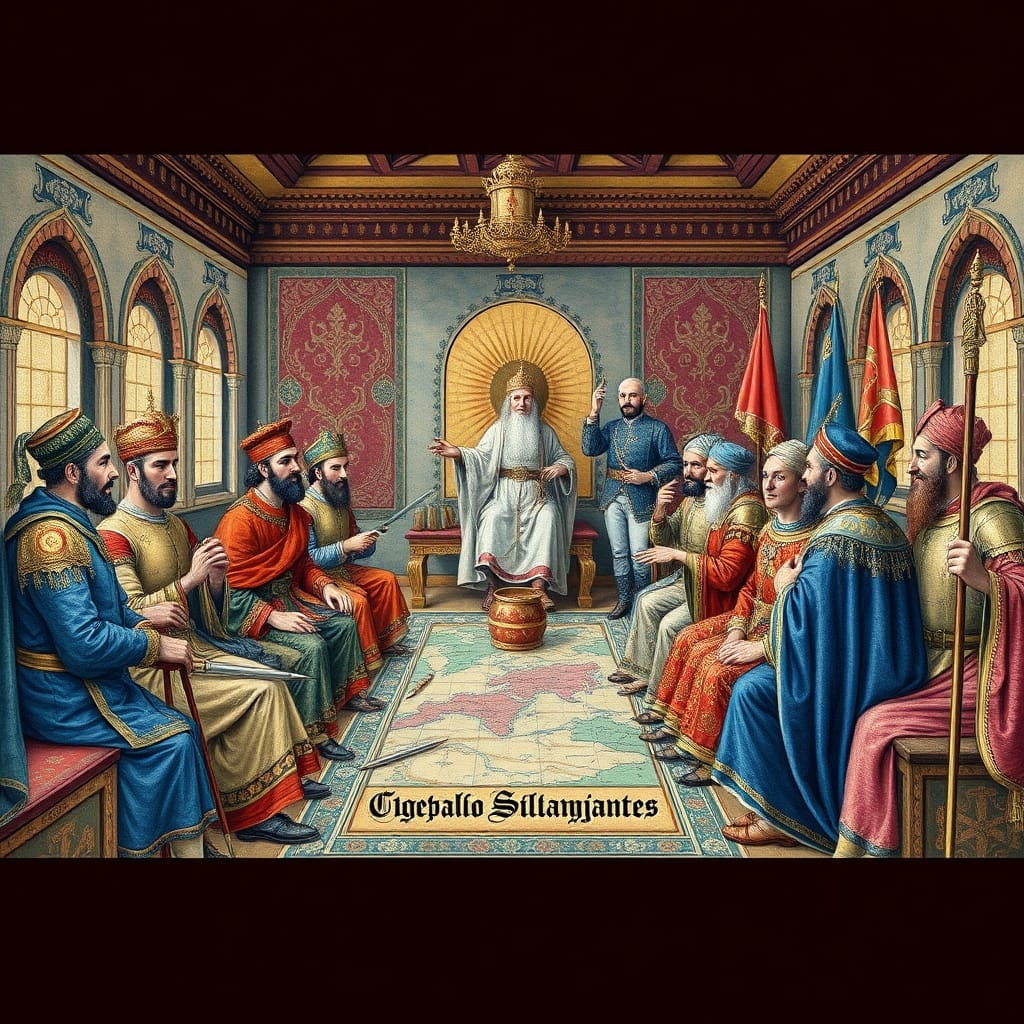
Suleiman I built a model of rulership that combined conquest with law, finance and bureaucracy. In his reign, the Imperial Council and state administration dealt with the problems of a much larger territory. Viziers, treasurers (defterdar) and chancellors (nişancı) played important roles in decision-making. For this reason, the change cannot be explained by the sultan’s personal will alone.
Military and Diplomatic Expansion
The first years of the reign passed with rapid military moves. Belgrade came under Ottoman rule in 1521, and Rhodes in 1522. The Battle of Mohács in 1526 radically changed the political structure of the Kingdom of Hungary. A long rivalry with the Habsburgs over Central Europe then began.
Developments in Hungary did not follow a straight line of annexation. In the politics centered on Buda, a multi-layered balance took shape among local dynasties, the Habsburgs and the Ottomans. Placing Buda under direct Ottoman administration in 1541 was an important turning point in this process. The Central European frontier thus gained a more permanent administrative structure.
Suleiman I advanced as far as Vienna in 1529, but the city could not be taken. Even so, the campaign demonstrated the reach of Ottoman power into the heart of Europe. In the 1530s, the struggle with the Habsburgs took on a diplomatic as well as a military character. Rapprochement with France was also an important instrument affecting the balance of power in Europe.
Suleiman I and the Balance of Power in the Mediterranean
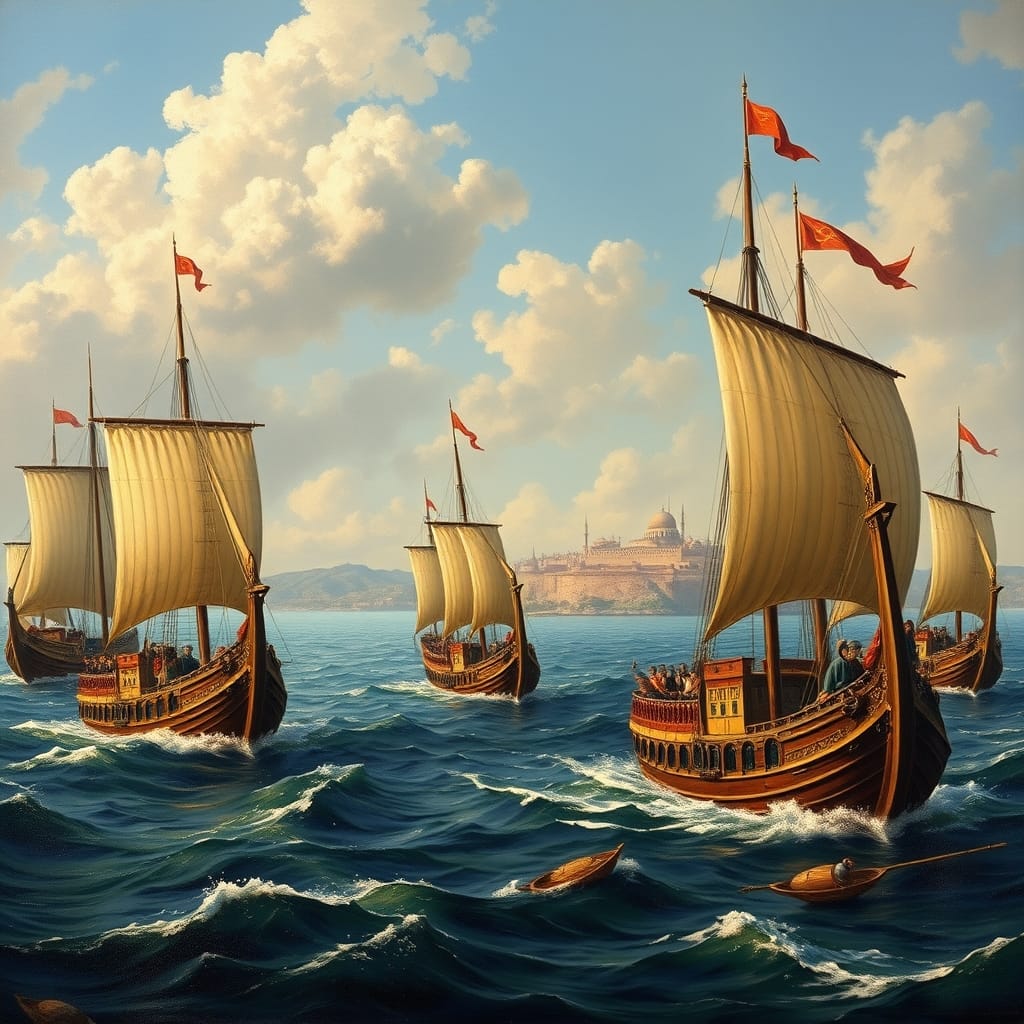
In the reign of Suleiman I, naval policy became as important as land campaigns. The appointment of Barbaros Hayreddin Pasha as grand admiral increased the effectiveness of the fleet. The naval Battle of Preveza in 1538 consolidated the weight of Ottoman sea power in the Mediterranean. The details can be explored in the article on why the Battle of Preveza mattered for the Ottomans.
In addition, the North African coasts and the Aegean islands became part of a broader naval strategy. The state evaluated ports and sea lanes together with military objectives. The Mediterranean thus became not only a battlefield but also an arena of trade and diplomacy. This strengthened Istanbul’s international role.
Central Administration and Law
The fact that Suleiman I is remembered as “Kanuni,” the Lawgiver, shows how the legal and regulatory activity of his reign lives on in memory. The sultan did not create a new legal system. Instead, he compiled and updated earlier customary regulations and strengthened uniformity in their application. Islamic law and the sultan’s laws were parts of a single administrative framework that worked together.
Law codes on taxation, land, crime and public order in particular helped standardize administration. Bureaucrats such as the chancellor Celâlzâde Mustafa Çelebi were influential in this process. The fatwas of the chief jurist Ebussuud Efendi also strengthened the harmony between law and state practice. This structure made it easier to bind provincial administration to the center.
These regulations created a common ground of practice for judges, district governors and other provincial officials. Law could also serve the central authority as a tool for limiting arbitrary practices in the provinces. Of course, practice was not exactly the same in every region. Local conditions, older traditions and the economic structure could shape the form that decisions took.
The growth of central administration also increased the need for manpower. The palace, the madrasas and the military organization offered different career paths. The workings of the devshirme system were among the decisive factors, especially in forming the standing troops and the governing cadres. However, not all of the bureaucracy was made up of people of devshirme origin.
Economy, Taxation and Trade
The expanding empire required greater revenue and a better logistical order. For this reason, survey registers (tahrir) played an important role in recording tax sources and the population. The timar system supported the provincial army while also regulating the distribution of agricultural revenues. The state depended heavily on this fiscal infrastructure to finance its campaigns.
Under Suleiman I, commercial ties between Istanbul, the Balkans, Anatolia, Syria and Egypt remained strong. Yet transformations in world trade were creating new pressures. Portuguese activity in the Indian Ocean affected policy in the Red Sea and the Persian Gulf. The Ottoman administration answered this rivalry with fleets, ports and regional alliances.
Egypt’s tax revenues and grain production were of special importance for the empire’s financial and provisioning system. The ports of Syria were among the gateways through which eastern trade reached the Mediterranean. The Balkans supported the central economy with grain, livestock and mining. Different regions were thus bound more tightly together within a single fiscal network.
On the other hand, the commercial privileges granted to France were part of the diplomatic and economic relations of the period. It would be misleading to equate them directly with the economic dependence of later centuries. The arrangements of the sixteenth century operated within a different balance of power. Caroline Finkel also evaluates the period within the mutual relations of European and Mediterranean politics.
Society, Palace and Dynasty
The change under Suleiman I was also visible in palace life. The position of Hürrem Sultan was one of the important developments that increased the political visibility of dynastic women. Palace marriages, imperial sons-in-law serving as viziers and the position of the princes reshaped networks of power. This process carried early signs of the palace politics that would become more pronounced in later centuries.
The execution of Prince Mustafa in 1553 is one of the most important events revealing the harsh side of the dynastic order. The later struggle between Bayezid and Selim also showed that the problem of succession persisted. A strong central state, therefore, did not eliminate rivalry within the dynasty. The education of princes and their experience as provincial governors are important for understanding this structure.
The waqf system of pious foundations played a major role in education, health, religious services and aid to the poor. Through the foundations they established, members of the state elite both produced public services and gained social prestige. These institutions supported the growth of cities. They also made many services that the central administration did not provide directly sustainable at the local level.
In the social order, cities, craft guilds, foundations and religious institutions shaped daily life. As Istanbul’s population and consumption needs grew, provisioning policy became more critical. The state attached great importance to the regular delivery of basic goods to the capital. This approach shows that the market was not left entirely free.
Architecture, Culture and the Imperial Image
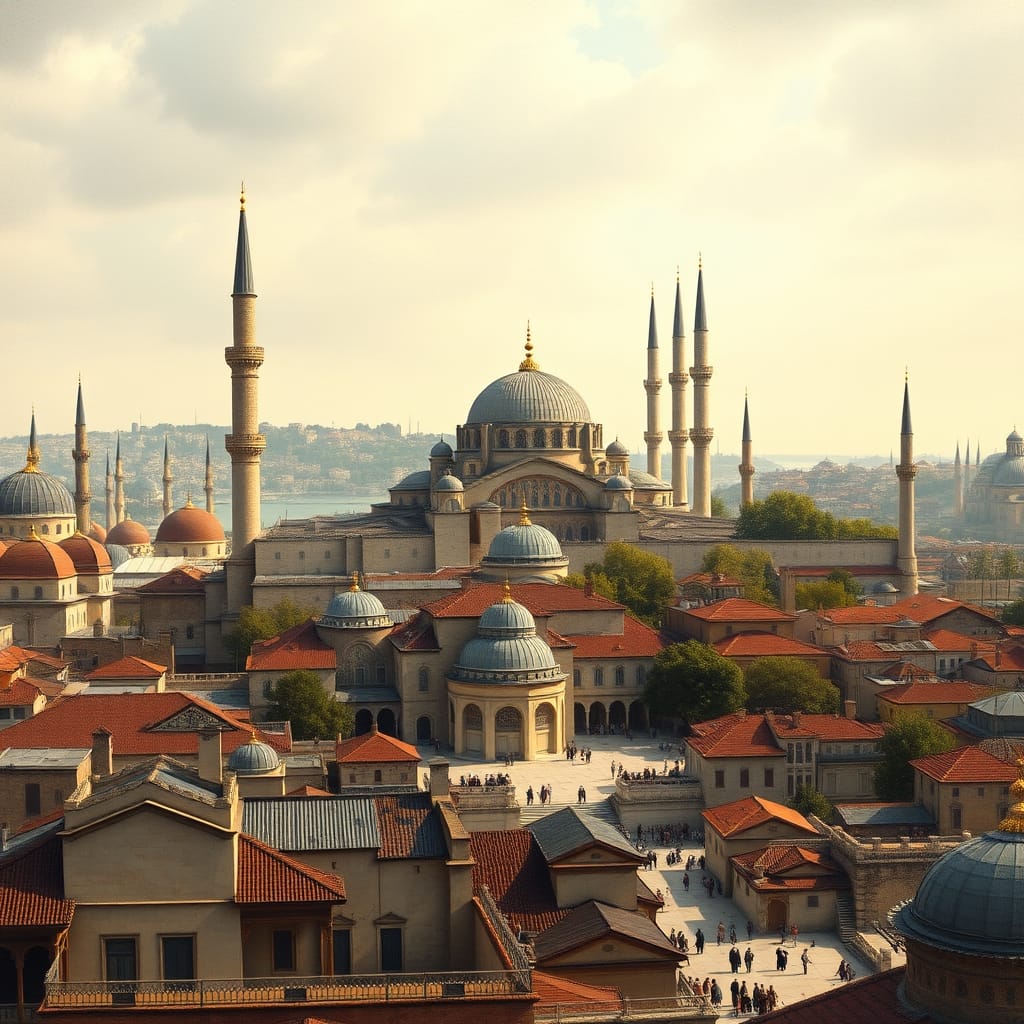
The reign of Suleiman I is one of the eras in which architecture’s power of political representation was most evident. During Mimar Sinan’s tenure as chief architect, mosques, complexes, bridges, waterways and public buildings were built. The Süleymaniye Complex is one of the strongest examples of this vision. It brought together worship, education, charity and urban planning in a single setting.
Mimar Sinan’s contributions to Ottoman architecture were not limited to aesthetic achievement. Large building programs made the resources, technical capacity and charitable ideals of the central power visible. Foundations also provided the financial support that kept these facilities running for a long time. Architecture thus forged a link between government and social service.
Monumental buildings such as the Süleymaniye reshaped the skyline of the capital. New neighborhoods, commercial areas and service networks developed around the complexes. Waterways and bridges were infrastructure investments that directly affected daily life. For this reason, the architectural program was not only symbolic but also a functional state investment.
Poetry and history writing were also important parts of court culture. The sultan wrote poems under the pen name “Muhibbî.” The Süleymannâme tradition recorded the campaigns and the image of the sovereign. Artistic production was therefore not merely a matter of taste but part of the dynasty’s language of legitimacy.
Long-Term Effects
Suleiman I’s forty-six-year reign allowed institutions to take root across a vast territory. Yet by the end of this long reign, the state began to face new problems. Campaign costs rose, frontiers lengthened and tensions over succession grew harsher. Evaluating the period only through a story of uninterrupted rise would therefore be incomplete.
Later Ottoman authors often used the legacy of this period as an ideal standard. Calls for a return to the “order of Kanuni” grew stronger especially during administrative crises. However, this memory sometimes simplified historical reality. The success of the sixteenth century was also the result of pragmatic responses to constantly changing conditions.
İsmail Hakkı Uzunçarşılı’s classic works examine the military and administrative organization in detail. The success of this organization was one of the main pillars of growth in the sixteenth century. However, the same institutions had to be adapted continually to changing conditions. The transformations of later centuries were also the result of this need.
In conclusion, the reign of Suleiman I was not simply an era in which the Ottoman Empire grew in territory. Law, bureaucracy, the navy, finance, palace politics and architectural representation all changed at the same time. This many-sided transformation made the empire one of the leading political powers of Europe, the Mediterranean and the Islamic world.
Sources
- Halil İnalcık, Devlet-i Aliyye: Osmanlı İmparatorluğu Üzerine Araştırmalar.
- İsmail Hakkı Uzunçarşılı, Osmanlı Tarihi.
- Caroline Finkel, Osman’s Dream: The Story of the Ottoman Empire 1300–1923.
- Turkish Historical Society publications.
- TDV Encyclopedia of Islam, entry “Süleyman I.”