The Tulip Era, which lasted from the Treaty of Passarowitz in 1718 to the Patrona Halil Rebellion of 1730, is an important period that, although often remembered for courtly entertainments, cautiously opened the first doors to Ottoman modernization through diplomacy, architecture, printing, and urban culture.
Contents
- What Was the Tulip Era?
- The Political Background of the Period
- The First Reforms in Ottoman Modernization
- Printing, Books, and Cultural Life
- Architecture, Urban Life, and Entertainment Culture
- The Patrona Halil Rebellion and the End of the Period
- Conclusion

What Was the Tulip Era?
The Tulip Era refers to the period in Ottoman history between 1718 and 1730, associated with the reign of Ahmed III and the grand vizierate of Nevşehirli Damat İbrahim Pasha. The name comes from the tulip’s transformation into an aesthetic symbol in courtly and elite circles during the period; however, its historical significance is not limited merely to a fascination with flowers or a culture of entertainment.
After the Treaty of Passarowitz, following long and exhausting wars, the Ottoman administration began searching for a new balance in relation to the West. As emphasized in Halil İnalcık’s approach to processes of Ottoman change, the state often turned to reconsidering its institutions during periods of crisis. In this respect, the period was a phase of adaptation and observation that followed military defeats.
During these years, the sultan, the grand vizier, and court circles commissioned new pavilions, gardens, water structures, and entertainment venues in Istanbul. At the same time, however, envoys were sent to European capitals, a printing press was established, translation activities increased, and urban culture became more visible. In other words, the Tulip Era was a transitional phase in which the Ottomans began to understand the outside world not only on the battlefield but also in the realms of diplomacy and culture.
During which sultan’s reign did the Tulip Era take place?
The period coincided with the reign of Sultan Ahmed III. Ahmed III ascended the throne after the Edirne Incident of 1703 and was deposed during the Patrona Halil Rebellion in 1730. For this reason, the Tulip Era is regarded as both the most brilliant and the most controversial part of his reign. The most influential statesman of the period was Nevşehirli Damat İbrahim Pasha.
Why is the Tulip Era known by this name?
In 18th-century Istanbul, the tulip became a symbol of elegance, wealth, and refined taste. Rare varieties of tulips were cultivated in palace gardens, while the tulip motif became prominent in poetry, miniature painting, tiles, and textile patterns. However, this name was not the official designation of the period itself, but rather a concept later used by historians and cultural historians.
The Political Background of the Period
To understand the Tulip Era, one must first look at the Ottoman world at the end of the 17th century and the beginning of the 18th. The Treaty of Karlowitz in 1699 had created a major rupture in the Ottoman Empire’s line of expansion in Europe. The Treaty of Passarowitz in 1718, following losses on the Austrian and Venetian fronts, strengthened the need for a peaceful foreign policy.
As seen in İsmail Hakkı Uzunçarşılı’s studies on Ottoman political history, this was not a period in which the state entirely abandoned its classical policy of conquest; however, the central administration, at least temporarily, turned from war toward diplomacy, fiscal recovery, and the search for internal order. This choice prepared the intellectual groundwork for later Ottoman reforms.
The Ottoman administration began to follow military and technical developments in Europe more closely. The sending of envoys to centers such as Paris, Vienna, and Moscow was important in this regard. In particular, the embassy of Yirmisekiz Çelebi Mehmed Efendi to France enabled Ottoman elites to acquire more concrete information about European urban planning, court life, printing, scientific institutions, and diplomatic protocol.
This diplomatic opening should be evaluated within the broader Ottoman tradition of governance. For readers seeking background on the state’s decision-making mechanisms and central bureaucracy, the topic of the basic institutions of Ottoman state administration complements this context.
The Tulip Era and the First Reforms in Ottoman Modernization
The Tulip Era is often described as the beginning of Westernization, but this expression must be used carefully. The reforms carried out during the period were not broad institutional transformations like the Tanzimat or the reforms of Mahmud II. Rather, they were characterized by observation, selective adaptation, and cultural contact.
One of the most important innovations was in the field of diplomacy. By sending temporary envoys to European capitals, the Ottoman Empire aimed not only to gather political information but also to learn about technical, cultural, and administrative developments in Europe. The Paris Embassy Report of Yirmisekiz Çelebi Mehmed Efendi is one of the best-known texts reflecting this curiosity.
In this embassy report, the palaces, gardens, theaters, observatories, and printing houses of Paris are carefully described. The envoy’s observations show that Ottoman elites had begun to see Europe not only as a military rival but also as a sphere of civilization worthy of study. As Caroline Finkel also emphasizes in Osman’s Dream, 18th-century Ottoman history was too dynamic and multifaceted to be explained solely through the concept of decline.
Why is the Tulip Era important for modernization?
The Tulip Era was like an early laboratory of Ottoman modernization. Rather than directly imitating developments in Europe, the state tried to select elements that could be adapted to its own political and social structure. The printing press, translation committees, embassy reports, changes in architectural taste, and urban arrangements were signs of this selective adaptation.
Was the Tulip Era Westernization?
Defining the period simply as “Westernization” would be incomplete. Most innovations remained limited to the court and upper administrative circles; a deep transformation spreading across all segments of society had not yet taken place. Nevertheless, the fact that Ottoman elites began to observe Europe systematically created an intellectual threshold for later reform periods. To understand the later stages of this trajectory, the content on the Tanzimat and Islahat Edicts is also complementary.

Printing, Books, and Cultural Life
The most enduring innovation of the period was the establishment of the first Turkish printing press operated by Muslims in the Ottoman Empire through the efforts of İbrahim Müteferrika and Said Efendi. The press, authorized in 1727, did not print religious works; instead, it published books mainly in the fields of history, geography, language, and science. This limitation was the result of a cautious compromise that took the sensitivities of the ulema into account.
The establishment of the printing press did not immediately create a major revolution in the Ottoman world of knowledge, because book production was still expensive, literacy was limited, and the manuscript tradition remained strong. Nevertheless, the printing press was an important turning point in the reproduction and dissemination of knowledge. Information on İbrahim Müteferrika in the TDV Encyclopedia of Islam shows that he was not only a printer but also a multifaceted intellectual interested in geography, politics, and questions of military organization.
Translation activities also increased during this process. Translations from Eastern and Western sources broadened the worldview of Ottoman intellectual circles. The growing interest in history, geography, and technical knowledge reveals that the modernization process was not limited to military reforms alone.
The printing press was one of the quietest yet most lasting innovations of the Tulip Era; while entertainment and court life were temporary, the door opened by printed knowledge pointed to a long-term change in mentality.
For the broader structure of Ottoman educational and knowledge institutions, looking at the Ottoman education system helps explain why the printing press was a slow but important innovation.
Architecture, Urban Life, and Entertainment Culture
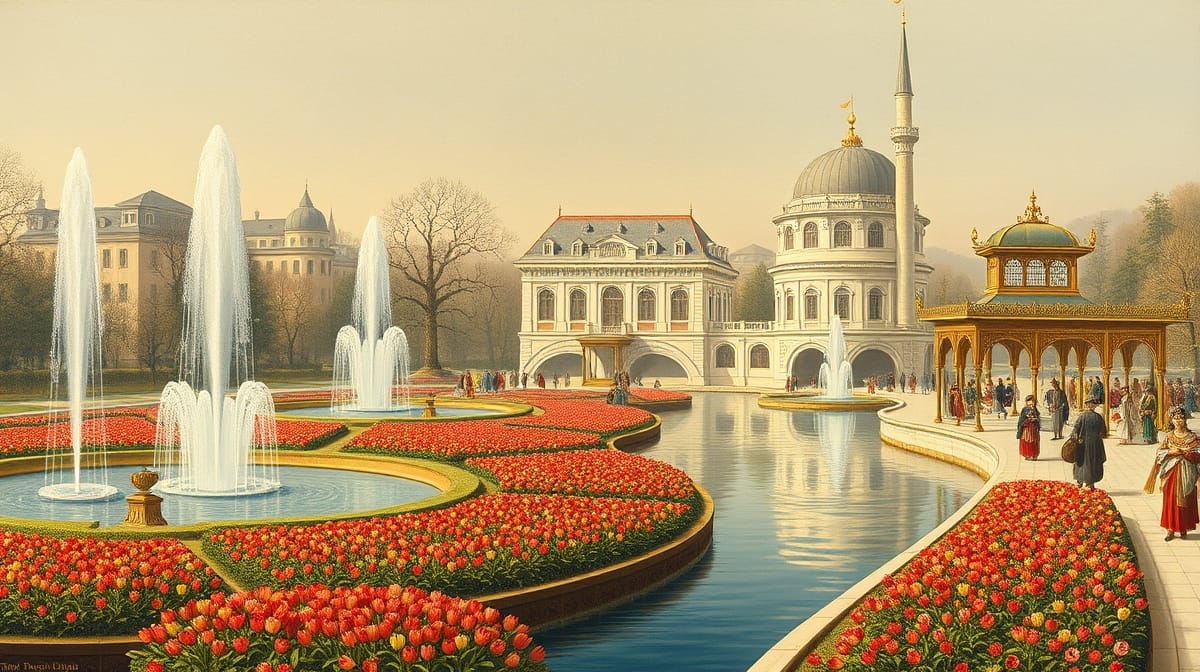
The most distinctive image that comes to mind when the Tulip Era is mentioned is that of pavilions, gardens, summer palaces, fountains, and nocturnal entertainments in Istanbul. The Sadabad Pavilion and the area around Kâğıthane became one of the centers of the period’s urban aesthetic. The entertainments held there gave court circles a new kind of social visibility.
Architecturally, the period did not completely break away from the classical Ottoman style; however, it produced a more elegant, decorative taste that was open to external influences. Fountains, square arrangements, garden architecture, and water structures were among the most visible examples of this taste. The Fountain of Ahmed III is one of the symbolic structures reflecting the artistic and architectural sensibility of the period.
This aesthetic transformation has a special place within the general characteristics of Ottoman art and architecture. This is because the 18th century also represents the beginning of a transitional process in which the classical architectural language began to open toward Baroque and Rococo influences.
Was the Tulip Era a period of entertainment?
Yes, during these years, entertainment culture became strikingly visible in courtly and elite circles; however, explaining the period solely through pleasure and extravagance would be one-sided. Festivals, tulip gardens, poetry gatherings, and musical assemblies were part of the period, but so too were diplomacy, printing, and architectural innovations. Therefore, the Tulip Era should be evaluated both as a culture of consumption and display and as a search for early modernization.
As Suraiya Faroqhi’s studies on Ottoman society and urban history show, Ottoman cities were not merely centers of administration but also spaces of consumption, craft production, culture, and social encounter. From this perspective, the garden and excursion culture of Istanbul is an important source for understanding the social life of the period.
The Patrona Halil Rebellion and the End of the Period
The Patrona Halil Rebellion, which broke out in 1730, brought the period to an end. Behind the rebellion lay not only a reaction to entertainment culture, but also economic hardships, new taxes, discontent among artisans and janissaries, expectations of war, and the conspicuous luxury surrounding the court. For this reason, explaining the rebellion with a single cause is historically inadequate.
As a result of the rebellion, Nevşehirli Damat İbrahim Pasha was killed, Ahmed III was deposed, and Mahmud I became sultan. Some structures at Sadabad were destroyed, and the symbols of entertainment and luxury associated with the period were targeted. Yet certain innovations, such as the printing press, did not disappear completely. This shows that although the period came to an end, some of the doors it opened did not close.
For a broader evaluation of the role of janissary and urban elements in rebellions, content on the place of the Janissaries in Ottoman society and the causes of Ottoman rebellions provides useful background.
Misconceptions About the Tulip Era
The most common misconception about this period is the idea that all statesmen were detached from reality and concerned only with entertainment. Certainly, there was luxury consumption, ostentatious entertainment, and practices that made social inequality more visible in court circles. Yet during the same years, diplomatic reports were being prepared, a printing press was being established, translations were being made, and European institutions were being studied.
Another misconception is the idea that the period suddenly modernized the Ottoman Empire. In reality, the Tulip Era was not a radical reform program, but rather an early period of awareness and experimentation. The institutional results of modernization would become more apparent later, especially during the reigns of Selim III and Mahmud II and in the Tanzimat period.
For this reason, historians should regard the period neither entirely as “the entertainment stage of decline” nor as “the direct beginning of modern Turkey.” A more accurate approach is to evaluate it as a complex and cautious Ottoman response to the shifting balance of power in the 18th-century world.
Conclusion
Although the Tulip Era stands out in Ottoman history for entertainment, aesthetics, and court life, its real importance lies in printing, diplomacy, translation activities, architectural innovations, and the effort to observe Europe. This period was a critical threshold at which the Ottoman Empire began to understand a changing world, carrying the still limited but meaningful first signs of modernization.
Sources
- Halil İnalcık, Devlet-i Aliyye.
- İsmail Hakkı Uzunçarşılı, Osmanlı Tarihi.
- Caroline Finkel, Osman’s Dream.
- Suraiya Faroqhi, Osmanlı Kültürü ve Gündelik Yaşam.
- TDV Encyclopedia of Islam, entries on Lâle Devri and İbrahim Müteferrika.