The conquest of Cyprus was a major strategic turning point that enabled the Ottoman Empire to secure trade routes in the Eastern Mediterranean, break Venetian influence, and establish a stronger naval policy along the Egypt-Syria-Anatolia line.

Quick Summary
- Cyprus was the key island of Eastern Mediterranean trade routes.
- The Ottomans wanted to restrict Venetian piracy and bases.
- The campaign began in 1570, and Nicosia was taken quickly.
- The resistance of Famagusta ended with an Ottoman victory in 1571.
- The conquest shifted the Mediterranean balance in favor of the Ottomans.
Contents
- The Mediterranean Balance before the Conquest of Cyprus
- The Main Reasons for the Campaign
- Brief Chronology: How Did the Cyprus Campaign Progress?
- How Did the Conquest of Cyprus Change Ottoman Strategy?
- Ottoman Naval Policy and the Shadow of Lepanto
- Conclusion
The Mediterranean Balance before the Conquest of Cyprus
The sixteenth century was the period when the Ottoman Empire became a great power in the Mediterranean. Naval policy expanded especially during the reign of Suleiman the Magnificent. The Ottomans under Suleiman the Magnificent supported their land power in the Mediterranean with naval strength. For this reason, Cyprus was not merely an island but a matter of imperial security.
From the era of Barbarossa Hayreddin Pasha onward, the Ottoman fleet gained influence in the Western Mediterranean. The historic importance of the Battle of Preveza for the Ottomans became the symbol of this supremacy. Yet Venice’s presence in Cyprus continued in the Eastern Mediterranean. For the Ottomans, this meant an incomplete security ring.
According to Halil İnalcık, Ottoman expansion cannot be explained solely by a desire for conquest. The state considered trade routes, tax revenues, and strategic passages together. Cyprus stood at the very center of this logic. The island lay close to the Anatolian coasts, Syrian ports, and the maritime route to Egypt.
Why was the conquest of Cyprus seen as strategic?
Although Cyprus was under Venetian rule, it lay in the middle of Ottoman geography. The island closely affected the Antalya, Alanya, Silifke, and İskenderun line. It also occupied a critical position for maritime transport from Egypt to Istanbul. For this reason, the Ottoman administration could not leave the island outside its control.
On the other hand, Venetian ships and pirate groups were harassing Ottoman merchants. Ottoman sources state that Cyprus had become a refuge for pirate activities. This claim played an important role in legitimizing the campaign. Thus, the conquest of Cyprus was also defended on security grounds.
The Main Reasons for the Campaign
There were several fundamental reasons behind the Cyprus campaign. First, the island was located at the crossroads of Eastern Mediterranean trade. After the conquest of Egypt, the Ottomans began to attach greater importance to this route. This was because Egyptian revenues and the Red Sea connection were valuable for the imperial treasury.
The second reason was Venice’s political presence in the region. The Republic of Venice traded with the Ottomans but remained a rival at the same time. This dual relationship frequently produced tension. For this reason, Istanbul wanted to remove Cyprus from Venetian pressure.
The third reason was connected to the political aims of Selim II’s reign. Statesmen such as Sokollu Mehmed Pasha carefully debated the consequences of the campaign. However, there was a strong tendency in court circles in favor of taking Cyprus. İsmail Hakkı Uzunçarşılı emphasizes the influence of political and naval circles in the decision-making process.
The Cyprus campaign shows that the Ottomans regarded the Mediterranean not only as a battlefield but also as a geography of trade and security.
The conquest of Cyprus and Ottoman trade routes
The conquest of Cyprus especially affected maritime traffic between Egypt, Syria, and Anatolia. Once the island came under Ottoman control, the security chain in the Eastern Mediterranean grew stronger. Risks along pilgrimage and trade routes also decreased. This situation made the Ottoman central administration’s view of the seas even clearer.
In addition, the island possessed fertile agricultural lands and ports. Its production of sugar, cotton, and grain had economic value. After the conquest, the Ottoman administration incorporated the island into the classical provincial system. Thus, Cyprus became not only a military base but also a fiscal resource.

Brief Chronology: How Did the Cyprus Campaign Progress?
The Ottoman campaign began in 1570. Lala Mustafa Pasha took command of the land operation. Piyale Pasha supported the campaign with naval power. This dual structure showed that the Ottomans used land and sea power together.
The first major target was Nicosia. After completing preparations for the siege, the Ottoman army placed the city under intense pressure. Nicosia came under Ottoman control on September 9, 1570. This victory greatly weakened resistance in the island’s interior.
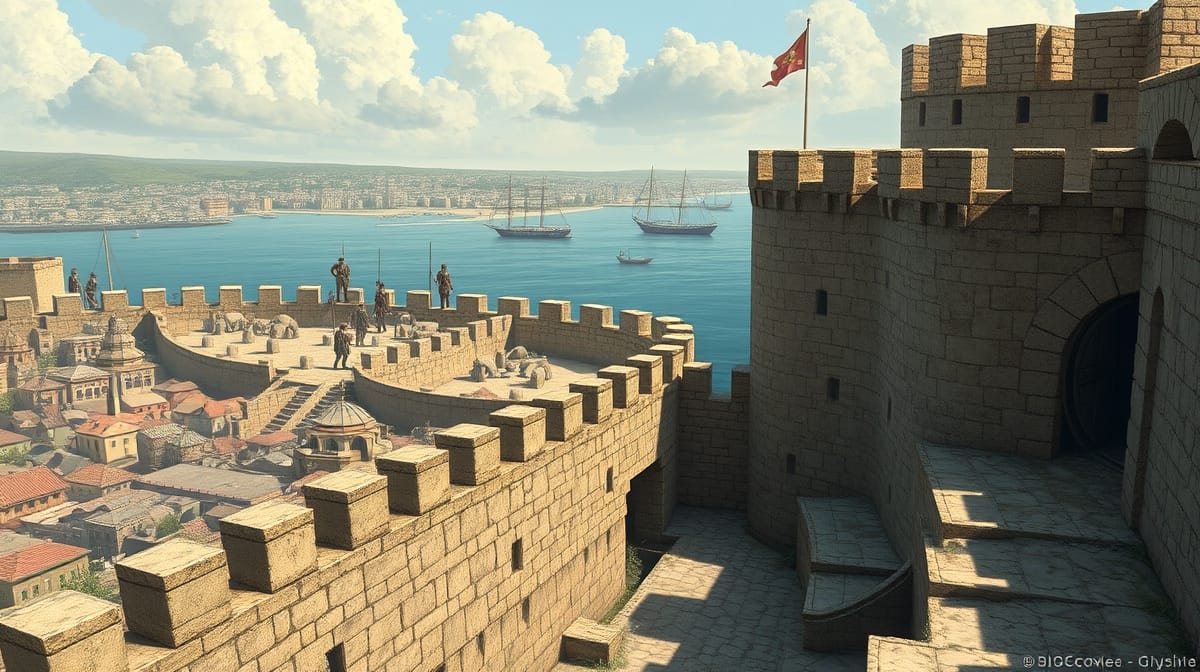
Famagusta, however, resisted for much longer. The Venetian commander Marcantonio Bragadin defended the fortress for months. The siege lasted until the summer of 1571. In the end, Famagusta surrendered, and the conquest of Cyprus was completed.
The difference between the sieges of Nicosia and Famagusta
Nicosia was one of the island’s administrative centers, and its rapid fall had a major impact. By contrast, Famagusta was more resilient because of its strong walls and harbor position. The Ottoman army pursued a patient siege strategy there. This process shows that conquests were not won by pitched battles alone.
Famagusta in particular proved how difficult fortress warfare in the Mediterranean could be. The long siege imposed serious costs on the Ottoman army. Yet the result was decisive in terms of the strategic objective. Once the entire island was taken, Venice lost its most important base in the Eastern Mediterranean.
How Did the Conquest of Cyprus Change Ottoman Strategy?
The conquest of Cyprus increased the Ottomans’ defensive depth in the Eastern Mediterranean. A safer line now emerged between the coasts of Anatolia, Syria, and Egypt. This situation produced not only military but also administrative consequences. The island was incorporated into the Ottoman provincial system, and a new order was established.
This development turned the balance of power in the Mediterranean against Venice. After losing a major base such as Cyprus, Venice’s room for maneuver in the east narrowed. The Ottomans, meanwhile, integrated the Rhodes, Egypt, Syria, and Cyprus line. Thus, a more coherent network of control emerged in the eastern Mediterranean.
Cyprus also became an important stop for Ottoman naval logistics. Its ports were used for supplying ships and transporting troops. When necessary, the island served as a forward base supporting the coasts of Syria and Egypt. For this reason, the conquest made imperial defense more flexible.
A new Ottoman line in Mediterranean dominance
The conquest of Cyprus strengthened Ottoman dominance in the Mediterranean with an eastern focus. The Ottomans now controlled not only the coasts but also maritime passages. This was one of the important signs of the transition from a land empire to a maritime empire. Caroline Finkel emphasizes that Ottoman power operated on multiple fronts during this period.
This new line was also meaningful for the security of Egypt. Egypt carried both economic value and religious prestige for the Ottomans. The routes to the Hijaz and the Red Sea connection were tied to this region. For this reason, Cyprus was regarded as a kind of northern gate to Egypt.
Ottoman Naval Policy and the Shadow of Lepanto
The conquest of Cyprus provoked a major reaction in Europe. Under the leadership of Pope Pius V, the Holy League was formed. Venice and Spain played important roles in this alliance. As a result, the Ottoman fleet suffered a severe defeat at the Battle of Lepanto in 1571.
Yet this defeat did not lead to the loss of Cyprus. The Ottoman Empire built a new fleet within a short time. Sokollu Mehmed Pasha’s famous approach reflected this will to recover. The state did not completely abandon its presence in the Mediterranean.
On the other hand, Lepanto showed that Ottoman naval power was not unlimited. The battle had a major morale effect on European public opinion. Even so, the strategic outcome was different. Cyprus remained Ottoman, and Venice accepted this situation in 1573.
Did the defeat at Lepanto change the result of the conquest of Cyprus?
The defeat at Lepanto was a serious blow militarily. Yet when the diplomatic and strategic consequences are considered, the picture is more balanced. The Ottomans renewed their fleet and preserved their dominance over Cyprus. For this reason, the conquest of Cyprus ultimately became a lasting gain.
This situation also demonstrates the resilience of Ottoman war strategy. Even when defeat occurred on one front, the state was able to preserve its main objective. In this respect, Cyprus explains the difference between conquest and naval battle. The island was taken, the battle was lost, but the strategic outcome remained in the Ottomans’ favor.
Administrative and Social Order after the Conquest
After taking the island, the Ottomans established a new administrative order there. Cyprus was linked to the imperial system with the status of a beylerbeylik. The timar system, tax registers, and settlement policies were put into effect. These practices were part of the classical Ottoman understanding of administration.
The Ottoman administration encouraged the settlement of a Muslim Turkish population on the island. Some families from Anatolia were sent to Cyprus. Over time, this process changed the island’s social structure. However, the local Christian population also continued to exist in economic life.
Suraiya Faroqhi’s studies on Ottoman social structure show that imperial administration accommodated local orders. A similar practice was seen in Cyprus. While establishing tax and security arrangements, the Ottomans tried not to completely disrupt local production. In this way, the island became a manageable province in the long term.
The Place of Cyprus in Ottoman Mediterranean Policy
Cyprus became a cornerstone of Ottoman Mediterranean policy. Together with Rhodes and Egypt, the island completed the eastern line. This situation gave the Ottoman fleet room for maneuver. It also created a diplomatic advantage against Venice and other European powers.
In addition, the conquest of Cyprus strengthened the Ottoman logic of permanent bases at sea. The state was no longer merely a power that organized campaigns. It was also an empire that managed ports, fortresses, and maritime routes. This distinction is important for understanding sixteenth-century Ottoman power.
In domestic politics, the conquest gave the reign of Selim II a major military success. The history of Ottoman sultans filled with wars and conquests gives Cyprus a special place. This was because the campaign was one of the major conquests in which the sultan was not personally present at the front. Even so, the result demonstrated the determination of the central administration.
Conclusion
The conquest of Cyprus enabled the Ottoman Empire to reestablish the balance of security, trade, and diplomacy in the Eastern Mediterranean. The island limited Venetian influence and strengthened the Egypt-Syria-Anatolia line. Despite the defeat at Lepanto, the conquest proved permanent. As a result, the conquest of Cyprus was a historic turning point that changed the direction of Ottoman dominance in the Mediterranean.
Sources
- Halil İnalcık, The Ottoman Empire: The Classical Age.
- İsmail Hakkı Uzunçarşılı, Ottoman History.
- Caroline Finkel, Osman’s Dream.
- Suraiya Faroqhi, The Ottoman Empire and the World Around It.
- TDV Encyclopedia of Islam, Cyprus entry.