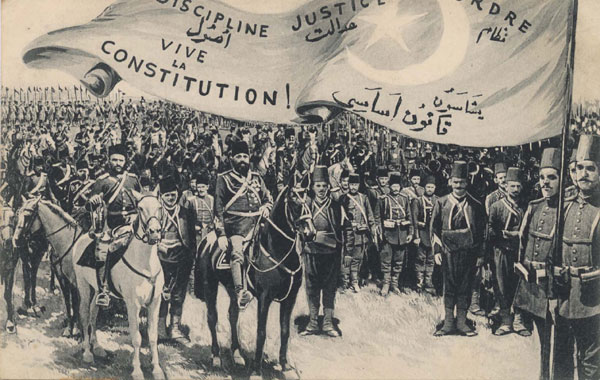
The democratization movements in the Ottoman Empire form a process that runs from the Deed of Alliance (Sened-i İttifak) of 1808 to the Second Constitutional Era proclaimed in 1908. In this process, attempts were made to limit the sultan’s powers through written documents, equality before the law was proclaimed and an elected parliament was established. These democratization movements, however, were frequently interrupted by wars and one-party rule.
Quick Summary
- 1808 Deed of Alliance: an unprecedented document signed between the central bureaucracy and the provincial notables (ayan).
- 1839 Tanzimat and 1856 Reform edicts: equality before the law and new rights for non-Muslims.
- 1876 Kanun-i Esasi: the first constitution and the first parliament elected by the people.
- 1908 Second Constitutional Era: the constitution came back into force, and parties competed in elections.
- 1909 amendments: the government became accountable to parliament.
- After the 1913 Raid on the Sublime Porte, the Committee of Union and Progress established one-party rule.
Contents
- First steps: the Deed of Alliance, the Tanzimat and the Reform Edict
- The First Constitutional Era: the first constitution and parliament
- The Second Constitutional Era and the birth of parties
- The 1909 amendments: a stronger parliament
- Elections and opposition
- Interruptions: the 31 March Incident and the Raid on the Sublime Porte
- Frequently asked questions
Democratization Movements in the Ottoman Empire: First Steps
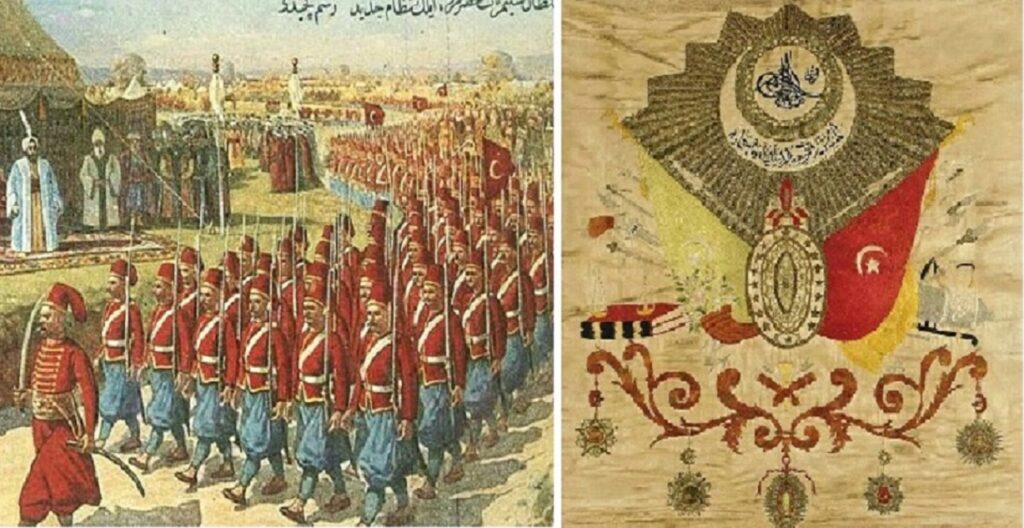
The first link in the chain is the Deed of Alliance, signed on 7 October 1808. According to the TDV Encyclopedia of Islam, Grand Vizier Alemdar Mustafa Pasha invited the powerful provincial notables to Istanbul to restore order in the country. At the end of the negotiations, an unprecedented text was signed between the central bureaucrats and notables such as Çapanoğlu Süleyman Bey and Karaosmanoğlu Ömer Ağa. Although Mahmud II found the document onerous, he approved it with an imperial rescript (hatt-ı hümayun).
The encyclopedia also notes that the document’s terms were never implemented. Some researchers compare the Deed of Alliance to the Magna Carta, signed in England in 1215 between the king and the nobles. The outcomes of the two documents, however, were very different. Even so, the fact that another power obtained written rights in the face of the sultan was a significant break under the conditions of the time and an early step in the democratization movements.
Then came the era of edicts. The Gülhane Rescript, proclaimed on 3 November 1839, declared that all subjects were equal before the law and that the security of life, property and honor was guaranteed by the state. The Reform Edict of 1856, issued under pressure from the Western states, aimed to remove the differences between Muslims and non-Muslims. According to the encyclopedia, there is a general view that the Tanzimat era ended in 1878, when parliament was closed. We discussed the details of these documents in our article on the change of regime.
The First Constitutional Era: The First Constitution and the First Parliament
The real turning point in the democratization movements came with the proclamation of the Kanun-i Esasi on 23 December 1876. The constitution provided for a bicameral parliament called the General Assembly (Meclis-i Umumi). The members of the Senate (Meclis-i Ayan) were appointed by the sultan, while the members of the Chamber of Deputies (Meclis-i Mebusan) were elected by the people. Under the constitution, neither chamber could meet while the other was closed.
According to the TDV Encyclopedia of Islam entry on the Chamber of Deputies, one deputy was to be elected for every 50,000 male inhabitants. Deputies had to be Ottoman subjects who were at least thirty years old and knew Turkish. Votes were to be cast secretly, and elections were to be held every four years. Each deputy was to represent not only his own region but all Ottomans.
The first parliament opened on 19 March 1877 and worked for two sessions: 19 March–28 June 1877 and 13 December 1877–February 1878. During the Russian war, parliament sharply criticized the government. On 13 February 1878 Abdülhamid II suspended parliament indefinitely. This opened an interval that would last about thirty years. We described the pioneers of constitutionalism in our article Who were the Young Ottomans?.
The Second Constitutional Era and the Birth of Parties
The democratization movements gained new momentum when the constitutional regime was proclaimed again on 23 July 1908 and the constitution came back into force. There was, however, no election law. According to the encyclopedia, an election bill that had been drafted in the First Constitutional Era but never enacted was put into force provisionally. With minor changes, this text was used in the elections of 1908, 1912, 1914 and 1919.
Under this system, each sancak was an electoral district and each nahiye an electoral branch. Sancaks with a male population between 25,000 and 75,000 elected one deputy each. Elections were held in two stages: primary voters chose secondary electors, who in turn elected the deputies. The voting age was twenty-five, and the minimum age for candidates was thirty. To prevent anyone from voting twice, the note “seen” was entered on voters’ identity papers.
The elections of 1908 were the first in which parties competed. The opposition gathered in the Liberal Party (Ahrar Fırkası), founded on 14 September 1908 around Prince Sabahaddin. The Committee of Union and Progress won the elections by a crushing majority, and the Chamber of Deputies was opened with a splendid ceremony on 17 December 1908. The opening speech was read on the sultan’s behalf by the palace chief secretary Ali Cevad Bey, after which Abdülhamid II also spoke a few sentences. We compared the origins of the Unionists in our article on the Young Ottomans and the Young Turks.
The 1909 Amendments: A Stronger Parliament
In 1909 sweeping amendments were made to the Kanun-i Esasi. According to the TDV Encyclopedia of Islam entry on the constitutional regime (Meşrutiyet), these amendments shifted the balance between the legislature and the executive in favor of parliament. A system resembling the constitutional monarchies of Europe was thus adopted. With the amended Article 53, deputies and senators also gained the right to propose laws.
According to the encyclopedia, the members of the government were now individually responsible to parliament for their own areas. Alongside the signatures of the members of the government, the sultan’s signature became a constitutional requirement for laws to enter into force. The sultan’s dissolution of parliament was also made more difficult, requiring the approval of the Senate. On 28 May 1914, however, the Unionists removed this power of the Senate, making it easier again to dissolve parliament.
Elections and Opposition
Opposition to the Committee of Union and Progress grew stronger over time. It gathered around the Freedom and Accord Party (Hürriyet ve İtilaf Fırkası), founded in 1911. To strengthen their position, the Unionists dissolved parliament on 18 January 1912 and called early elections. According to the encyclopedia, this election, in which the resources of power were used, was called the “election of the clubs” (sopalı seçim) by the opposition.
After the Armistice of Mudros, Sultan Vahdeddin dissolved parliament on 21 December 1918. The government of Ali Rıza Pasha, which was on good terms with the national movement in Anatolia, decided to hold elections after it was formed on 2 October 1919. This decision paved the way for parliament to meet one last time.
The last elections were held at the end of 1919, in the shadow of occupied Istanbul. The Greeks and Armenians did not take part in these elections. The new parliament adopted the National Pact (Misak-ı Milli), but after the occupation of Istanbul on 16 March 1920 the British raided parliament. Some deputies were arrested and exiled to Malta.
Interruptions: The 31 March Incident and the Raid on the Sublime Porte
During the Second Constitutional Era, the democratization movements and the institutions they had created suffered heavy blows. According to the TDV Encyclopedia of Islam, the 31 March Incident of 13 April 1909 began as a reaction against the domineering attitude of the Committee of Union and Progress. The vanguard of the Action Army (Hareket Ordusu) from Salonica reached Yeşilköy by train on 19 April, and the revolt was quickly suppressed. Holding the sultan responsible for the events as well, parliament deposed Abdülhamid II on 27 April 1909 and put Mehmed Reşad on the throne in his place.
Four years later came a second blow. Amid the collapse caused by the Balkan War, the leaders of the Committee of Union and Progress raided the Sublime Porte on 23 January 1913 and forced the government to resign. According to the encyclopedia, after the assassination of Mahmud Şevket Pasha on 11 June 1913, the Committee of Union and Progress cowed the opposition. In this way it established a one-party rule that would last until the Armistice of Mudros.
Despite these interruptions, the experience of parliament, elections and constitution gained through the democratization movements was not wasted. A large part of the founding cadres of the Republic grew up within the political life of this period. We discussed the party experiments of the Republic’s early years in our article on the attempts to move to multiparty politics.
Frequently Asked Questions
What were the democratization movements in the Ottoman Empire?
The main ones were the 1808 Deed of Alliance, the 1839 Tanzimat Edict, the 1856 Reform Edict, the First Constitutional Era of 1876 and the Second Constitutional Era of 1908. The constitutional amendments of 1909 were also an important stage in this process.
Which was the first Ottoman constitution?
The first constitution was the Kanun-i Esasi, proclaimed on 23 December 1876. With it, the first elected parliament was established.
Could women vote in the Ottoman Empire?
No. Electoral arrangements were based on the male population. In Turkey, women won the right to vote in municipal elections in 1930 and in parliamentary elections in 1934.
Why were the democratization movements in the Ottoman Empire interrupted?
Wars, the suspension of parliament in 1878, the 31 March Incident of 1909 and the Raid on the Sublime Porte in 1913 interrupted the process. The one-party rule established after 1913 and the occupation of 1920 also halted the working of parliament.
Conclusion
Over the course of a century, the democratization movements in the Ottoman Empire moved from the sultan’s absolute authority toward a constitutional order. The path that began with the Deed of Alliance and the edicts reached the experience of parliament and elections with the constitutional regimes of 1876 and 1908. Although wars and one-party rule interrupted the process, this experience left an important legacy to the Republican era.








2 thoughts on “Democratization Movements in the Ottoman Empire”