The transition to multi-party life failed in Turkey in its first two attempts. The Progressive Republican Party, founded in 1924, was closed down in 1925 after the Sheikh Said rebellion. The Free Republican Party, founded in 1930, survived for only three months. A lasting transition came only after the Second World War, with the founding of the Democrat Party in 1946.
Quick Summary
- The first opposition party, the Progressive Republican Party, was founded in 1924 and closed on 3 June 1925.
- The Law on the Maintenance of Order, passed after the Sheikh Said rebellion, narrowed the space for opposition.
- The Free Republican Party was founded on 12 August 1930 and dissolved itself three months later.
- The Democrat Party was founded on 7 January 1946 and won the 1950 elections.
- The transition to multi-party life became permanent in the new international climate after the Second World War.
Contents
- Why did the attempts fail?
- The Progressive Republican Party
- The Sheikh Said rebellion and the Takrir-i Sükun law
- The Free Republican Party
- The experience inherited from the Ottomans
- Features of the single-party years
- The lasting transition in 1946
- The Democrat Party’s victory in 1950
- Frequently asked questions
Why Did the Transition to Multi-Party Life Fail?
There is no single reason why the attempts at a transition to multi-party life failed. The Republic had only just been founded, and the reforms had not yet taken root in society. There was concern that groups opposed to the regime would gather around the opposition parties. The rebellion in the east and the economic crisis also led the government to put security first. The main reasons are as follows:
- The newness of the Republic and of the reforms.
- The opposition being seen as standing in the same camp as opponents of the regime.
- The Sheikh Said rebellion of 1925 and the extraordinary measures that followed.
- The unrest caused by the world economic crisis of 1929.
- Society’s limited experience of democratic politics.
The Progressive Republican Party (1924–1925)
According to the TDV Encyclopedia of Islam, the 1924 Constitution required soldiers who were members of parliament to return to their actual duties. Some pashas, including Kâzım Karabekir, resigned from the army and remained as deputies. They left the People’s Party and founded the Progressive Republican Party under the chairmanship of Kâzım Karabekir. The People’s Party, in turn, changed its name to the Republican People’s Party.
Among the party’s founders were also leading figures of the National Struggle such as Ali Fuat Cebesoy and Rauf Orbay. According to the encyclopedia, the Istanbul press supported the opposition’s founding of a party. A liberal approach to the economy and decentralized administration stood out in the party programme. The opposition concentrated its criticism on Prime Minister İsmet Pasha. When İsmet Pasha resigned, Fethi Bey (Okyar) became prime minister on 22 November 1924.
From the point of view of the transition to multi-party life, this period began hopefully. Within a few months, however, a major rebellion in the east of the country changed the political climate completely.
The Sheikh Said Rebellion and the Takrir-i Sükun Law
According to the TDV Encyclopedia of Islam, the Sheikh Said rebellion broke out on 13 February 1925 in the village of Piran near Diyarbakır. The rebellion deeply affected domestic politics. İsmet Pasha was brought back as prime minister, and martial law was declared in fourteen provinces. According to the encyclopedia, the Law on the Maintenance of Order (Takrir-i Sükun) was passed on 4 March 1925.
With this law the government gained the power to close organizations that disturbed the social order and to ban publications. According to the encyclopedia, two Independence Tribunals were set up, one in the region of the rebellion and the other in Ankara. Some newspapers were closed and many journalists were arrested. On 28 June 1925 death sentences were passed on Sheikh Said and forty-six others, and they were carried out the next day.
The programme of the Progressive Republican Party stated that religious beliefs would be respected. According to the encyclopedia, it was alleged that the party had fanned the rebellion. The Eastern Independence Tribunal demanded the closure of the party’s branches in the region. The government then closed the party on 3 June 1925. Thus the first of the attempts at a transition to multi-party life came to an end.
The Free Republican Party (1930)
The world economic crisis of 1929 also hit Turkey hard. According to the TDV Encyclopedia of Islam, Mustafa Kemal suggested to Fethi Bey that he found a new party. The aim was to ease the unrest that single-party rule had caused in society and to keep liberal views under control. The Free Republican Party was founded in Istanbul on 12 August 1930.
The party was greeted with great enthusiasm and organized rapidly. Tens of thousands of people welcomed Fethi Bey on his visit to İzmir. In the municipal elections of October 1930 the party won in some places, but allegations of pressure and irregularities came to the fore. According to the encyclopedia, this interest alarmed the government and the president. The Republican People’s Party began to accuse the new party of reaction and hostility to the Republic.
According to the encyclopedia, three months after its founding Fethi Bey announced in a petition that the party had been dissolved. The transition to multi-party life was thus cut short for a second time. The People’s Republican Party (Ahali), founded in the same period, was also closed.
Shortly afterwards, in December 1930, the Menemen Incident took place. According to the encyclopedia, the killing of the reserve officer Kubilay provoked a very harsh reaction from Mustafa Kemal. The incident further hardened the regime’s view of the opposition.
The Experience Inherited from the Ottomans
The debate on the transition to multi-party life was not new for Turkey. In the last period of the Ottoman Empire there had been constitutional-era parliaments and various political parties. The fierce rivalry between the Committee of Union and Progress and the Freedom and Accord Party had turned violent with the Raid on the Sublime Porte in 1913. We discussed the debates on the regime in this period in our article on the change of regime in the Ottoman state. We described the roots of the idea of constitutionalism in our article on the Young Ottomans and the Young Turks.
Features of the Single-Party Years
After 1930 single-party rule grew stronger in Turkey. According to the TDV Encyclopedia of Islam, Recep Peker was appointed secretary-general of the Republican People’s Party. The Turkish Hearths were closed and their property was transferred to the newly founded People’s Houses. Other associations were wound up in a similar way.
Elections continued to be held in this period, but the candidates were chosen by the single party. Parliament consisted of the single party, and opposition could be voiced only to a limited extent within the party. We described the development of the constitutional tradition inherited from the Ottomans in our article on democratization movements in the Ottoman Empire.
How Did the Lasting Transition Come About in 1946?
The victory of the democracies in the Second World War affected Turkey too. The National Development Party, founded by Nuri Demirağ in 1945, became the first opposition party of this period. According to the TDV Encyclopedia of Islam, the single-party regime began to unravel from 1945 onwards.
While the Land Reform Law was being debated, Celal Bayar, Refik Koraltan, Fuad Köprülü and Adnan Menderes submitted a motion. The motion called for the principle of national sovereignty to be put into practice. It went down in history as the “Memorandum of the Four”. The reaction against its authors accelerated the founding of a new party.
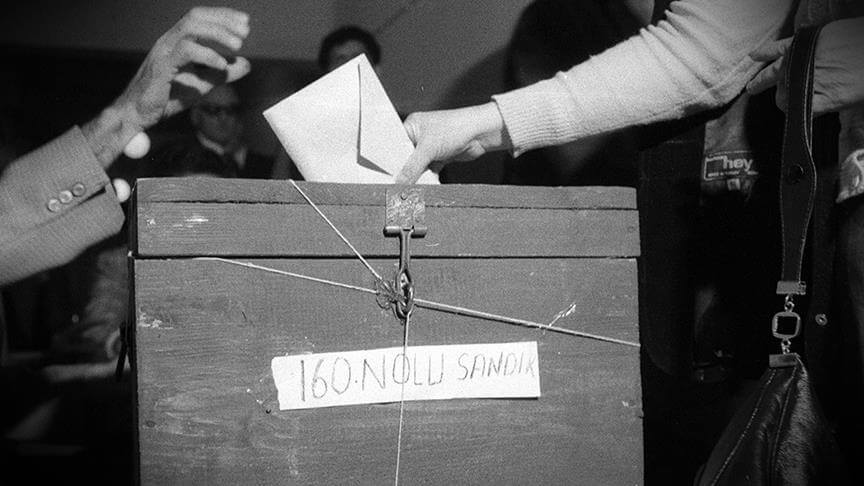
According to the encyclopedia, three of the authors of the motion were expelled from the party. Then the Democrat Party was founded on 7 January 1946 under the chairmanship of Celal Bayar. The government brought the elections forward by a year. The Republican People’s Party won the elections of 21 July 1946. According to the encyclopedia, this election, held under the method of “open vote, secret count”, went down in the history of Turkish democracy as a disputed one.
In a declaration published in 1947, İnönü announced that he stood at an equal distance from all parties. This step played an important role in making the transition to multi-party life permanent.
The Democrat Party’s Victory in 1950
According to the TDV Encyclopedia of Islam, a new election law providing for direct, equal and free elections was adopted on 16 February 1950. Turnout in the elections of 14 May 1950 was 89.3 per cent. According to the encyclopedia, the Democrat Party, which received 53.3 per cent of the vote, won 415 of the 487 seats. The Republican People’s Party, with 39.9 per cent of the vote, managed to win sixty-nine seats.
The new parliament elected Celal Bayar president, and Adnan Menderes formed the government. Refik Koraltan became speaker of parliament and Fuad Köprülü foreign minister. The change of power through elections showed that the transition to multi-party life had now become irreversible.
Frequently Asked Questions
Why did the attempts at a transition to multi-party life fail?
The newness of the Republic, the Sheikh Said rebellion, movements opposed to the reforms and the economic crisis were the main reasons. The government feared that the opposition parties were giving room to opponents of the regime.
When did the transition to multi-party life in Turkey become permanent?
It began with the founding of the Democrat Party in 1946 and became permanent with the change of power in the 1950 elections.
Why was the Progressive Republican Party closed?
On the allegation that it had fanned the Sheikh Said rebellion, it was closed on 3 June 1925 on the basis of the powers granted by the Law on the Maintenance of Order.
Who founded the Free Republican Party?
Fethi Bey (Okyar) founded it at Mustafa Kemal’s suggestion. The party was founded on 12 August 1930 and dissolved itself three months later.
Conclusion
The transition to multi-party life failed in Turkey in its first two attempts. The Progressive Republican Party was closed after the Sheikh Said rebellion, and the Free Republican Party dissolved itself. The security concerns of the young Republic and the economic crisis produced this result. A lasting transition began only after the Second World War, in 1946, and was completed with the 1950 elections. These experiences show that democracy depends as much on political culture as on institutions.
Sources
- TDV Encyclopedia of Islam, entry “Türkiye” (Turkey)
- TDV Encyclopedia of Islam, entry “Mustafa Kemal Atatürk”
- TDV Encyclopedia of Islam, entry “Şeyh Said” (Sheikh Said)
- Mete Tunçay, Türkiye Cumhuriyeti’nde Tek-Parti Yönetiminin Kurulması (1923-1931) [The Establishment of Single-Party Rule in the Republic of Turkey, 1923–1931].
- Cemil Koçak, Türkiye’de İki Partili Siyasi Sisteme Geçiş [The Transition to a Two-Party Political System in Turkey].