The basic difference between the Young Ottomans and the Young Turks lies in the period in which they emerged and the methods they used. The first movement opposed the Tanzimat governments in the 1860s, while the Young Turks opposed the regime of Abdülhamid II after 1878. The first fought with newspapers and the pen. The second founded secret societies and in 1908 forced the constitution to be proclaimed again.
Quick Summary
- The Young Ottomans were intellectuals who opposed the Tanzimat governments in the 1860s.
- “Young Turks” is the general name for the individuals and organizations that opposed Abdülhamid II after 1878.
- Because the European press called both groups “Jeune Turquie,” the names are often confused.
- The first movement prepared the ground for the First Constitutional Era (1876), the second for the Second Constitutional Era (1908).
- The strongest organization of the Young Turks was the Committee of Union and Progress.
Contents
- Why are the names confused?
- The first generation: the Young Ottomans
- Who were the Young Turks?
- The difference in period
- The difference in ideas
- The difference in method and organization
- Two constitutions, two movements
- Common ground
- Comparison table
- Frequently asked questions
Why Are the Names Confused?
The source of this confusion is the European press. According to the TDV Encyclopedia of Islam, the expression “Jeune Turquie” was used in the nineteenth century for many different groups. Mustafa Fazıl Pasha also used this expression in the letter he wrote to Sultan Abdülaziz in 1867. According to the encyclopedia, the French name of the society founded in Baden-Baden in the same year was likewise “Jeune Turquie.”
The encyclopedia states that the name of this society should be translated as the “New” or “Young Ottomans.” This prevents it from being confused with the Young Turks of the Abdülhamid II era. Tarık Zafer Tunaya proposed calling the two movements the “First” and “Second” Young Turk movements. According to the encyclopedia, this proposal did not gain general acceptance.
Who Were the Young Ottomans?
The Young Ottomans were intellectuals who criticized the government policies of the Tanzimat period. According to the encyclopedia, their opposition was directed more at the government, especially Âli Pasha, than at the sultan. The leading figures of the group were Namık Kemal, Ziya Pasha and Ali Suavi. Şinasi is regarded as one of the movement’s forerunners.
How the group was founded is debated. According to the encyclopedia, the first group, founded in Istanbul in 1865, was called “Meslek.” The Young Ottoman Society proper emerged in Europe in 1867. Namık Kemal, Ziya Bey and Ali Suavi arrived in Paris on 30 May 1867. They were supported by Mustafa Fazıl Pasha of the Egyptian dynasty.
According to the encyclopedia, in June 1867 some members of the Meslek group planned to raid the Sublime Porte and kill Âli Pasha. The plan came to light when one of the members revealed it. Mehmed, Nuri and Reşad Beys fled abroad and were sentenced to death in absentia.
Mustafa Fazıl Pasha had lost his right of succession in Egypt in 1866. According to the encyclopedia, he set aside 300,000 francs a year for the society. When he made peace with Sultan Abdülaziz, however, his support for the opposition declined.
The intellectuals in exile spread their ideas through newspapers. Ali Suavi launched Muhbir in London on 31 August 1867. The first issue of the newspaper Hürriyet was also published in London, on 29 June 1868. The paper closed with its 100th issue, published in Geneva on 23 June 1870. We described the movement in more detail in our article Who were the Young Ottomans?.

Who Were the Young Turks?
The name Young Turks is used for the opposition that arose after Abdülhamid II suspended the parliament. According to the encyclopedia, the General Assembly did not meet after 14 February 1878 until the Second Constitutional Era. The opposition wanted the Constitution (Kanun-ı Esasi) to be put back into force. Over time almost every opponent of the regime came to be called a Young Turk.
The organized face of the movement appeared in 1889. According to the TDV Encyclopedia of Islam, on 2 June 1889 four students of the Imperial School of Medicine founded the Ottoman Union Society (İttihad-ı Osmani Cemiyeti). They were İbrahim Temo, Abdullah Cevdet, İshak Sükuti and Mehmed Reşid. The society later took the name Ottoman Union and Progress.
According to the encyclopedia, after 1894 the movement expanded with the participation of bureaucrats, officers and ulema. An attempted coup by a group of bureaucrats in 1896 failed, and many people were arrested.
The leading figure among the Young Turks in Europe was Ahmed Rıza. According to the encyclopedia, he attended lectures on positivism in Paris and in 1895 took charge of the newspaper Meşveret. Prince Sabahaddin, meanwhile, played an important role at the First Young Turk Congress, held in Paris on 4–9 February 1902. The congress failed to unite the opposition, and two separate groups emerged.
The Difference in Period and Political Climate
The Young Ottomans emerged at a time when the Tanzimat bureaucracy was powerful. After the Reform Edict (1856), internal unrest and foreign interference had increased. According to the encyclopedia, Âli and Fuad Pashas considered it necessary to carry out the reforms through strict administration. The opposition intellectuals, by contrast, wanted a parliament and a constitution.
The Young Turks grew up in a period when the parliament was closed and the press was tightly controlled. That is why they preferred secret societies to open opposition. According to the encyclopedia, in 1901 Abdülhamid II ordered that the word “müfsid” (mischief-maker) be used instead of “Young Turk” in official correspondence. We discussed this period in our article on the reign of Abdülhamid II.
The Difference in Ideas
The Young Ottomans explained constitutional order through the Islamic principle of consultation (meşveret). In Namık Kemal’s writings the concepts of fatherland, freedom and consultation came to the fore. The movement aimed to unite peoples of different religions and origins in a common Ottoman identity. This outlook is known as Ottomanism. We described Namık Kemal’s thought in our article on Namık Kemal and the idea of freedom.
The intellectual world of the Young Turks was more varied. Figures such as Ahmed Rıza were influenced by Auguste Comte’s positivism. According to the encyclopedia, the society’s name, “Union and Progress,” was also proposed under the inspiration of Comte’s motto “order and progress.” The movement, which at first defended Ottomanism, gradually drew closer to Turkism. We compared these currents in our article on Ottoman intellectual movements.

The Difference in Method and Organization
The members of the first generation were mostly writers and journalists. They tried to shape public opinion through newspapers such as Tasvir-i Efkar, Muhbir and Hürriyet. According to the encyclopedia, there was no full agreement of ideas among them, and their leading figures returned home after a while. Namık Kemal, too, came back to Istanbul on 24 November 1870.
The Young Turks, by contrast, gradually turned into a revolutionary organization. According to the encyclopedia, after 1905 Bahaeddin Şakir reorganized the society under the name Ottoman Committee of Progress and Union. In 1907 the committee merged with the Ottoman Freedom Society in Salonica. The officers in Macedonia became the movement’s real strength. Prince Sabahaddin, meanwhile, took a separate path by founding the Society for Private Initiative and Decentralization.
Two Constitutions, Two Movements
The ideas of the Young Ottomans produced a concrete result in 1876. According to the encyclopedia, the Constitution was proclaimed on 23 December 1876. Namık Kemal and Ziya Pasha stood beside Midhat Pasha in the preparation of the constitution. They objected, however, to Article 113, which gave the sultan the power of exile. We described the process of proclaiming the constitution in our article on the Tersane Conference and the Constitution.
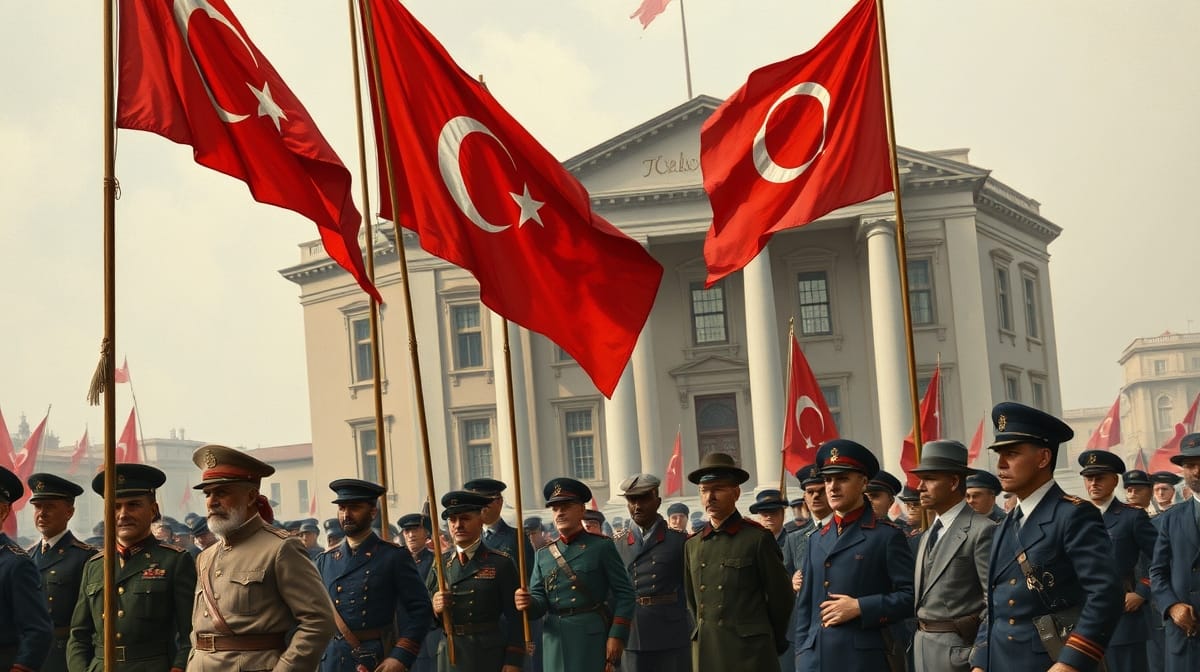
The goal of the Young Turks was to put this constitution back into force. According to the encyclopedia, the 1908 revolution was carried out by the Ottoman Committee of Progress and Union. The parliament was summoned to meet again on 23–24 July 1908. The other Young Turk groups made no direct contribution to this revolution. We discussed this change of regime in our article on the change of regime.
What the Two Movements Had in Common
Despite their differences, the two movements also had things in common. Both aimed to save the state through a constitution and a parliament. Both published newspapers in exile and addressed European public opinion. Both generations tried to prevent the disintegration of the Ottoman Empire. This common ground also fed later debates on democratization in the Ottoman Empire.
Comparison Table
The main differences between the Young Ottomans and the Young Turks are summarized in the table below.
| Criterion | Young Ottomans | Young Turks |
|---|---|---|
| Period | 1865–1876 | 1878–1908 |
| Opposed | Âli Pasha and the Tanzimat governments | The regime of Abdülhamid II |
| Leading figures | Namık Kemal, Ziya Pasha, Ali Suavi | Ahmed Rıza, Prince Sabahaddin, Bahaeddin Şakir |
| Organization | A loose circle of intellectuals | Secret societies, above all Union and Progress |
| Publications | Tasvir-i Efkar, Muhbir, Hürriyet | Meşveret, Mizan, Şura-yı Ümmet |
| Ideas | Consultation, Ottomanism, Islamic legitimacy | Positivism, centralism, increasingly Turkism |
| Result | First Constitutional Era (1876) | Second Constitutional Era (1908) |
Frequently Asked Questions
Are the Young Ottomans and the Young Turks the same movement?
No. There is about a generation between the two movements. Because both defended constitutional government, however, they are seen as connected.
What did the Young Ottomans advocate?
They wanted a parliament, a constitution and freedom. They based these demands on the Islamic principle of consultation.
What was the most important organization of the Young Turks?
It was the Committee of Union and Progress. The society was founded in 1889 under the name Ottoman Union (İttihad-ı Osmani).
Where does the name Young Turk come from?
It comes from the expression “Jeune Turquie” in the European press. According to the encyclopedia, the expression was used by analogy with Mazzini’s “Giovine Italia” movement.
Conclusion
The Young Ottomans and the Young Turks are two separate generations of Ottoman constitutionalism. The first fought the Tanzimat governments with the pen and opened the way to the constitution of 1876. The second organized against Abdülhamid II and in 1908 put that constitution back into force. Their common goal was constitutional government, but their methods and intellectual worlds differed.
Sources
- TDV Encyclopedia of Islam, entry “Yeni Osmanlılar Cemiyeti” (Young Ottoman Society)
- TDV Encyclopedia of Islam, entry “Jön Türkler” (Young Turks)
- TDV Encyclopedia of Islam, entry “İttihat ve Terakki Cemiyeti” (Committee of Union and Progress)
- TDV Encyclopedia of Islam, entry “Kānûn-ı Esâsî”
- TDV Encyclopedia of Islam, entry “Ahmed Rızâ”
- Şerif Mardin, The Genesis of Young Ottoman Thought.
- M. Şükrü Hanioğlu, Bir Siyasal Örgüt Olarak Osmanlı İttihad ve Terakki Cemiyeti ve Jön Türklük [The Ottoman Committee of Union and Progress as a Political Organization and Young Turkism].