The Abbasid period came to be regarded as the golden age of Islamic civilization thanks to its powerful Baghdad-based administration, translation movement, scientific institutions, trade networks, and cosmopolitan urban culture.

Quick Summary
- Baghdad became the main center of science and culture.
- Bayt al-Hikma accelerated translation and research activities.
- Trade routes nourished the urban economy and the circulation of knowledge.
- Scholars from different religions and languages worked together.
- Mathematics, medicine, astronomy, and philosophy made major advances.
Contents
- The Abbasids and the Concept of the Golden Age
- The Rise of Baghdad and the Idea of a New Center
- Bayt al-Hikma and the Translation Movement
- The World of Science, Philosophy, and Education
- Economy, Urban Life, and Cultural Diversity
- The Effects of the Abbasid Legacy on the Ottoman World
- Conclusion
The Abbasids and the Concept of the Golden Age
The Abbasids opened a new era in Islamic history when they overthrew Umayyad rule in 750. The dynasty based its legitimacy on descent from Abbas, the uncle of the Prophet Muhammad. This claim helped bring different communities under the same political umbrella. In addition, the new administration expanded the role of non-Arab Muslims in state life.
The phrase golden age does not refer only to military achievements. It emphasizes vitality in science, literature, urbanization, and institutional development. Especially between the 8th and 10th centuries, the Islamic world became a powerful intellectual center. Articles in the TDV Encyclopedia of Islam treat this period as a distinct stage in terms of scholarly and translation activities.
Why did the political center change during the Abbasid period?
During the Umayyad period, the political center was Damascus. The Abbasids, however, shifted the center of power to Iraq and the Iranian lands. This choice strengthened social support in the eastern provinces. Alongside this, Mesopotamia’s ancient urban culture nourished the institutional structure of the new state.
This shift also influenced the direction of Islamic civilization. The state entered into more intensive contact with the Byzantine and Iranian heritage. As a result, administrative language, court culture, and bureaucracy became richer. At the same time, this process reinterpreted different traditions within an Islamic framework.
The Rise of Baghdad and the Idea of a New Center
Baghdad was founded by Caliph al-Mansur in 762. Thanks to its strategic location on the banks of the Tigris, the city grew rapidly. Its proximity to routes leading to the Persian Gulf, Iran, Syria, and Anatolia also provided a major advantage. For this reason, Baghdad became both a political center and a commercial crossroads.
The city’s circular plan reflected the centralized character of power. The palace, mosque, and administrative buildings stood at the center. Markets, neighborhoods, and craft districts developed around this core. Thus, the city became not merely a governed space but a productive stage for civilization.

How did the Abbasids turn Baghdad into a center of attraction?
The Abbasids drew scholars, secretaries, physicians, and merchants to Baghdad. The courtly milieu established a system of patronage that supported knowledge and expertise. The reigns of Harun al-Rashid and al-Ma’mun stood out especially in this respect. This support ensured the continuity of scientific production.
Baghdad’s strength did not come from the palace alone. Booksellers, copyists, madrasas, mosques, and private study circles developed in the city. Wealthy families also sponsored scholarly gatherings. This environment made knowledge part of everyday urban life.
Bayt al-Hikma and the Translation Movement
Bayt al-Hikma is one of the strongest symbols of Abbasid intellectual life. The institution brought together translation, library, and research activities. Works in Greek, Syriac, Middle Persian, and Sanskrit were translated into Arabic. In this way, ancient and eastern knowledge entered circulation in a new language.
These translations were not merely mechanical transfers. Translators explained, debated, and developed the texts. Intensive work was carried out especially in logic, medicine, mathematics, astronomy, and philosophy. As Dimitri Gutas emphasizes in his studies, the translation movement rested on broad social and political demand.
Why did the Abbasids attach such great importance to translation?
The Abbasids considered knowledge valuable for state administration and social prestige. Astronomy was useful in calendar calculations, medicine in court practice, and mathematics in financial affairs. Philosophy and logic also provided new tools for theological debates. For this reason, translation met both practical and intellectual needs.
Translators such as Hunayn ibn Ishaq were among the leading figures of this process. They carried the tradition of Galen and Hippocrates into Arabic medical literature. In addition, Indian mathematics and the Iranian tradition of statecraft were also influential. As a result, Arabic became a broad language of scholarship.
The real achievement of the golden age was not copying old knowledge, but developing it through new questions.
The World of Science, Philosophy, and Education
In the Abbasid world, mathematics, astronomy, medicine, geography, and philosophy developed rapidly. Al-Khwarizmi left a lasting impact through his work on algebra. Al-Kindi became an important figure who brought philosophy into the Arabic intellectual tradition. Al-Razi, meanwhile, produced extensive works in medicine and chemistry.
Astronomy in this period was not merely a theoretical pursuit. It mattered for calculating prayer times, determining the qibla, and compiling calendars. For this reason, observatories and astronomical tables attracted great interest. Geography, too, was nourished by trade and travel culture.
How did education spread during the Abbasid period?
Education in the Abbasid era was not confined to a single institution. Mosques, libraries, private homes, and study circles all contributed to the production of knowledge. Scholars traveled from city to city to collect reports and learning. This mobility created a shared scholarly language across the Islamic world.
Book production also accelerated this spread. The use of paper made it easier to multiply manuscripts. Baghdad, Samarkand, and other cities benefited from this technology. In this way, knowledge was able to reach broader communities.
This educational environment also influenced later Islamic societies. To understand the Ottoman madrasa tradition, assessments of the education system in the Ottoman Empire are useful. In addition, the effects of the Ottoman sultans on education and science reveal another period of this long legacy.
Economy, Urban Life, and Cultural Diversity
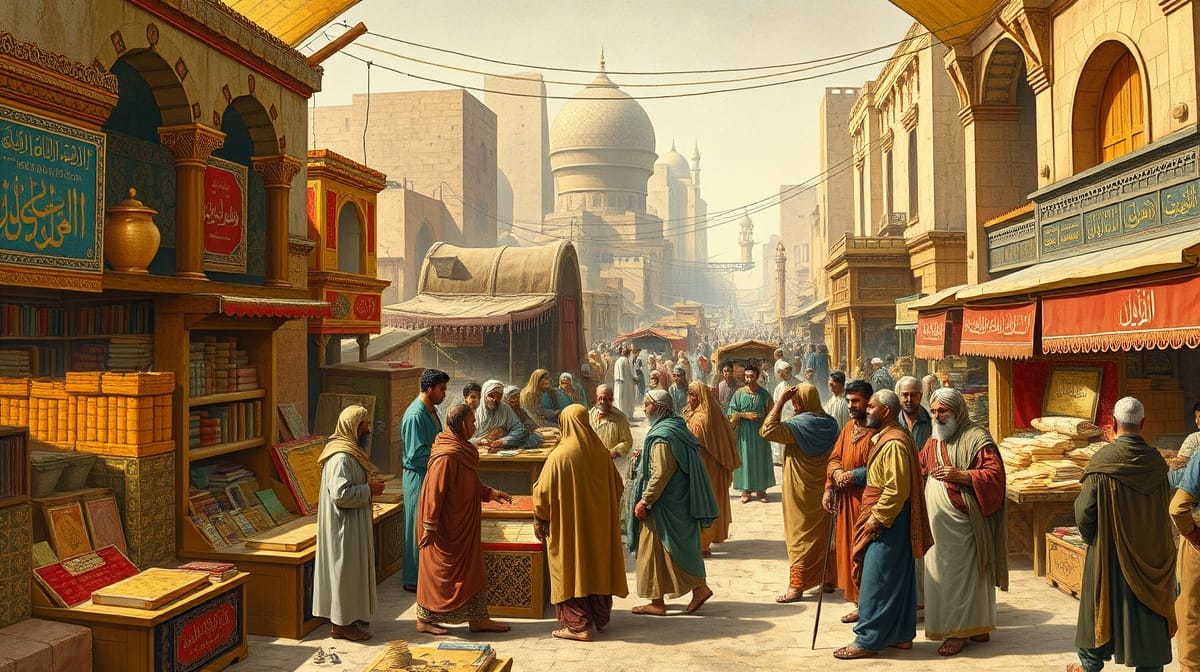
Behind the golden age stood a strong economy. The Abbasids controlled extensive trade routes and revitalized urban markets. Centers such as Basra, Baghdad, Kufa, and Fustat were connected to networks of production and distribution. In this way, scholarly life received direct support from economic prosperity.
Merchants did not carry goods alone. They also carried news, books, technical knowledge, and ideas. The Indian Ocean, Central Asian, and Mediterranean routes strengthened this exchange. Alongside this, charitable practices similar to waqfs supported education and health services.
Why was a cosmopolitan society an advantage for the Abbasids?
In Baghdad, Muslims, Christians, Jews, Sabians, and different ethnic groups lived together. This diversity created an important accumulation of knowledge in the fields of scholarship and crafts. Syriac Christian physicians and translators in particular stood out in the history of science. For this reason, Abbasid culture was multilingual and multilayered.
Yet this diversity did not always proceed without problems. Sectarian debates, court rivalries, and social tensions increased from time to time. Even so, the period offered a unique example of bringing different knowledge traditions together. This feature is one of the most distinctive aspects of the golden age.
Urban culture also appeared powerfully in the later Ottoman world. For example, the Ottoman waqf system is important for understanding the relationship between education and social welfare. In addition, commercial spaces in the Ottoman Empire show the continuity of the urban economy.
The Effects of the Abbasid Legacy on the Ottoman World
The Abbasids were a dynasty that lived centuries before the Ottomans. Even so, they left a lasting mark on Islamic political thought. The caliphate, the patronage of learning, and city-centered culture retained their importance in later Muslim states. The Ottomans, too, interpreted this legacy according to their own conditions.
In Ottoman history, debates over the caliphate come especially to the fore with the reign of Selim I. In this context, the process by which the caliphate passed to the Ottomans helps clarify the political meaning of the Abbasid legacy. In addition, the Imperial Council and Ottoman state administration offer another example of centralized bureaucracy.
The Ottoman learned class established links with the older Islamic heritage through madrasas and court patronage. This connection was not a matter of direct copying. Rather, the Ottomans assessed the Seljuk, Ilkhanid, Mamluk, and Abbasid experiences together. The approach to state and society found in the works of Halil İnalcık makes it possible to understand this continuity within a broader history.
The Limits of the Abbasid Period and the Road to Decline
The emphasis on the golden age does not ignore all the problems of the period. Over time, the Abbasid center lost control over the provinces. The rise of Turkish commanders and the influence of the Buyids and Seljuks limited the caliph’s political power. Nevertheless, cultural authority continued for a long time.
In 1258, the Mongol capture of Baghdad created a major rupture. Libraries, institutions, and the political center suffered a severe blow. Yet the accumulated heritage of Islamic civilization did not disappear completely. Centers such as Cairo, Damascus, Tabriz, Samarkand, and later Istanbul carried this legacy forward.
Conclusion
In conclusion, the Abbasids shaped the golden age of Islamic civilization through Baghdad-centered politics, the translation movement, a strong urban economy, and a multicultural scholarly environment. This period is not merely a brilliant memory of the past. It is also a historical example showing how knowledge grows through institutions, cities, and patronage.
Sources
- TDV Encyclopedia of Islam, article on the Abbasids.
- TDV Encyclopedia of Islam, article on Bayt al-Hikma.
- Dimitri Gutas, Greek Thought, Arabic Culture.
- Marshall G. S. Hodgson, The Venture of Islam.
- Halil İnalcık, Devlet-i Aliyye.










1 thought on “Why Was the Abbasid Period the Golden Age of Islamic Civilization?”