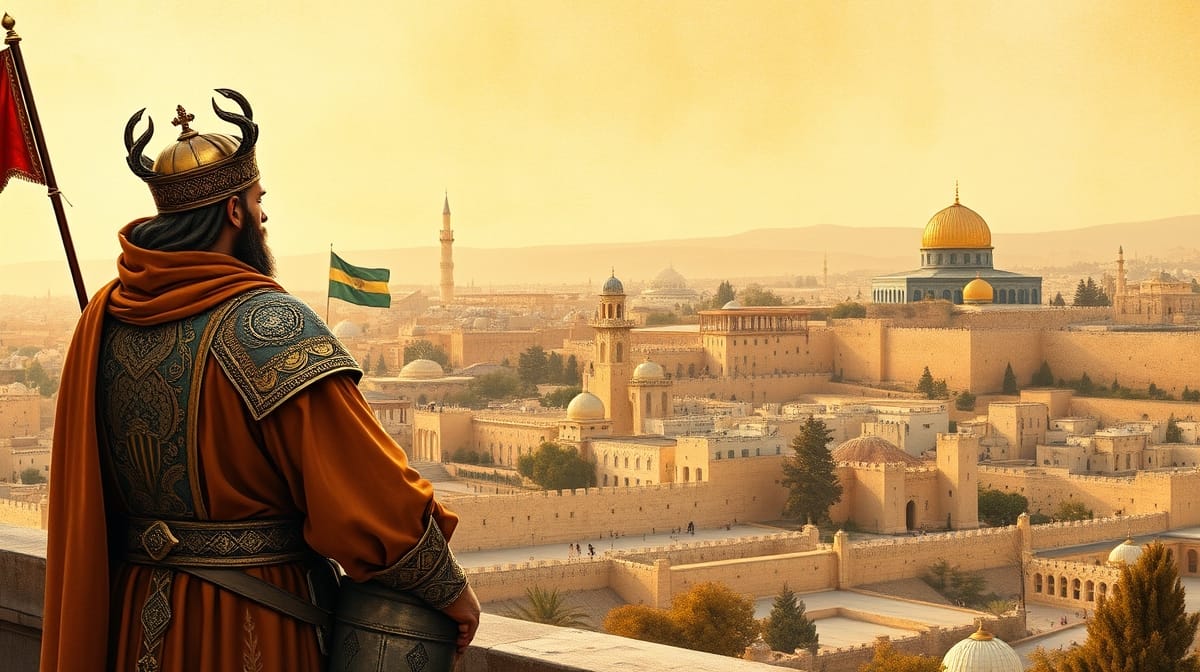
After heavily defeating the Crusader army at the Battle of Hattin in 1187, Saladin besieged Jerusalem and recaptured the city under controlled terms of surrender rather than through bloody revenge, becoming an enduring symbol of leadership in the Islamic world.
Quick Summary
- Saladin first established political unity in Egypt and Syria.
- The Battle of Hattin was the military turning point in the conquest of Jerusalem.
- The Crusader army collapsed under thirst and strategic encirclement.
- Jerusalem was taken under terms of surrender on October 2, 1187.
- The conquest strengthened the ideal of unity in the Islamic world.
Contents
- Who Was Saladin?
- The Crusader Occupation of Jerusalem and Its Historical Importance
- How Did Saladin Build Unity?
- The Battle of Hattin: The Gate to Jerusalem
- How Did Saladin Besiege Jerusalem?
- The Consequences of the Conquest and the Third Crusade
- Conclusion
- Sources
Who Was Saladin?
Saladin was a military leader of Kurdish origin, born in Tikrit in 1137 or 1138. His real name was Yusuf ibn Ayyub. Historical sources describe him both as the founder of a state and as a powerful representative of the politics of jihad.
In his youth, he was trained in the service of the Zengids. He took part in the Egyptian campaigns alongside his uncle Shirkuh. He also rose rapidly in Cairo at a time when the Fatimid caliphate was weakening.
In 1169, he became vizier of Egypt. In 1171, he ended the Fatimid caliphate and had the sermon read in the name of the Abbasid caliphate. Thus Egypt was reconnected to the central politics of the Sunni Islamic world.
The Saladin entry in the TDV Encyclopedia of Islam does not explain his success solely through military victory. According to it, his real strength came from the political balance he established across Egypt, Syria, and al-Jazira.
The Crusader Occupation of Jerusalem and Its Historical Importance
Jerusalem fell into Crusader hands during the First Crusade in 1099. A great massacre took place in the city. This event left a deep wound in Muslim memory.
Jerusalem was not only a military target. The city held a special place because of al-Aqsa Mosque, the Dome of the Rock, and the belief in the Mi’raj. It was also regarded as sacred by Christians and Jews.
For this reason, the struggle over Jerusalem was not merely a war for territory. It was also a question of legitimacy, sanctity, and political leadership. Saladin understood this meaning very well.
The Crusader Kingdom, meanwhile, had built a fragile structure centered on Jerusalem. Coastal cities, castles, and knightly orders supported this structure. Yet internal conflicts gradually weakened its defense.
The conquest of Jerusalem was not a sudden attack for Saladin, but the result of a long-term policy of unity.
How Did Saladin Build Unity?
Before marching on Jerusalem, Saladin reduced the fragmentation within the Islamic world. First, he consolidated his power in Egypt. He then turned toward establishing influence over the cities of Syria.
In 1174, Nur al-Din Mahmud Zengi died. This death created a power vacuum in Syria. Saladin made use of this vacuum through careful diplomacy and military moves.
Damascus, Aleppo, and the surrounding regions were critical centers on the road to Jerusalem. Yet taking these cities alone was not enough. Saladin also had to win the support of local emirs.
At this point, his politics can be compared with later Islamic states. In Ottoman history, for example, the ideas of legitimacy and unity also became decisive. On this subject, the article How Did the Caliphate Pass to the Ottomans? Historical Process and Consequences offers a similar framework of leadership.
On the other hand, Saladin was not merely a warrior ruler. He established political order through waqfs, madrasas, and urban administration. In this respect, he also strengthened Islamic urban culture.
In Islamic societies, the waqf system was an important institution that supported religious and social life. For the Ottoman example, the article titled The Waqf System in the Ottoman Empire: Mosques, Madrasas, and Social Aid explains this background.
Saladin and the Politics of Jihad
Saladin used the call to jihad together with political unity. This call gathered scattered emirates around a common goal. However, his method did not rely only on religious discourse.
He supported his army with regular revenues, loyal commanders, and strategic fortresses. He also closely followed the Crusaders’ internal disputes. In this way, he presented the image of a patient leader waiting for the right moment.
The Battle of Hattin: The Gate to Jerusalem
The Battle of Hattin was fought near Tiberias on July 4, 1187. Saladin left the Crusader army in a difficult position, thirsty and exposed in open terrain. This strategy determined the outcome of the battle.
The Crusader army advanced toward Tiberias under harsh conditions. Heat, thirst, and exhaustion broke the soldiers’ resistance. Muslim forces also increased the pressure by controlling the water sources.
At the end of the battle, King Guy of Lusignan of Jerusalem was captured. Raynald of Chatillon also fell into Saladin’s hands. According to the sources, Saladin personally punished Raynald because he had broken treaties.
The victory at Hattin broke the military backbone of the Crusaders. Acre, Nablus, Jaffa, and other centers were left defenseless one after another. For this reason, Jerusalem had now become an isolated target.

Why Did Saladin Win at Hattin?
Saladin won at Hattin for three main reasons. First, he chose the terrain correctly. Second, he drew the Crusader army away from water sources.
Third, he did not force his army into a hasty attack. Instead, he increased the pressure of encirclement. Thus the Crusader forces lost strength before the battle had even begun.
This strategy recalls the balance between siege warfare and pitched battle seen in Ottoman military history. In this context, the article How Was the Ottoman Army Founded, and Who Made It Up? is suitable for a comparative reading of military organization.
How Did Saladin Besiege Jerusalem?
After Hattin, Saladin did not rush to march directly on Jerusalem. He first brought the surrounding castles and cities under control. In this way, he narrowed Jerusalem’s routes of assistance.
Balian of Ibelin took charge of Jerusalem’s defense. There were many civilians, clergy, and soldiers in the city. However, the Crusaders’ great army had been destroyed at Hattin.
Saladin arrived before Jerusalem in September 1187. The siege lasted several weeks. Muslim forces put pressure on the walls and weakened the defense with mangonels.
Nevertheless, resistance in the city had not completely collapsed. Balian warned that if they did not surrender, great destruction would follow. Saladin, however, did not take revenge for the massacre of 1099 through mass slaughter.
The parties agreed on terms of ransom and safe passage. Different payment amounts were set for men, women, and children. Some of those who could not pay were freed through various initiatives.
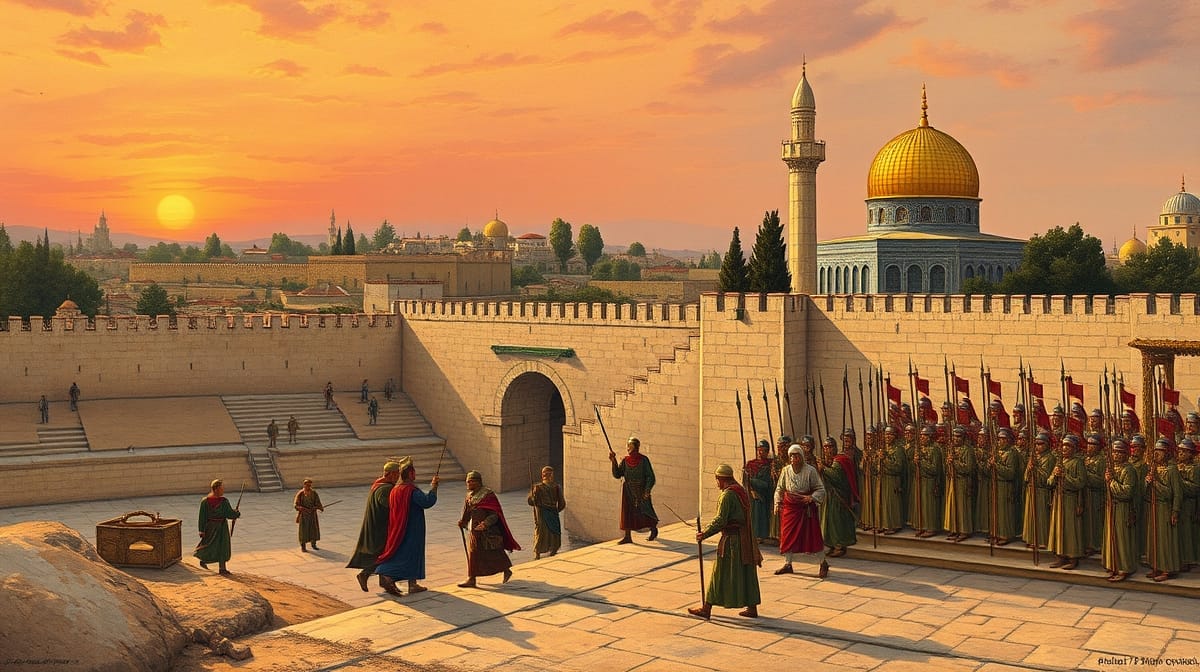
On October 2, 1187, Jerusalem surrendered. This date was greeted with great joy in the Islamic world. The reopening of al-Aqsa Mosque for Muslim worship carried particular symbolic importance.
Saladin and the Policy of Mercy
Saladin did not pursue a harsh policy of revenge in Jerusalem. This attitude earned him respect in both Muslim and some Christian sources. However, this narrative should not be overly romanticized.
After the conquest, a ransom system was applied. Some of the Latin Christians in the city left. The situation of Eastern Christian communities followed a different course.
Even so, the conquest of 1187 differed markedly from the Crusader massacre of 1099. For this reason, Saladin’s name came to be associated with the concepts of justice and moderation.
The Consequences of the Conquest and the Third Crusade
The conquest of Jerusalem caused great repercussions in Europe. Pope Gregory VIII called for a new Crusade. Thus the Third Crusade began.
King Richard the Lionheart of England, King Philip II of France, and the German emperor Frederick Barbarossa joined the campaign. However, the goals of the campaign did not fully come together. This situation limited the power of the Crusaders.
Richard captured Acre and achieved success along the coastal line. Despite this, he could not retake Jerusalem. The agreement made in 1192 allowed Christian pilgrims to visit Jerusalem.
This development showed Saladin’s diplomatic strength. His success on the battlefield was preserved at the negotiating table as well. As a result, Jerusalem remained under Muslim rule.
The question of Jerusalem retained its special place in Islamic politics in the following centuries as well. During the Ottoman period, the city came under imperial administration after Selim I. For this process, the article titled As a Result of Which War Did Jerusalem Leave the Hands of the Ottoman State? completes the later-period context.
Jerusalem also became one of the cities under Ottoman rule where different religious communities lived together. This structure can be connected with the understanding of administration described in the article What Rights Did the Ottoman Millet System Grant to Non-Muslims?.
What Did the Conquest of Jerusalem Mean in the Islamic World?
The capture of Jerusalem provided moral superiority in the Islamic world. Saladin created a common goal among fragmented political structures. This success made him more than an ordinary ruler.
The TDV Encyclopedia of Islam entries examine Saladin’s legacy together with the institutionalization of the Ayyubid State. This approach is important. For the conquest was not merely the acquisition of a city.
In particular, Sunni madrasa networks, waqfs, and urban administration supported the permanence of the conquest. Thus, after the military victory, Jerusalem became a political and religious center.
Conclusion
Saladin did not recapture Jerusalem by the force of the sword alone; he first established political unity, then gained strategic superiority at Hattin, and finally conquered Jerusalem under measured terms of surrender, becoming remembered in history as a ruler associated with justice, leadership, and resolve.
Sources
- TDV Encyclopedia of Islam, Saladin entry.
- TDV Encyclopedia of Islam, Ayyubids entry.
- Ibn al-Athir, al-Kamil fi al-Tarikh.
- Imad al-Din al-Isfahani, al-Fath al-Qussi fi al-Fath al-Qudsi.
- Baha al-Din Ibn Shaddad, al-Nawadir al-Sultaniyya wa’l-Mahasin al-Yusufiyya.