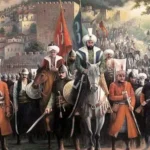
Jerusalem passed out of Ottoman hands as a result of the First World War. The city was lost in December 1917 on the war’s Sinai and Palestine front, ending the four centuries of Ottoman rule that had begun in 1517.
The short answer
- War: the First World War (1914–1918)
- Front: the Sinai and Palestine front
- Dates: 9 December 1917 (surrender of the city) — 11 December 1917 (General Allenby’s formal entry)
- Sultan: Mehmed V Reşad; real power lay with the Committee of Union and Progress and Enver Pasha
When did Jerusalem come under Ottoman rule?
Jerusalem was annexed in 1517, during Selim I‘s Egyptian campaign, after the defeat of the Mamluk Sultanate. The city then remained under Ottoman administration for roughly four hundred years.
Under Suleiman the Magnificent the walls were rebuilt from the ground up; the ramparts that ring the Old City today are his work. Throughout Ottoman rule the holy sites of all three faiths were protected and the city’s communities continued to live under their own religious law.

How did the Sinai and Palestine front open?
The Ottoman Empire entered the First World War alongside the Central Powers (Germany, Austria-Hungary and Bulgaria) and so faced the Entente. The front opened because of the Suez Canal: hoping to sever Britain’s lifeline to India, the Ottomans mounted two canal offensives, in 1915 and 1916. Both failed.
After those failures the initiative passed entirely to the British. Forces under General Edmund Allenby crossed Sinai and pressed on Gaza; the third battle of Gaza and the fall of Beersheba broke the Ottoman defensive line and opened the road to Jerusalem.
December 1917: the surrender of the city
Ottoman troops evacuated Jerusalem without a fight, so that no battle would be waged inside the holy city. On 9 December 1917 the mayor carried out a white flag and offered the city’s surrender to British soldiers.
Two days later, on 11 December 1917, Allenby entered through the Jaffa Gate — dismounting and walking in on foot. The gesture was deliberate: the aim was to look like respect for a holy city rather than a conquest. This is why sources cite both dates; 9 December is the surrender, 11 December the formal entry.
What followed the loss
- Ottoman military strength in Syria and Palestine was crippled; the front collapsed completely with the defeat at Nablus in September 1918.
- The region’s future had already been shaped by wartime agreements: the Sykes-Picot Agreement (1916) and the Balfour Declaration (November 1917).
- The Armistice of Mudros was signed on 30 October 1918 and the Arab provinces were effectively lost.
- In 1922 Palestine formally became a British Mandate under a League of Nations decision.
The empire’s wartime relationship with its Arab subjects is a debate of its own; we take it up in did Palestine betray the Ottomans?
Why did Jerusalem matter so much?
- Judaism: the site of the Temple and the central holy city of the faith.
- Christianity: home of the Church of the Holy Sepulchre, at the heart of the pilgrimage route.
- Islam: the first qibla and the third sanctuary, where al-Aqsa Mosque stands.
This threefold sanctity made the city a symbol far beyond its military value. That is why the change of hands in 1917 was received not as front-line news but as an international event.
Frequently asked questions
As a result of which war did Jerusalem fall out of Ottoman hands?
The First World War. The city passed to British forces in December 1917, on the war’s Sinai and Palestine front.
Under which sultan was Jerusalem lost?
Under Mehmed V Reşad. In practice, however, the state was run by the Committee of Union and Progress, above all by Enver Pasha.
Under which sultan was Jerusalem taken?
Under Selim I, in 1517, when it was taken from the Mamluks during the Egyptian campaign.
On which front were Palestine and Jerusalem lost?
On the Sinai and Palestine front. It opened with the Ottoman offensives against the Suez Canal and ended, after the British counter-attack, with the loss of the whole of Palestine.
How long did Ottoman rule in Jerusalem last?
About 400 years, from 1517 to 1917.
Related articles
- Why were the Balkan Wars a major turning point for the Ottomans?
- How did the Crimean War tie the Ottomans to European politics?
- The Ottoman-Iranian wars: three centuries of rivalry
Sources
- Fahir Armaoğlu, 20. Yüzyıl Siyasî Tarihi (Political History of the 20th Century).
- Erik Jan Zürcher, Turkey: A Modern History.
- Eugene Rogan, The Fall of the Ottomans: The Great War in the Middle East.
- TDV Encyclopaedia of Islam (DİA), entry “Kudüs”.