The villagers and townspeople of the Ottoman Empire who were liable to pay taxes were called the reaya. That single word is the answer usually asked for in textbooks and exams — but who the reaya were, which taxes they paid and why, and how the arrangement held the state together cannot be told in one sentence. This article gives the answer first, then the system behind it.
The short answer: reaya
Reaya was the collective name for the productive, tax-paying part of Ottoman society: villagers, farmers, and the artisans and craftsmen of the towns. The word comes from the Arabic ra’iyya, “the flock that is tended”; in Ottoman usage it was not derogatory but meant “the governed and protected population”.
Facing the reaya stood the askerî (military) class: soldiers serving in the sultan’s name, together with judges, professors and state officials. This group paid no tax; it lived on what was collected from the reaya. This is the basic division of Ottoman social order.
Ottoman social structure: rulers and ruled
Ottoman society fell into two broad groups. The division rested on function rather than birth — someone from the reaya could be educated and pass into the askerî class.
| Class | Who | Tax status | Main function |
|---|---|---|---|
| Askerî (rulers) | Members of the seyfiye, ilmiye and kalemiye | Exempt | Administration, security, justice |
| Reaya (ruled) | Villagers, farmers, artisans, craftsmen, merchants | Liable | Production and trade |
The reaya was defined without regard to whether a person was Muslim or non-Muslim. Religion did not change the class; it changed which taxes were owed, as set out below.
Village and town: one class, different tax items
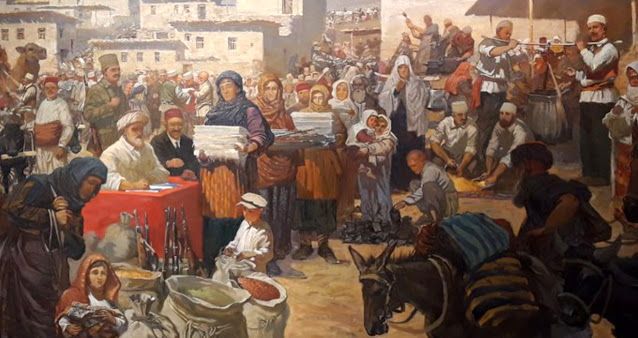
Villages and towns belonged to the same reaya class, but their economies differed and taxation followed suit.
- Villages: livelihoods rested on agriculture. Tax was taken as a share of the harvest.
- Towns: markets, guilds and crafts dominated. Tax was calculated on goods sold and craft products made.
Keeping the towns lively mattered to the state for a further reason: markets meant both revenue and the production an army needs. We describe how that network functioned in our article on trade places in the Ottoman Empire.
The timar system: the frame in which tax was collected
Most of the villages and towns liable for tax sat inside the timar system. Instead of paying a cash salary, the state assigned the tax revenue of a district to a sipahi.
- The sipahi lived on the revenue granted to him and, in proportion to its size, maintained armed horsemen known as cebelü.
- The peasant went on working the land and handed the sipahi his share of the produce.
- Ownership of the land stayed with the state; the peasant could pass the right of use from father to son.
- A peasant who left his land idle for three consecutive years owed the çift bozan levy.
Through this arrangement the state maintained an army without drawing cash from the treasury, while guaranteeing that production continued. The breakdown of the system became one of the gravest problems of Ottoman finance from the seventeenth century onwards.
Types of Ottoman tax
Ottoman taxes fall under two headings: şer’î taxes grounded in religious law, and örfî taxes imposed by the sultan’s decree.
Öşür (tithe)
The produce tax taken from Muslim reaya. Although the name means “one tenth”, the rate varied by region and by whether the land was irrigated, in practice ranging from one eighth to one twentieth.
Haraç
The tax on land worked by non-Muslim reaya. It had two forms: harâc-ı mukāseme, taken as a share of the produce, and harâc-ı muvazzaf, a fixed amount based on the size of the holding. It can be regarded as the non-Muslim counterpart of the tithe.
Cizye (jizya)
A poll tax levied on non-Muslim men, understood as the counterpart of military obligation. Women, children, the elderly, clergy and those unable to work were exempt. It was collected in three bands — âlâ, evsat and ednâ — according to ability to pay.
Çift resmi and avârız
Çift resmi was an örfî tax on the Muslim peasant holding as much land as a pair of oxen could work; its non-Muslim counterpart was the ispence. Avârız was at first collected only in extraordinary circumstances such as war, but became a regular levy from the seventeenth century.
How were taxes collected?
Collection rested on the tahrir registers. In every district conquered or newly reorganised, the number of households, the cultivated area and the volume of production were recorded, and tax was calculated from that register. The aim was to prevent arbitrary levies.
In timar districts the sipahi did the collecting; in districts tied directly to the treasury it fell to officials such as the emin, the mültezim or the mütesellim. Village and town headmen worked alongside them, and complaints went to the qadi — tax disputes in the Ottoman Empire could be taken to court. We look at the daily work of the qadis in what did an Ottoman qadi do?
Frequently asked questions
What were the village and town people liable to pay taxes called?
They were called the reaya. This productive, tax-paying part of society formed the basis of the Ottoman economic order.
Did reaya mean only peasants?
No. Alongside peasants, the artisans, craftsmen and merchants of the towns were also reaya. What they shared was producing and paying tax.
Who paid no tax?
Members of the askerî class — soldiers, qadis, professors and state officials — were exempt. Jizya, in addition, was not taken from women, children, the elderly or the clergy.
Did Muslims and non-Muslims pay the same taxes?
No. Muslim reaya paid öşür and çift resmi, while non-Muslim reaya paid haraç, cizye and ispence. The class was the same; the tax items differed.
Did the reaya own the land?
No. Ownership of mîrî land belonged to the state; the peasant held the right of use (tasarruf). That right could pass from father to son, but it could be revoked if the land was left idle.
Sources
- Halil İnalcık & Donald Quataert, An Economic and Social History of the Ottoman Empire.
- Şevket Pamuk, The Ottoman Economy and Its Institutions.
- Halil İnalcık, The Ottoman Empire: The Classical Age 1300–1600.
- TDV Encyclopaedia of Islam (DİA), entries “Reâyâ”, “Cizye”, “Öşür” and “Tımar”.