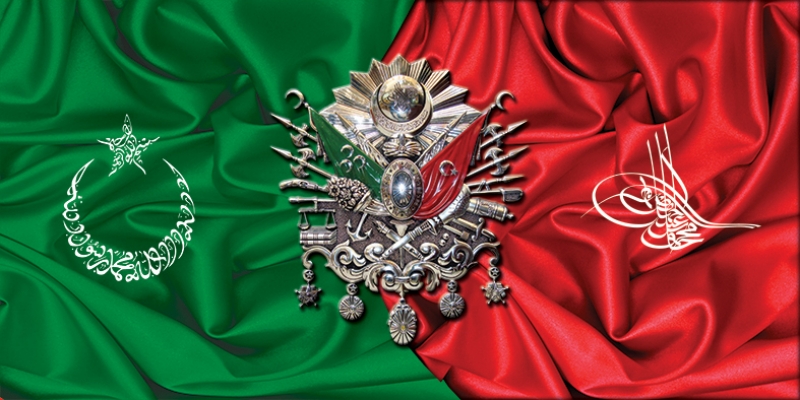
The meaning of the Ottoman coat of arms comes from the fact that each figure on it represents one of the state’s values. According to the TDV Encyclopedia of Islam, at the top of the late-period coat of arms stands the sultan’s tughra, and beneath it a crescent bearing an inscription. Flags with the crescent and star spread out to both sides. Figures such as weapons, scales and books express values such as power, justice and learning.
Quick Summary
- In the early period, the sultan’s tughra was used instead of a state coat of arms.
- The pennants of Janissary units bore figures such as a sword, a crescent, an elephant and a dragon.
- The late-period coat of arms is a symmetrical composition arranged in a Western manner.
- At its top, inside a circle, is the sultan’s tughra.
- There are no animal figures such as lions or eagles on the coat of arms.
Contents
- What is a coat of arms?
- The meaning of the coat of arms
- The coat of arms in the early period
- The symbols
- The crescent and star
- The tughra
- How the coat of arms changed
- Common mistakes
- Frequently asked questions
What Is a Coat of Arms?
According to the TDV Encyclopedia of Islam, a coat of arms is a symbol formed by combining several shapes. Each figure has its own meaning, and the whole has a general meaning. Coats of arms around the world usually feature animals, imaginary creatures, weapons, stars and flowers. According to the encyclopedia, the ancient Turks called animal shapes that served as emblems “ongun.”
According to the encyclopedia, Attila’s banner is known to have borne the image of a bird, and the Göktürk standard a wolf’s head. The Anatolian Seljuks used the double-headed eagle motif on coins, tiles and stone decoration. According to the encyclopedia, this eagle, sometimes seen with the inscription “es-sultan,” was a symbol of sovereignty. We described the old Turkic standard in our article on the Göktürk flag.
What Is the Meaning of the Ottoman Coat of Arms?
The meaning of the Ottoman coat of arms lies in showing the values on which the state rested in a single composition. According to the generally accepted view, the tughra represents sovereignty, the flags dominion and the weapons military strength. The scales symbolize justice, and the books learning and law. The crescent and star, as the emblem of the state and of the Islamic world, also occupy an important place on the coat of arms.
Read one by one, these symbols also show how the state saw itself. A strong army, just laws and an order founded on learning form the main message of the coat of arms. For this reason it is regarded not merely as an ornament but as a summary of a whole conception of the state.
Was There a Coat of Arms in the Early Period?
According to the TDV Encyclopedia of Islam, in the early periods, when the Ottomans did not favor figurative images, they used the sultan’s tughra as the state emblem. According to the encyclopedia, the army, and especially the Janissary units, carried pennants with emblems. Each unit identified itself with a different figure, such as a sword, a crescent, an elephant or a dragon. In other words, animal figures appeared not on the state coat of arms but on the pennants of certain military units.
This reflects the preference of a culture that kept its distance from figurative depiction. For a long time the identity of the state was expressed not through images but through writing, that is, through the tughra. The tughra therefore remained the state’s most powerful visual signature for centuries. The coat of arms in the Western sense appeared much later.
What Are the Symbols on the Coat of Arms?
According to the encyclopedia, the state coat of arms that emerged in later periods is a symmetrical composition with many elements, arranged in a Western manner. At the top, inside a circle, is the sultan’s tughra. A crescent with an inscription inside it cradles the tughra from below. In the center is a medallion with sixteen stars encircling a rosette motif.
According to the encyclopedia, on either side of the medallion are two flags with the crescent and star, unfurling from the center toward the sides. Behind the flags, figures of symbolic objects such as weapons, scales and books spread outward. This arrangement aims to show the state’s power, justice and learning together.
The weapons symbolize the army and defense. The scales stand for justice, and the books for learning and law. The flags with the crescent and star represent sovereignty. As for the meaning of the sixteen stars, the sources give no definite information.

When Did the Crescent and Star Come into Use?
The history of the crescent and star is also important for understanding the meaning of the Ottoman coat of arms. According to the TDV Encyclopedia of Islam, Emel Esin notes that the crescent and star were regarded among the ancient Turks too as a symbol of the ruler and of brilliance. According to the encyclopedia, the tamgas (brands) of some Turkic tribes were also crescent-shaped. Again according to the encyclopedia, a map dated 1561 shows the regions ruled by the state with crescents on a red background.
According to the encyclopedia, Selim III had an eight-pointed star added to the crescent on army and navy flags. The upper part of his imperial seal also bears a crescent and a six-pointed star. According to the encyclopedia, at the end of the eighteenth century red began to be used more often on ships’ flags.
In the later period, the official flag raised over fortresses and government buildings was the red flag with the crescent and star. According to the encyclopedia, with the abolition of the Janissaries the word “bayrak” (flag) was also banned, and the word “sancak” was used instead. This detail shows that symbols carried political meaning not only through their form but also through their names.
The Tughra: The Signature at the Top of the Coat of Arms
According to the TDV Encyclopedia of Islam, the tughra is a written emblem that represented Turkic rulers from the Oghuz khagans to the Ottoman sultans. The word appears in Middle Turkic as “tugrag,” meaning “the ruler’s seal and signature.” According to the encyclopedia, a tughra is not “written” but “drawn.” The first tughra belongs to Orhan Gazi (1324); no tughra of Osman Gazi has been found.
According to the encyclopedia, a tughra consists of five parts. The base (sere) bears the names of the sultan and his father and the prayer “el-muzaffer daima” (ever victorious). From here two nested loops (beyze) extend to the left, while an arm (hançer) extends to the right. Three vertical shafts (tuğ, or elif) rise from the base, and three streamers (zülfe) curl down from their tops.
According to the encyclopedia, the prayer formula began as “muzaffer daima” under Murad I and as “el-muzaffer daima” under Mehmed II. The old view that the tughra originated when Murad I dipped his hand in ink and pressed it on a document has been set aside. According to the encyclopedia, the tughra of the Seljuk ruler Tughrul Bey is accepted to have been the Kınık tribal brand made up of a bow and arrow. We discussed the tughra in detail in our article on the meaning of the tughra.
According to the encyclopedia, the title “shah” entered the tughra with Selim I. The high official responsible for drawing the sultan’s tughra was called the nişancı. After the office of nişancı was abolished, those who drew the tughra were called tuğrakeş, a title that lasted until 1922. Decrees (fermans) sent to the provinces always bore the tughra. According to the encyclopedia, from the late fifteenth century the tughra became an artistic emblem decorated with illumination.
This development of the tughra also explains the meaning of the Ottoman coat of arms. By placing the tughra, the sultan’s signature, at the very top, the coat of arms puts sovereignty at its center. In this way the old written emblem and the new pictorial composition are united in a single whole.
How Did the Coat of Arms Change over Time?
According to the TDV Encyclopedia of Islam, this composition was used extensively as the official state coat of arms and as a decorative element. According to the encyclopedia, it began to deteriorate in the reign of Mahmud II and completely lost its original form in the reign of Abdülhamid II. The best-known version today is the coat of arms of Abdülhamid II’s reign, which often appears on official documents and on building façades. Despite these changes, the meaning of the Ottoman coat of arms remained essentially the same: sovereignty, strength, justice and learning.
The symbols continued to change in the last years of the empire. According to the encyclopedia, after the abolition of the sultanate a new flag reserved for the caliph was adopted. It bore a white sun with eight rays on a green ground, and within it a white crescent and star on a red ground. According to the encyclopedia, the national flag of the imperial era was retained.
Common Mistakes
Some accounts claim that the coat of arms features lions and eagles; this is not true. The double-headed eagle was an emblem of sovereignty of the Anatolian Seljuks. The late-period state coat of arms contains no animal figures. Nor are the coat of arms and the tughra the same thing: the tughra is the sultan’s signature, while the coat of arms is the symbol of the state.
Some accounts link the sixteen stars on the coat of arms to sixteen Turkic states. Yet no document from the period in which the coat of arms was made supports this interpretation. Explanations of this kind that are not based on sources should be treated with caution.
Frequently Asked Questions
What is the meaning of the Ottoman coat of arms?
Through figures such as the tughra, flags, weapons, scales and books, the coat of arms expresses sovereignty, strength, justice and learning together.
Why does the meaning of the Ottoman coat of arms begin with the tughra?
Because in the early period the sultan’s tughra was used as the state emblem. On the late-period coat of arms, too, the tughra stands at the top.
Are there animal figures on the coat of arms?
No. Animal figures appeared only on the pennants of certain Janissary units.
To whom does the first tughra belong?
According to the TDV Encyclopedia of Islam, the first tughra belongs to Orhan Gazi and is dated 1324.
Conclusion
The meaning of the Ottoman coat of arms comes from its gathering of the state’s values into a single composition. In the early period the tughra fulfilled this role; in the late period a coat of arms arranged in the Western style was used. The tughra, crescent, flags, weapons, scales and books are its main elements. Reading the meaning of the Ottoman coat of arms correctly requires looking to the sources rather than to legends.