The meaning of the Ottoman tughra lies in its role as the official signature bearing the sultan’s name, his father’s name and a prayer for victory. The word comes from the Middle Turkic “tugrag,” meaning “the ruler’s seal and signature.” Placed at the very top of imperial decrees, this sign showed that the document was issued in the sultan’s name. It was said that a tughra was not written but “drawn.”
Quick Summary
- The tughra is the official signature bearing the names of the sultan and his father.
- The text ends with the prayer “el-muzaffer dâimâ,” that is, “ever victorious.”
- The earliest known example is Orhan Gazi’s tughra of 1324; no tughra of Osman Gazi has been found.
- A tughra consists of the kürsü, two beyzes, the arm, three tuğs and three zülfes.
- The tughra was drawn by the nişancı, a member of the Imperial Council; later this task passed to the tughrakeshes.
- The Turkish expression “yazı tura” (heads or tails) comes from the tughra side of coins.
Contents
- The meaning of the word tughra
- The parts of the tughra
- How is a tughra read?
- The first tughra and its development
- Who drew the tughra?
- Illumination and Mustafa Rakım’s touch
- Where the tughra was used
- Frequently asked questions
The Meaning of the Word Tughra
To grasp the meaning of the Ottoman tughra, it helps to start with the word itself. The TDV Encyclopedia of Islam defines the tughra as the written emblem that represented Turkish rulers, from the Oghuz khagans to the Ottoman sultans. The Middle Turkic word “tugrag” passed into Persian as “nişân” and into Arabic as “tevkī‘” and “alâmet.” Documents used ornate expressions such as “tuğrâ-yi garrâ,” “nişân-ı hümâyun” and “tevkī‘-i refî‘.” The preparation of a tughra was also described with the verb “to draw” rather than “to write.”
The roots of the tradition go back to the Seljuks. According to the encyclopedia, the Seljuks had an office called the “Dîvân-ı Tuğra” that handled tughra matters. Tughril Beg’s tughra is accepted to have been the Kınık tamga, made up of a bow and arrow, seen on Seljuk coins. However, no originals of tughra-bearing documents from this period have survived.
Some researchers draw an even more concrete connection. According to Paul Wittek, Seljuk decrees in which only the word “sultan” was written in thick letters may have inspired the first tughras. The three upright letters of the word and the curve of the final “nun” resemble the skeleton of later tughras. Mamluk tughras, by contrast, were rectangular and did not resemble this line at all.
The Meaning of the Ottoman Tughra and Its Parts

Each part of the Ottoman tughra has a name. The TDV Encyclopedia of Islam divides a tughra in which the letters are written without dots into five parts:
- Kürsü (sere): The lower part containing the names of the sultan and his father and the prayer.
- Beyzes: Two nested loops that curve out from the kürsü to the left.
- Arm (hançer): The extension of the beyzes stretching to the right and downward.
- Tuğs: The three vertical strokes rising from the kürsü; they are in fact alif letters.
- Zülfes: The three ornamental lines that curl down to the left from the tops of the tuğs.
No matter how many alifs appeared in the text, the number of tuğs always remained three. In the eighteenth century an attempt was also made to give the tughra fixed proportions. In this system the height of the tughra was taken as twice the length of the kürsü. The “mahlas” section in the image is a later addition that began with Mustafa Rakım Efendi, discussed below.
How Is a Tughra Read?
The text of the Ottoman tughra follows a short formula. First comes the sultan’s name, then “bin” (son of) and his father’s name. After the titles, the text ends with the prayer “el-muzaffer dâimâ.” The tughra of Selim I, for example, reads “Selîm Şah b. Bâyezîd Han el-muzaffer dâimâ.”
This sentence is read as “Selim Shah, son of Bayezid Khan, ever victorious,” and it sums up the meaning of the Ottoman tughra in a single line. Suleiman the Magnificent used the title shah for his father as well: “Süleyman Şah b. Selîm Şah Han el-muzaffer dâimâ.” According to the encyclopedia, the title shah began with Selim I and continued, with the exception of Mehmed III, until Mahmud II.
Other parts of the formula were added over time. In the tughras of Bayezid I, the title “han” began to be added to the father’s name. From Mahmud I onward, this title moved next to the sultan’s own name. The prayer appears as “muzaffer dâimâ” under Murad I and as “el-muzaffer dâimâ” under Mehmed II, and it became fixed from Suleiman II onward.
The First Tughra and Its Development
According to the TDV Encyclopedia of Islam, the tughra tradition begins with Orhan Gazi, and the earliest known example is dated 1324. No tughra belonging to Osman Gazi has been found. In Orhan’s tughra, the three alifs in the phrase “Orhan b. Osman” were extended upward and the three “nun”s to the left. The basic structure of all later tughras was determined by this arrangement.
In Orhan Gazi’s tughra of 1348, the “nun” letters began to turn into curves. Under Murad I, these curves were reduced to two, forming the inner and outer beyzes. In the tughras of Bayezid I, the arm appeared as an extension of the beyzes. The encyclopedia notes that in the Anatolian beyliks, too, tughras were drawn in the same style in the names of the beys. For the general framework of the founding period, see our article Who was Osman Gazi?.
There is also a popular legend about the origin of the Ottoman tughra. The historian Hammer wrote that Murad I dipped his hand in ink and pressed it on paper to ratify a treaty with Ragusa. According to the story, the sultan pressed his hand down with the thumb and little finger spread apart and the other three fingers held together. The TDV Encyclopedia of Islam stresses that this explanation has now been completely abandoned.
Who Drew the Tughra?
Drawing the sultan’s tughra was the duty of the nişancı, a member of the Imperial Council (Divan-ı Hümayun). According to the encyclopedia, this official also appears in the sources as “tuğraî,” “tevkīî” and “muvakki‘.” The Law Code of Organization (Teşkilât Kanunnâmesi) of Mehmed II regulated the nişancı’s duties and powers in detail. You can read about how the council worked in our article What was the Imperial Council?.
Learning to draw the tughra was called “meşk-i tuğrâ.” When the office of nişancı was abolished in 1836, tughra matters were assigned to the defter emini, and the tughra began to be drawn by tughrakeshes. This title was used until 1922; the last tughrakesh was İsmail Hakkı Altunbezer. Among the sultans, the only one who was himself a tughrakesh was Ahmed III.
The use of the Ottoman tughra was bound by certain rules. Decrees sent within Istanbul could go without a tughra, but those sent to the provinces always bore one. A grand vizier setting out on campaign was given “blank decree papers bearing the tughra” to use during the campaign. Viziers and beylerbeys, instead of a signature, used a separate mark called the “pençe.”
Illumination and Mustafa Rakım’s Touch
From the late fifteenth century onward, the tughra also stood out for its decoration. In the sixteenth century, with the art of illumination at its peak, tughras were sometimes drawn in gold instead of ink. According to the encyclopedia, ornate tughras were prepared in advance and handed over to the treasury after being counted. When one was to be used, it was pasted to the top of the decree, and the nişancı confirmed the join by writing “sahhü’l-vasl” across both sheets.
In the eighteenth century, as decoration declined, the flaws in the tughra’s form became more evident. The great transformation came at the beginning of the nineteenth century with the calligrapher Mustafa Rakım Efendi. Rakım refined the letters of the tughra one by one, balanced the spaces between them and tilted the tuğs slightly to the left. The custom of writing the sultan’s mahlas (pen name) in the upper right corner also began with him; Mahmud II’s mahlas “Adlî” was placed there in this way.
The 1815 tughra of Mahmud II on the entrance gate of Topkapı Palace is one of the clearest examples of this new style. The encyclopedia considers the tughra of Abdülhamid II, drawn by the calligrapher Sami Efendi in 1905, the most powerful in aesthetic terms. Because Mehmed V and Mehmed VI were both sons of Abdülmecid, the texts of their tughras were identical. For this reason, the name Vahdeddin was placed inside the kürsü in the last sultan’s tughra.
Where the Tughra Was Used
The tughra’s main place was on documents issued in the sultan’s name, such as fermans and berats. The TDV Encyclopedia of Islam defines the ferman as the general name for the sultan’s orders, written in accordance with council decisions and bearing the tughra. The tughra was also used on coins. One side of a coin bore the sultan’s tughra and the other the place and date of minting; the Turkish expression “yazı tura” (heads or tails) comes from this.
Inscriptions bearing the tughra became a tradition in the eighteenth century under Ahmed III. The first example of this tradition is the 1723 repair inscription of the Great Dam (Büyük Bend). The 1431 inscription with the tughra of Murad II in Thessaloniki is an older, exceptional example. Sultan Abdülmecid’s tughra in Hagia Sophia and Abdülhamid II’s tughra in the dome of the German Fountain in Sultanahmet are two examples made in mosaic.
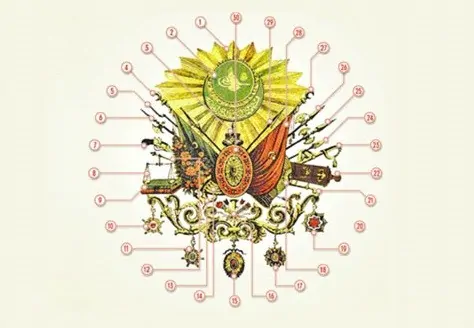
The Ottoman tughra is the sultan’s personal signature and should not be confused with the state’s coat of arms. You can find the symbols of the coat of arms in our article on the meaning of the Ottoman coat of arms and in the video below.
Frequently Asked Questions
What is the meaning of the Ottoman tughra?
The tughra is the sultan’s official signature and the emblem of his sovereignty. It contains the sultan’s name, his father’s name, his titles and a prayer meaning “ever victorious.”
What is written in an Ottoman tughra?
It contains the sultan’s name, the word “bin” (son of), his father’s name, titles such as “han” and “şah,” and the prayer “el-muzaffer dâimâ.” The letters are written without dots and stacked in an interlaced composition.
Was the meaning of the Ottoman tughra the same for every sultan?
The basic structure and meaning stayed the same, but the text changed according to each sultan’s name. Titles and the prayer were also added over time. This is why every sultan had a tughra of his own.
Who did the first tughra belong to?
The earliest known tughra is dated 1324 and belongs to Orhan Gazi. No tughra belonging to Osman Gazi has been found.
Conclusion
The meaning of the Ottoman tughra lies in its being the official signature that gathered the sultan’s name and authority into a single sign. From Orhan Gazi’s tughra of 1324 to that of the last sultan, the basic structure was preserved, but the form developed continuously. In the hands of the nişancıs and tughrakeshes, the tughra became both an instrument of government and a work of calligraphic art.
Sources
- TDV Encyclopedia of Islam, entry “Tuğra”
- TDV Encyclopedia of Islam, entry “Nişancı”
- TDV Encyclopedia of Islam, entry “Ferman”
- Suha Umur, Osmanlı Padişah Tuğraları [The Tughras of the Ottoman Sultans], Istanbul 1980.
- Mübahat S. Kütükoğlu, Osmanlı Belgelerinin Dili (Diplomatik) [The Language of Ottoman Documents: Diplomatics], Istanbul 1994.