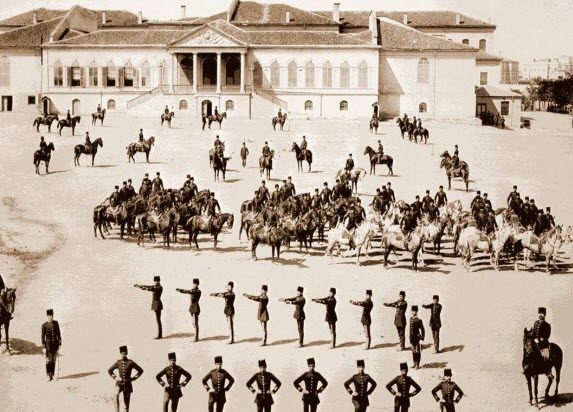
The word meaning military school in the Ottoman Empire is “Harbiye.” Its full name was Mekteb-i Harbiye, and the school began teaching in 1834 at the Maçka Barracks in Istanbul to train officers for the land army. “Mekteb” means school and “harbiye” means “of war.” For all military schools taken together, the expression “mekâtib-i askeriyye” was used.
Quick Summary
- The best-known word for a military school is Harbiye, in full Mekteb-i Harbiye.
- “Mekteb” means school and “harbiyye” means “of war”; together they mean “school of war.”
- The school began teaching in 1834; Mahmud II’s visit in 1835 was regarded as its official opening.
- Earlier, the Naval Engineering School had opened in 1775 and the Land Engineering School in 1795.
- Harbiye moved to Ankara in 1936; it is the root of today’s Turkish Military Academy.
Contents
- The meaning of the word
- Military schools before Harbiye
- The founding of Mekteb-i Harbiye
- What was education like at Harbiye?
- Military rüşdiyes and idadis
- From Harbiye to the Military Academy
- Frequently asked questions
The Word Meaning Military School in the Ottoman Empire: Harbiye

The first word of the phrase is “mekteb.” According to the TDV Encyclopedia of Islam, it is a noun of place derived from the root k-t-b, meaning “to write,” and it means “school.” Its plural is “mekâtib.” The encyclopedia notes that from the nineteenth century onward the word mektep was placed at the beginning of the names of almost all educational institutions.
The second word, “harbiye,” comes from the Arabic “harb,” meaning war. The suffix “-iyye” gives it the sense “of war, related to war.” Thus Mekteb-i Harbiye literally means “school of war.” Today’s Turkish name “Harp Okulu” (military academy) is a direct Turkish rendering of this phrase.
When all the military schools were referred to together, the expression “mekâtib-i askeriyye,” that is, “military schools,” was used. The institutions that ran these schools also bore names such as the Mekâtib-i Askeriyye Nezâreti (Directorate of Military Schools). In quizzes and exams, the expected one-word answer is usually Harbiye.
Military Schools before Harbiye
Harbiye was not the first military school opened by the state. The TDV Encyclopedia of Islam describes the Imperial Naval Engineering School (Mühendishâne-i Bahrî-i Hümâyun) as the first school founded in the modern sense in the history of Turkish education. Its opening was prompted by the army’s technical weakness in the Russian war that began in 1768. After the Çeşme raid of 1770, trained personnel were needed to rebuild the navy.
For a long time the school’s opening date was given as 1773. According to the encyclopedia, however, this date is misleading; French archival documents place the opening on 29 April 1775. The second major school, the Imperial Land Engineering School (Mühendishâne-i Berrî-i Hümâyun), opened in Hasköy in 1795. Among the early names of this school, which was connected with Selim III’s Nizam-ı Cedid army, was “Mekteb-i Fünûn-ı Harbiyye.”
In other words, the word “harbiye” had been associated with military education even before Mekteb-i Harbiye. The encyclopedia also notes that Hasköy was chosen deliberately because it was far from the city. The aim was to keep the students from forming ties with the Janissaries. At this military school, courses centered on mathematics and geometry were taught by Turkish teachers, without employing foreign instructors.
In 1827 the Mekteb-i Tıbbiyye was also founded to train military physicians. According to the TDV Encyclopedia of Islam, the school was opened on the initiative of the chief physician Behcet Mustafa Efendi to train physicians and surgeons for the Asakir-i Mansure. It began teaching on 14 March, celebrated today as Medicine Day in Turkey, in the Tulumbacıbaşı Mansion in Şehzadebaşı.
The Founding of Mekteb-i Harbiye
The founding of Harbiye is linked to the new military order that followed the abolition of the Janissary Corps in 1826. According to the TDV Encyclopedia of Islam, a training ground (talimgâh) was opened in Şehzadebaşı to meet the officer needs of the Asakir-i Mansure-i Muhammediyye. However, this first attempt came to nothing because of the Ottoman-Russian war. You can read about the abolition of the corps in our article on the Auspicious Incident (Vaka-i Hayriye).
The real step was taken in 1831. Ahmed Fevzi Pasha, the marshal of the Hassa Army, formed “sıbyan companies” with a few hundred men he selected from among the soldiers at Selimiye. Unlike the others, these soldiers were also taught to read and write. According to the encyclopedia, the sıbyan companies formed the foundation of Harbiye, and these soldiers were regarded as the first Harbiye cadets.
In the same years, Hüsrev Pasha proposed opening a military school in the style of the École Militaire in France. Mahmud II entrusted this task to Mehmed Namık Pasha. Although the revolt of Muhammad Ali Pasha, the governor of Egypt, delayed the process, the Maçka Barracks were converted into a school in 1834. The school was provided with classrooms for 400 people, a library, a mosque, a hospital, a printing house and a kitchen.
In its early years the school was known by different names such as “Ekol Militer,” “Mekteb-i Ulûm-i Harbiyye” and “Mekteb-i Fünûn-ı Harbiyye.” Mahmud II visited the school on 1 July 1835, eight months after teaching began. This visit was accepted as the official opening date, and the school’s name was registered as Mekteb-i Harbiyye. We discussed the transformation of the army in this period in our article on the first regular army.
What Was Education Like at Harbiye?
In its first years the school was not a modern institution in today’s sense. Because the students arrived without any prior education, they were first taught reading, writing and basic religious knowledge (ilmihal). The first eight years of the nine-year program were called the “first school” and the last year the “second school.” In the second school, subjects such as geometry, physics and astronomy were taught.
During the tenure of Selim Satı Pasha (1837–1841), military teachers were brought from Europe. From 1840 onward, French became one of the compulsory subjects. Under Emin Pasha (1841–1846), emphasis was placed on science and professional courses. On 10 October 1846, Harbiye moved to its building in Pangaltı, opened by Sultan Abdülmecid.
Under the new arrangement in Pangaltı, education at Harbiye lasted four years. A fifth “general staff class” (erkânıharp sınıfı), which trained staff officers, was added to the program. During the Constitutional period this class was separated and became an independent school called the Erkân-ı Harbiyye Mektebi (Staff College). The military school produced its first regular graduates at the end of the 1847–1848 academic year; twenty-four officers graduated.
The school’s building was also affected by wars. During the Crimean War (1853–1856) the building in Pangaltı was given to allied troops, and Harbiye moved first to Taşkışla and then to the Tıbbiye building in Gülhane. The building, ruined by fire, was rebuilt under Sultan Abdülaziz, and the school returned there in 1862. Under the command of Galib Pasha, the course of study was reduced to three years, and importance was given to physical education and sport.
Goltz Pasha, the German officer appointed inspector of military schools in 1882, put practical training ahead of theoretical lessons. According to the encyclopedia, in this period military education shifted from French to German influence. From 1904 onward, Harbiye schools were also opened in Edirne, Manastır, Erzincan, Damascus and Baghdad.
Military Rüşdiyes and İdadis
Over time, lower levels were established to prepare students for Harbiye. On Emin Pasha’s initiative, military idadis at the secondary level were opened first. During the command of Süleyman Hüsnü Pasha, the first military rüşdiyes began teaching in 1875. From then on, entry to Harbiye required three years of rüşdiye and four years of idadi.
These levels formed a structure parallel to the rüşdiyes and idadis of civilian education. You can find out what the idadis were in our article on the name given to high-school-level schools, and the general picture in our article on the education system. The video below on the primary and secondary school subjects of the period also opens a different window on the topic.
From Harbiye to the Turkish Military Academy
As the First World War began, students were graduated early, and the Harbiye school was closed on 4 August 1914. After the war, the British occupied the building in Pangaltı on 13 December 1918. Attempts were made to reopen the school in different buildings in Istanbul, but it was abolished in October 1922.
Meanwhile, the foundation of a new school had been laid in Ankara. According to the TDV Encyclopedia of Islam, a training ground was opened in Cebeci on 15 July 1920 to train officers quickly for the National Struggle. This institution was converted into the Mekteb-i Harbiyye on 1 April 1923 and moved to Pangaltı the same year. On 24 September 1936, Harbiye moved to Ankara again, this time permanently.
Today the school continues to teach in Ankara under the name Kara Harp Okulu (Turkish Military Academy). The Air Force Academy separated from Harbiye in the 1951–1952 academic year. The staff class opened within Harbiye in 1846 also gradually turned into an independent academy.
Frequently Asked Questions
What is the word meaning military school in the Ottoman Empire?
The best-known answer is Harbiye. The word is the shortened name of Mekteb-i Harbiye, founded in 1834, and it means “of war.”
When was Mekteb-i Harbiye founded?
The school began teaching in 1834 at the Maçka Barracks. Mahmud II’s visit on 1 July 1835 is accepted as its official opening date.
Which was the first military school?
The first school in the modern sense was the Imperial Naval Engineering School, opened in 1775. It was founded to train engineers and officers for the navy.
Is the word meaning military school in the Ottoman Empire still used today?
Yes. The Harbiye district of Istanbul takes its name from the school building in Pangaltı. Cadets of the military academy are still called “Harbiyeli.”
Conclusion
The word meaning military school in the Ottoman Empire is Harbiye, and it means “of war.” Mekteb-i Harbiye was founded after the abolition of the Janissary Corps to meet the modern army’s need for officers. The tradition of military education that began with the engineering schools acquired a systematic structure with Harbiye. Today this tradition continues with the Turkish Military Academy.
1 thought on “The Word Meaning Military School in the Ottoman Empire”