The short answer to the question “Did Palestine betray the Ottomans?” is no. The documents do not show that the people of the region rose up en masse against the Ottomans. The Arab Revolt against the Ottomans was launched in 1916 in the Hejaz by Sharif Hussein, the emir of Mecca. Most of the Arab population of the region, on the other hand, remained loyal to Ottoman rule throughout the war, and many of them fought in the Ottoman army.
Quick Summary
- The region remained under Ottoman rule for about four centuries, from 1516 to 1917.
- The Arab Revolt was launched not by the people of the region but by Sharif Hussein, the emir of Mecca.
- The British made contradictory promises to both the Arabs and the Zionists.
- Jerusalem passed into British hands in December 1917 without a fight.
- Most of the population did not join the revolt.
- After the war the region came under the British Mandate, and the Arabs opposed this administration.
Contents
- The answer to the question
- Four centuries of Ottoman rule
- Whose revolt was the Arab Revolt?
- Arab nationalism
- What did the people of the region do in the war?
- The loss of Jerusalem
- What happened after the war?
- Traces of the Ottoman period
- Common errors
- Frequently asked questions
Did Palestine Betray the Ottomans?
The accusation of “betrayal” arises from attributing the Arab Revolt of the First World War to all Arabs. Yet the revolt began in the Hejaz, and its leaders were Sharif Hussein, the emir of Mecca, and his sons. Most of the people around Jerusalem, Nablus and Gaza did not join the revolt. Accusing an entire people of betrayal therefore does not fit the historical facts. Making this distinction is important in the writing of history.
Of course, during the war years some Arab intellectuals took a stand against Ottoman rule. Some Bedouin groups also attacked retreating units. These incidents, however, remained limited and do not reflect the general attitude of the region. We examined the military side of the subject in detail in our article What the Palestinians Did to Ottoman Soldiers.
Four Centuries of Ottoman Rule
According to the TDV Encyclopedia of Islam, the region came under Ottoman administration in the reign of Selim I, after the Battle of Marj Dabiq in 1516. Suleiman the Magnificent had the walls of Jerusalem rebuilt. The walls and the gate of the Dome of the Rock were also renovated in this period. According to the encyclopedia, the walls surrounding the Haram area were rebuilt as well.
According to the encyclopedia, Ottoman rule was interrupted only between 1831 and 1840, in the time of Muhammad Ali Pasha of Egypt. Between 1872 and 1917 Jerusalem was a mutasarrifate attached directly to Istanbul. Nablus and Acre, on the other hand, were attached to the province of Beirut, founded in 1888. We described Selim’s Egyptian campaign in our article on how the caliphate passed to the Ottomans.
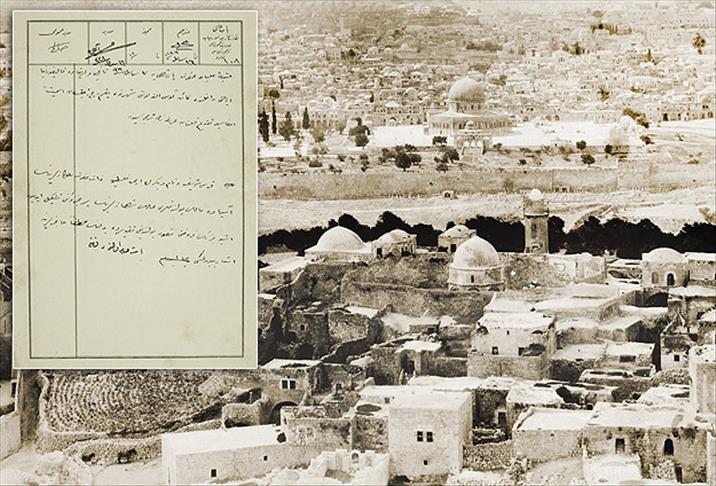
In the late period the region also took part in Ottoman political life. In the first Ottoman parliament, opened in 1877, Jerusalem was represented by Yusuf Ziya al-Khalidi. The railway between Jaffa and Jerusalem opened in 1892. The Haifa branch of the Hejaz Railway also linked the region to Damascus.
Whose Revolt Was the Arab Revolt?
According to the TDV Encyclopedia of Islam, in 1915–1916 Sharif Hussein corresponded with McMahon, the British High Commissioner. In this correspondence he was promised an independent Arab state. Trusting these promises, Hussein rebelled against the Ottomans in 1916. According to the encyclopedia, the British attached more importance to this revolt after their disappointment at Gallipoli.
At the same time, however, Britain and France signed the secret Sykes–Picot Agreement, which divided the region between them. According to the encyclopedia, the British Foreign Secretary Balfour also issued a declaration on 2 November 1917 supporting the establishment of a Jewish homeland in Palestine. The encyclopedia regards these developments as the British deceiving the Arabs with promises. These documents show that the real winners of the revolt were Britain and France.
How Did Arab Nationalism Develop?
At the beginning of the 20th century some Arab intellectuals founded secret societies. Most of these societies initially sought not independence but more rights within the empire. The Arab Congress that met in Paris in 1913 also voiced demands such as decentralization and the use of Arabic in official spheres. The centralizing policies of the Committee of Union and Progress, on the other hand, increased this discontent.
Even so, at the beginning of the war these movements had not spread to broad sections of the population. Arab nationalism was strongest among urban intellectuals. Most of the people living in the countryside kept their traditional loyalties.
What Did the People of the Region Do in the War?
With mobilization, large numbers of young men from the region were also taken into the Ottoman army. The soldiers fought on different fronts, from the Suez Canal to the Caucasus. Regiments made up of Arab soldiers also served at Gallipoli. Most of the region’s leading families cooperated with the Ottoman administration until the end of the war.
The war years were very hard for the people of the region. In 1915 there was a great locust plague, and famine and epidemics occurred throughout the war. According to the encyclopedia, the harsh measures of Cemal Pasha, commander of the Fourth Army, also provoked a reaction. By decision of a military court, eleven Arab nationalist leaders were executed in 1915 and twenty-one in 1916.
The Loss of Jerusalem
In 1917 the British army broke through the Gaza–Beersheba line. According to the TDV Encyclopedia of Islam, Beersheba fell on 31 October 1917. The new army group formed to defend Jerusalem was not successful either. On the night of 8–9 December, Ottoman units evacuated the holy city without a fight. According to the encyclopedia, General Allenby entered the city on 11 December 1917.
The city was surrendered to the British by the mayor of Jerusalem, Hussein Salim al-Husseini. In this way the holy places were spared damage in the fighting. According to the encyclopedia, Jerusalem remained under British military administration from 1917 to 1920.
According to the encyclopedia, by September 1918 the British had taken the whole region. Thus some four hundred years of Ottoman rule came to an end. This meant that the region changed hands after about four centuries. We told the story of the loss of Jerusalem in our article In which war was Jerusalem lost?
What Happened After the War?
After the war the Arabs demanded that the region be left to them. According to the TDV Encyclopedia of Islam, the San Remo Conference of 1920 placed the region under a British mandate. This administration was also approved by the League of Nations on 24 July 1922. Britain also separated the area east of the Jordan River and set up the Emirate of Transjordan. Abdullah, a son of Sharif Hussein, was placed at the head of the emirate.
According to the encyclopedia, the Jewish population rose from 38,754 in 1914 to 58,728 in 1918. The Arabs feared that the British would hand the region over to the Jews. Various uprisings took place in 1920, 1928, 1929 and 1933. In this period the Grand Mufti of Jerusalem, Hajj Amin al-Husseini, became the leading figure of the Arab opposition.
These developments show that the war did not give the Arabs of the region what they had expected. The Arabs, who had been expected to gain from the revolt, were forced into a new struggle against the British Mandate. According to the encyclopedia, Hajj Amin al-Husseini was also placed at the head of the Arab Higher Committee founded in 1936.
Traces of the Ottoman Period
The traces of four centuries of Ottoman rule can still be seen today. The walls surrounding Jerusalem and the city’s famous Damascus Gate were built in the time of Suleiman the Magnificent. The sebils, or public fountains, all around the city also date from this period. The clock tower in Jaffa, on the other hand, was built for the twenty-fifth anniversary of Abdülhamid II’s accession to the throne.
These works show the region’s long and deep-rooted bond with the Ottomans. It should not be forgotten that most of the population remained faithful to this bond during the war years as well.
Common Errors
Some errors appear frequently in texts written on this subject. For example, Sharif Hussein is sometimes presented as “the commander who committed betrayal on the Palestine front”. Yet Hussein was not a front commander in the Ottoman army but the emir of Mecca. He also launched the revolt in the Hejaz.
Another common claim is that the people of the region blinded thousands of Ottoman soldiers. No reliable document confirming this claim is known. The exact number of people from the region who fought in the Ottoman army is not known either, and the high figures given on this subject are not based on documents. We discussed the general results of the war in our article on the fall of the Ottoman Empire.
Frequently Asked Questions
Did Palestine betray the Ottomans?
No. The people of the region did not rise up en masse against the Ottomans. The Arab Revolt was launched in the Hejaz by Sharif Hussein, and most of the people of the region did not join it.
Why is the question “Did Palestine betray the Ottomans?” asked?
The attribution of the Arab Revolt to all Arabs and certain incidents at the end of the war gave rise to this question. The documents, however, do not support a collective betrayal.
When did Jerusalem pass out of Ottoman hands?
The British army entered Jerusalem in December 1917. Ottoman units had evacuated the city without a fight. The city was surrendered by its mayor.
Who was Sharif Hussein?
According to the TDV Encyclopedia of Islam, he was born in Istanbul and served for a long time as a member of the Council of State. In November 1908 he was appointed emir of Mecca. His sons, meanwhile, were deputies in the Ottoman parliament.
When did the Arab Revolt begin?
It began in 1916 in the Hejaz. The leader of the revolt was Sharif Hussein, the emir of Mecca, who had corresponded with the British and received the promise of an independent Arab state.
Conclusion
To the question “Did Palestine betray the Ottomans?”, the documents answer “no”. The Arab Revolt began in the Hejaz, and most of the people of the region remained loyal to Ottoman rule throughout the war. After the war, however, the Arabs saw that the British promises were empty. A new period of struggle began under the British Mandate. For this reason, the claim of collective betrayal is not supported by the historical record.