The period of the Four Caliphs was a critical turning point after the Prophet, when the Islamic community faced its first major tests in leadership, law, conquest, and politics; when the tradition of statehood was established, the consciousness of the ummah was strengthened, the office of the caliphate gained meaning, and the religious-political debates of later centuries were deeply shaped.
Quick Summary
- Caliphal rule first took institutional form and grew stronger.
- Conquests spread powerfully beyond Arabia across vast regions.
- The text of the Qur’an was preserved and compiled into a common mushaf.
- Political disputes left deep and lasting marks within the ummah.
- The principles of justice and shura became firmly embedded at the center of governance.
Contents
- What Is the Period of the Four Caliphs?
- Why Are Governance and Institutionalization Important?
- How Did the Conquests Change Islamic History?
- How Did Social and Political Divisions Begin?
- What Is the Long-Term Legacy of the Period?
- Conclusion

What Is the Period of the Four Caliphs?
The period of the Four Caliphs began in 632, when Abu Bakr was chosen as caliph. It ended in 661 with the martyrdom of Ali. In Islamic history, this period is known as the “Rightly Guided Caliphs”. The phrase means caliphs who followed the right path.
These four leaders were, in order, Abu Bakr, Umar, Uthman, and Ali. Each faced a different crisis. Yet all of them sought to ensure the continuity of the Islamic community. The TDV Encyclopedia of Islam treats this era as a foundational phase of early Islamic politics.
First of all, this period showed how leadership after prophethood would be carried out. The Prophet had been head of state, guide, and prophet. After his death, prophethood came to an end. Yet the community’s administrative and legal needs continued.
The First Leadership Test in the Period of the Four Caliphs
The selection of Abu Bakr prevented a political vacuum from emerging in Medina. The discussions held between the Ansar and the Muhajirun are important for this reason. This process is considered an early example of the idea of shura. However, the decision was not made easily.
During his brief caliphate, Abu Bakr fought against the Ridda movements. Some tribes refused to pay zakat. Others did not recognize the central authority. For this reason, the unity of the state faced its first major test.
According to Mustafa Fayda, this struggle was not merely military. It was also a demonstration of legal and political resolve. That is because zakat was the financial foundation of social order. Moreover, if central authority collapsed, the very idea of the state would weaken.
Why Are Governance and Institutionalization Important?
The main factor that makes the era of the Four Caliphs a turning point is the beginning of institutionalization. During these years, the state moved beyond tribal relations into a broader structure. The reign of Umar is especially decisive in this respect. The diwan system, regular salary registers, and provincial administration developed during this process.
Umar used new methods to govern the territories that expanded through conquest. He appointed governors, assigned judges, and founded military cities. Kufa, Basra, and Fustat are the best known of these cities. Thus, governance did not remain centered solely on Medina.
This structure influenced later Muslim states. The institutional continuity seen in Ottoman administration is also indirectly connected to this legacy. To understand this connection, the article the Imperial Council and Ottoman state administration offers a complementary framework.
The Understanding of Justice in the Period of the Four Caliphs
In the governance of the Four Caliphs, justice was not merely a moral principle. It was also the source of the state’s legitimacy. The caliphs considered it important to listen to the people’s complaints. The supervision of governors was also part of this understanding.
Umar’s administration in particular remained in memory for its emphasis on justice. Sources frequently describe his simple way of life. These accounts do not always come down to us with the same level of detail. Yet they reveal the period’s ideal type of ruler.
On the other hand, it is necessary to distinguish idealized narratives from historical reality. Early sources transmit some events as models of exemplary behavior. For this reason, the historian evaluates both the reports and the political context together. Hugh Kennedy also examines the early Islamic conquests within this broader context.
The Compilation of the Qur’an into a Mushaf
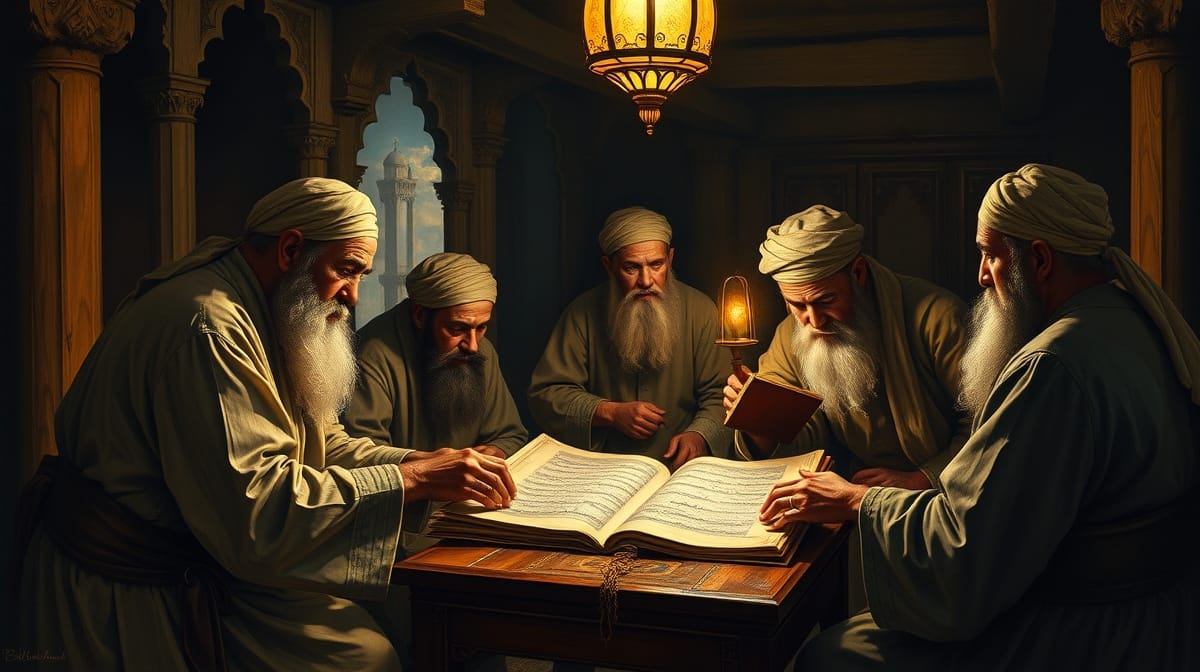
One of the most enduring decisions of this period was the preservation of the Qur’anic text. The first compilation effort began during the time of Abu Bakr. The martyrdom of many memorizers of the Qur’an at the Battle of Yamama accelerated this decision. In the reports, the committee headed by Zayd ibn Thabit comes to the fore.
During the reign of Uthman, standardized copies of the mushaf were reproduced. The copies sent to different regions aimed to limit disagreements over recitation. This step strengthened the Islamic community’s unity around a shared text. Therefore, the work on the mushaf was not only a religious decision but also a social one.
This process established a strong link in early Islamic society between the preservation of revelation and political unity.
How Did the Conquests Change Islamic History?
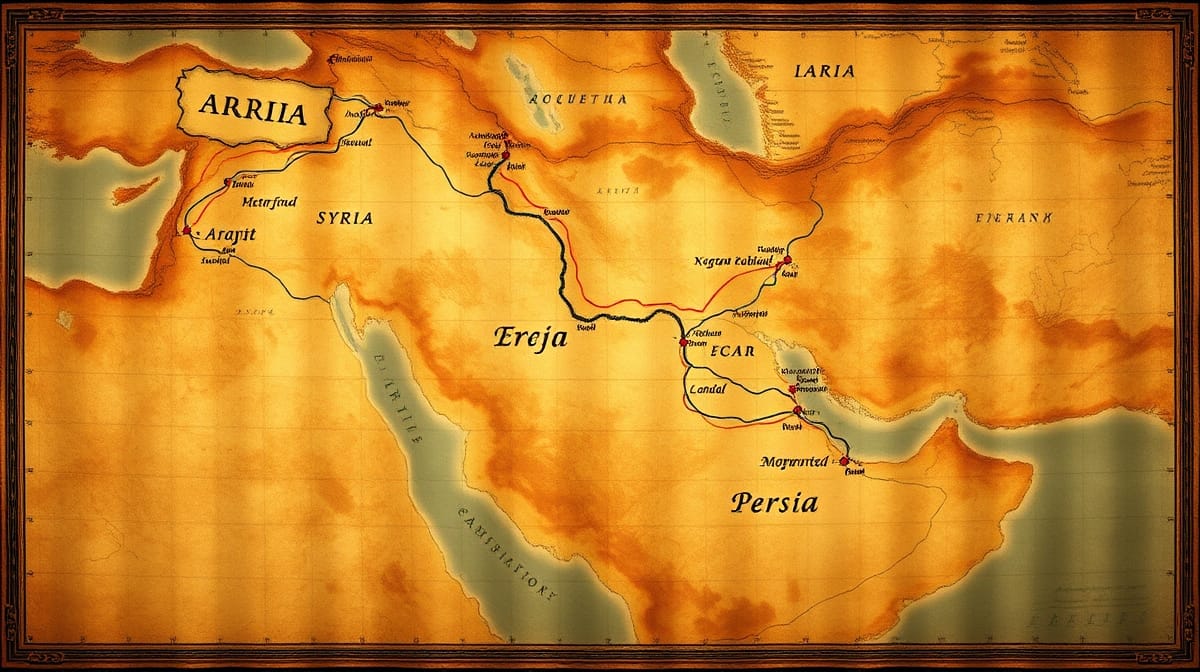
The period of the Four Caliphs was one of the fastest phases of expansion in Islamic history. Major transformations took place across Syria, Iraq, Egypt, and Iran. Victories against Byzantine and Sasanian forces gave rise to a new world order. Thus, the Islamic state ceased to be merely a regional power.
The campaigns that began under Abu Bakr produced major results in the time of Umar. The Battle of Yarmuk in 636 shook Byzantine domination in Syria. In the same years, the victories of Qadisiyyah and Nahavand weakened Sasanian power. As a result, the road to Iraq and Iran was opened.
The conquest of Egypt was also important for the Mediterranean world. The campaigns led by Amr ibn al-As created a new administration centered on Fustat. This affected trade routes and the tax system. In addition, Arabic gradually gained strength as the language of administration.
The Economic and Social Consequences of the Conquests
The conquests did not mean only territorial gain. They also produced new sources of taxation, military organization, and settlement policies. Practices such as jizya and kharaj shaped relations with different communities. This order became a model for later Islamic states.
Alongside this, the conquests established new relationships between Muslims and non-Muslims. Some local populations preserved their previous administrative experience. In certain regions, the existing bureaucracy was not completely dismantled. This method offered a practical solution for rapid governance.
The multi-religious social structure of Ottoman history was the product of a different age. Yet the early Islamic experience created a foundational memory in this regard. For this comparison, the article the Ottoman millet system and non-Muslim rights is a useful follow-up reading.
Military Organization in the Period of the Four Caliphs
During the years of the Four Caliphs, the army moved from tribal units centered on booty toward more regular structures. Military diwan records were kept during the reign of Umar. Granting soldiers salaries ensured continuity. In addition, garrison cities were established in frontier regions.
These cities were not only military bases. They also became cultural and religious centers. Circles of learning developed in Kufa and Basra. In this way, the movement of conquest also initiated new processes of urbanization.
This order influenced later models of expansion in Islamic history. Similarly, readers who wish to understand Ottoman growth may compare it with the article titled the reasons for the Ottoman State’s rapid growth.
How Did Social and Political Divisions Begin?
One reason the era of the Four Caliphs is regarded as a turning point is its internal crises. During Uthman’s reign, administrative choices caused debate. Kinship ties, appointments to governorships, and the distribution of booty became subjects of criticism. These tensions eventually turned into a serious rebellion.
The martyrdom of Uthman in 656 caused a deep shock in the Islamic community. This event was not merely a political assassination. It was also the beginning of a crisis of legitimacy. Later events showed that this rupture continued to grow.
When Ali became caliph, the community was already divided. The Battle of the Camel and the Battle of Siffin were among the first major internal conflicts between Muslims. The arbitration incident then gave rise to new debates. The Kharijite movement emerged in this environment.
The Meaning of the Battle of the Camel and the Events at Siffin
The Battle of the Camel took place between the supporters of Ali and those of Aisha, Talha, and Zubayr. The central issue was the punishment of Uthman’s killers. However, political conditions made a solution difficult. This event showed that even the generation of the Companions experienced a grave crisis.
The Battle of Siffin was the struggle between Ali and Mu’awiya, the governor of Damascus. At the end of the battle, the arbitration process began. This process led some groups to take a stance against Ali. Thus, political disagreement merged with religious discourse.
As a result, early Islamic society could not produce a single-centered politics. Nevertheless, these debates influenced the histories of law, theology, and sectarian formation. Researchers such as Adem Apak examine these events together with the social foundations of sectarian divisions. This approach is important for an impartial assessment.
What Is the Long-Term Legacy of the Period?
The period of the Four Caliphs came to be seen as an ideal era for later Muslim societies. In Sunni political thought, these caliphs were accepted as legitimate and exemplary rulers. In the Shi’i tradition, however, Ali’s position carried a special meaning. This differing memory forms one of the central debates in Islamic history.
This legacy is not limited to the history of sects. Issues such as the ethics of rulership, shura, justice, and sensitivity toward public property were also nourished by this period. Muslim thinkers frequently referred to this era in discussions of good governance. For this reason, the period remained alive in terms of both history and political thought.
The idea of the caliphate later changed under the Umayyads and Abbasids. Elements of dynastic monarchy gained strength. The Ottomans used the claim to the caliphate with a political meaning much later. To see this long trajectory, the article the process by which the caliphate passed to the Ottomans provides a relevant connection.
The Legacy of the Four Caliphs and Ottoman Perception
The legacy of the Four Caliphs was not a model directly copied in Ottoman political culture. Yet it was a powerful reference point in the language of legitimacy. The sultans emphasized the concepts of justice, the protection of religion, and public order. These concepts were compatible with early Islamic memory.
The Ottoman claim to leadership in the Islamic world was especially nourished by the idea of the caliphate. This claim was not equally strong in every period. However, it became more visible in the modern age. For a continuation of the subject, the article titled the leadership of the Ottoman sultans in the Islamic world may be read.
Nevertheless, the historian should not draw easy similarities between periods. Seventh-century Medina society and the Ottoman imperial order had different conditions. Even so, the search for justice, legitimacy, and unity produced shared themes. Therefore, when comparison is made carefully, it is instructive.
Conclusion
The period of the Four Caliphs is a fundamental turning point in Islamic history, when governance became institutionalized, geography expanded through conquests, and political divisions became pronounced. This period shows both the search for ideal rule and the lasting impact of historical crises. As a result, the legacy of the Four Caliphs still holds a central place in the memory of the Islamic world.
Sources
- TDV Encyclopedia of Islam (DİA), entry on al-Khulafa al-Rashidun.
- Mustafa Fayda, The Era of the Rightly Guided Caliphs.
- Adem Apak, Islamic History in Outline.
- Hugh Kennedy, The Great Arab Conquests.
- Philip K. Hitti, History of the Arabs.