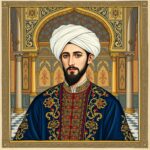
The reasons for the rapid growth of the Ottoman Empire were its favourable geographical position, the weakness of Byzantium and the Balkan states, the policy of tolerance called istimalet and a strong military order. The beylik was founded as a small frontier principality on the Byzantine border. Within about a century it turned into a vast state stretching from the Danube to the Euphrates.
Quick Summary
- Founded on a frontier bordering Byzantium, the beylik was well placed to expand.
- The civil wars in Byzantium and the political fragmentation of the Balkans made the conquests easier.
- The istimalet policy helped the local population warm to the new rule.
- The ahis, the gazis and the dervishes were influential in the founding period.
- The timar system and regular infantry units increased the strength of the army.
Contents
- The main reasons
- Geographical position and the frontier setting
- The weakness of neighbouring states
- The istimalet policy
- Ahis, gazis and dervishes
- Migration and settlement
- Military and administrative order
- The unity of the dynasty
- Chronology of the conquests
- Frequently asked questions
What Were the Reasons for the Rapid Growth of the Ottoman Empire?
Historians do not attribute this rapid growth to a single cause. Geography, the political conditions of the time, the approach to government and the military order all played a part together. The main reasons can be listed as follows:
- Its frontier position on the Byzantine border and the gaza environment.
- The weakening of Byzantium through civil wars and the fragmentation of the Balkans.
- The istimalet policy, based on winning over the local population.
- The support of the ahi, gazi and dervish communities.
- Turkmen migrations stretching from Anatolia to Rumelia.
- The timar system, regular military units and capable administrators.
Geographical Position and the Frontier Setting
Osman Bey’s beylik arose around Söğüt, on a frontier bordering Byzantine territory. Most of the other beyliks in Anatolia bordered one another and had limited room to expand. This beylik, by contrast, faced the weakened Byzantine lands directly. This situation drew to the region Turkmens who wanted to fight and win booty.
Byzantine defence in Anatolia had also weakened. The local defence units along the frontier had broken up, and the people of the region were worn out by heavy taxes. As a result, the fortresses of Bithynia changed hands one by one.
According to the TDV Encyclopedia of Islam, in the late 13th and early 14th centuries the idea of gaza was both a motivation and a source of legitimacy on the frontiers. According to the encyclopedia, in 1938 Paul Wittek put forward a thesis explaining the rise of the state through the spirit of gaza. Later historians debated this thesis and showed that the concept of gaza carried a more flexible meaning. We described the life of the founding bey in our article Who was Osman Gazi?
The Weakness of Neighbouring States
In the 14th century Byzantium was caught up in a severe civil war. John Kantakouzenos, one of the parties to the struggle for the throne, asked Orhan Bey for help and married his daughter Theodora to him. These relief campaigns allowed Turkish units to get to know Rumelia. We discussed the conquests of Orhan’s reign in our article on Ottoman expansion under Orhan Gazi.
There was no strong centre in the Balkans either. After the death of the Serbian King Stefan Dušan in 1355, the Serbian state broke apart. In the Bulgarian lands, too, there were rival dynasties. According to the encyclopedia, the sons of the Bulgarian tsar had divided the country among themselves, which made the conquest easier.
The situation in Anatolia was no different. The authority of the Ilkhanids in the region collapsed after the death of Abu Sa‘id Khan in 1335. The Turkish beyliks were rivals and had no unity among them. In this climate of rivalry, the first beylik to be annexed was Karasi. We covered this subject in our article on the first principality to join the Ottomans.
Istimalet: The Policy of Tolerance
According to the TDV Encyclopedia of Islam, istimalet is a policy based on winning the hearts of the people in the conquered lands. According to the encyclopedia, this approach was inherited from the Seljuks and, in the founding years, was applied as good relations with the Byzantine lords of Bithynia. Winning over an important raider family such as the Mihaloğulları is the best-known example of this.
The main results of the policy were seen in the Balkans. According to the encyclopedia, the local Christian population was protected, its rights were restored and religious freedom was granted. Exemptions from some taxes were also provided. It is also said that Balkan peasants, freed from feudal burdens, saw the new rule as a liberator. According to the encyclopedia, this practice was one of the reasons the Ottomans were able to hold on in the Balkans for centuries.
According to the encyclopedia, Halil İnalcık divides lasting conquest into stages. First the local ruler becomes a tribute-paying vassal. Then comes a period of adjustment, after which the local dynasty is set aside by peaceful means. The old order was not abolished all at once but adapted to the new system. We described the rights granted to non-Muslims in our article on the millet system.

Ahis, Gazis and Dervishes
The presence of strong communities around the beylik in the founding period also accelerated its growth. According to the TDV Encyclopedia of Islam, Aşıkpaşazade counts the ahis among the four groups that played an active role in the founding. According to the encyclopedia, Sheikh Edebali was also one of the ahi sheikhs and had married his daughter to Osman Bey. Orhan Bey, for his part, had taken the ahi title “ikhtiyar al-din”. The four groups listed by Aşıkpaşazade are the gazis, the ahis, the abdals and the bacıs.
The ahi brotherhoods were organizations that brought together craftsmen in towns and villages. According to the encyclopedia, Ibn Battuta, who travelled through Anatolia in the 14th century, describes how widespread these brotherhoods were. The gazis and dervish communities took part in conquest and settlement in the frontier regions. The lodges founded by dervishes became the nucleus of many new settlements. Ömer Lütfi Barkan calls these dervishes “colonizing Turkish dervishes”.
Migration and Settlement
Turkish settlers from Anatolia came to the conquered lands of Rumelia. According to the “Bulgaristan” entry of the TDV Encyclopedia of Islam, the population of the region was increased through these migrations. Yörük groups also settled in various parts of Rumelia. This new population helped make the conquests permanent. According to the encyclopedia, the yörüks who crossed into Rumelia kept their former way of life.
The textbook account of a “planned settlement policy”, however, is debatable. According to the “İskân” (Settlement) entry of the TDV Encyclopedia of Islam, some nomadic groups were forcibly moved to Rumelia. Even so, it is not entirely correct to say that the state pursued a systematic settlement policy from the very beginning. A large part of the migration happened spontaneously.
Military and Administrative Order
The beylik established regular military units early on. Under Orhan Bey, the yaya and müsellem units were formed. According to the TDV Encyclopedia of Islam, after the conquest of Edirne (1361), one-fifth of prisoners of war began to be set aside for the state. The Janissary Corps also grew out of the soldiers gathered in this way.
The timar system, in turn, supported a large cavalry army without burdening the treasury. According to the encyclopedia, counterparts of this system can also be seen in the iqta of the Seljuks and the pronoia of Byzantium. According to the encyclopedia, Timurtaş Bey made important arrangements in Rumelia in 1375–1381. In these arrangements, timars were also given to local Christian soldiers.
Continuity in government was also important. According to the encyclopedia, Murad I appointed Lala Şahin in Rumelia as beylerbeyi over the frontier beys. Viziers from the Çandarlı family played a role in establishing the order of the state. Members of this family served as viziers for about a century.
The Unity of the Dynasty
In Turkic states it was common for the country to be divided among members of the dynasty. This tradition had led many states to break up within a short time. In this beylik, however, the country came over time to be concentrated in the hands of a single ruler. As a result, the conquered lands were not split up among brothers, and the strength of the state was not dispersed.
Chronology of the Conquests
The speed of growth is clearly visible in the important conquests of the founding period. Some of the dates in the table are given differently in the sources.
| Year | Development |
|---|---|
| 1326 | Conquest of Bursa |
| 1331 | Conquest of Nicaea (İznik) |
| 1337 | Conquest of Nicomedia (İzmit) |
| 1352-1354 | Crossing into Rumelia with Tzympe and Gallipoli |
| 1361 | Conquest of Edirne |
| 1389 | First Battle of Kosovo |
| 1396 | Battle of Nicopolis |
This expansion was temporarily interrupted by the Battle of Ankara in 1402. We described the consequences of this defeat in our article on Bayezid I and the Battle of Ankara.
Frequently Asked Questions
What were the reasons for the rapid growth of the Ottoman Empire?
The main reasons were its frontier position, the weakness of Byzantium and the Balkans, the istimalet policy, the support of the ahi and gazi communities and the timar system.
What place did tolerance have among the reasons for the growth of the Ottoman Empire?
The policy of tolerance called istimalet made it easier for the people of the Balkans to accept the new rule. As a result, no major revolts broke out in the conquered lands.
What does istimalet mean?
It is a policy based on winning the hearts of the people in the conquered lands. Religious freedom, the protection of rights and tax concessions were its main elements. According to the encyclopedia, the concept is related to the Quranic notion of “mu’allafat al-qulub”, those whose hearts are to be won over.
Which was the first beylik to be annexed?
The Karasi beylik. It was annexed under Orhan Bey and played an important role in the crossing into Rumelia. The beylik’s seafaring experience made it easier to cross the Dardanelles.
When did the first crossing into Rumelia take place?
It took place under Orhan Bey, between 1352 and 1354, with the capture of the fortress of Tzympe and of Gallipoli.
Conclusion
The reasons for the rapid growth of the Ottoman Empire cannot be reduced to a single factor. Its frontier position and the weakness of its neighbours created opportunities for expansion. The istimalet policy led the conquered peoples to accept the new rule. The timar system and regular military units, in turn, made these gains permanent. In this way a small frontier beylik turned into a great state within a century.
Sources
- TDV Encyclopedia of Islam, entry “İstimâlet”
- TDV Encyclopedia of Islam, entry “Gazâ” (Gaza)
- TDV Encyclopedia of Islam, entry “Ahîlik” (Ahi Brotherhood)
- TDV Encyclopedia of Islam, entry “Murad I”
- TDV Encyclopedia of Islam, entry “İskân” (Settlement)
- Halil İnalcık, Devlet-i Aliyye I [The Sublime State I].