
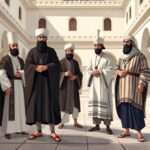
The Young Ottomans were opposition intellectuals who, between 1865 and 1876, challenged the Tanzimat bureaucracy and called for constitutional government. Figures such as Namık Kemal, Ziya Pasha and Ali Suavi spread their ideas through newspapers. Although the movement remained loosely organized, it laid the intellectual groundwork for the Ottoman constitution (Kanun-i Esasi) proclaimed in 1876.
Quick Summary
- These intellectuals opposed the authoritarian rule of the Tanzimat pashas.
- They defended the ideas of parliament, constitution and liberty through the Islamic principle of consultation (meşveret).
- In 1867 they went to Europe at the invitation of the Egyptian prince Mustafa Fazıl Pasha.
- In London they kept up their opposition with the newspapers Muhbir and Hürriyet.
- Their ideas formed the basis of the 1876 constitution and the First Constitutional Era.
Contents
- A short definition
- In what climate did they emerge?
- The founding: legend and fact
- The Paris and London years
- What did they want?
- Leading figures
- 1876 and after
- Why did the movement break up?
- Frequently asked questions
Who Were the Young Ottomans? A Short Definition
The TDV Encyclopedia of Islam defines this group as an opposition circle formed by Ottoman intellectuals against the government between 1865 and 1876. The name the group used in its own time was “Yeni Osmanlılar” (New Ottomans). In the European press, however, they were referred to as the “Jeunes Turcs.”
This naming caused confusion later on, because the opposition of the reign of Abdülhamid II also became known as the Young Turks. Historians therefore treat the intellectuals of the 1860s as a separate generation and carefully distinguish them from the later opposition.
In What Climate Did the Young Ottomans Emerge?
The Tanzimat Edict proclaimed in 1839 and the Reform Edict of 1856 launched a major transformation in government. The direction of this transformation, however, was set less by the sultan than by a few pashas at the Sublime Porte. In particular, the long-lasting influence of Âli Pasha and Fuad Pasha created a new bureaucratic authority.
The young intellectuals criticized this order from two angles. First, the reforms were carried out from the top down, without the participation of the people. Second, the interference of European states in internal affairs and foreign debts were undermining the state’s independence. In the following years these criticisms turned into demands for a parliament and a constitution.
Private journalism was also just beginning to flourish in this period. “Tasvir-i Efkâr,” published by Şinasi, was the stage for Namık Kemal’s first political writings. The press became this generation’s most effective weapon. For an overview of the intellectual movements of the period, see our article on Ottoman currents of thought.
The language of the newspapers also changed in this process. Instead of the heavy style of court literature, Namık Kemal and his friends tried to use a language that a wider readership could understand. Through these writings, concepts such as “homeland” (vatan) and “liberty” (hürriyet) became part of everyday political debate.
The Founding: The Belgrade Forest Legend and 1867
According to the common account, the society was founded in 1865 during an outing in the Belgrade Forest near Istanbul. This information rests largely on the memoirs of Ebüzziya Tevfik. The TDV Encyclopedia of Islam, however, draws attention to the contradictions in this account.
According to Kaya Bilgegil’s research, the group founded at the meeting in the Belgrade Forest bore the name “meslek.” A body called the Society of New Ottomans actually emerged in Europe in 1867. This distinction shows that the movement was more a loose circle than an organization.
The Young Ottomans and the Name “İttifak-ı Hamiyyet”
Members of the group sometimes presented themselves under the name İttifak-ı Hamiyyet. At that time the word “hamiyet” was used in the sense of patriotism. Şerif Mardin translated the name into English as “patriotic alliance.” For details on the members’ profile, see our article on the traces of the secret society.
The Young Ottomans in Europe: The Paris and London Years
In 1867 the government took harsh measures against opposition writers. Namık Kemal, Ziya Bey and Ali Suavi accepted the invitation of the Egyptian prince Mustafa Fazıl Pasha and went abroad. According to the TDV Encyclopedia of Islam, the group arrived in Paris on 30 May 1867.
Mustafa Fazıl Pasha had lost his right of succession in Egypt in 1866. Supporting the opposition to the Istanbul government therefore suited him as well. By covering the costs of the newspapers, the pasha became the movement’s most important patron.
Ali Suavi began publishing the newspaper Muhbir in London on 31 August 1867. Namık Kemal and Ziya Bey then launched the weekly Hürriyet on 29 June 1868. Until September 1869 Hürriyet was written by these two authors and became the voice of the movement.

The years of exile, however, deepened divisions rather than unity. Ali Suavi broke away from the group early. Some members were left without support after Mustafa Fazıl Pasha reconciled with Istanbul. After Âli Pasha’s death in 1871, many of them returned to Istanbul.
What Did the Young Ottomans Want?
Their demands were never gathered into a single program, but some common ideas stand out. For the roots of these ideas, see also our detailed article on the roots of the idea of liberty.
- Constitution and parliament: They wanted government to be limited by written rules and the people to take part in decisions through representatives.
- Consultation (meşveret): They argued that the principle of governing through consultation lay at the heart of Islam and that parliament was not a foreign invention.
- Ottomanism: They aimed to unite all subjects, regardless of religion and language, through the bond of a common homeland.
- Independent foreign policy: They opposed the intervention of the great powers and a government dependent on foreign loans.
- Freedom of the press: They considered it important that public opinion be able to scrutinize the government through newspapers.
What is striking about these ideas is that they defended concepts coming from the West in Islamic terms. Starting from the Qur’anic verses on consultation, Namık Kemal wrote that parliament had religious legitimacy. In this way the idea of a constitution could also be explained to conservative circles.
Leading Figures of the Young Ottomans
| Name | Role |
|---|---|
| Namık Kemal | Journalist and writer, the most effective advocate of the concepts of liberty and homeland |
| Ziya Pasha | Poet, co-author of the newspaper Hürriyet with Namık Kemal |
| Ali Suavi | Founder of the newspaper Muhbir, the group’s most radical member and the first to leave |
| Mustafa Fazıl Pasha | Egyptian prince, the movement’s financial backer in Europe |
| Şinasi | Founder of Tasvir-i Efkâr, the movement’s intellectual pioneer |
For Namık Kemal’s life and works, you can read our article Namık Kemal: the powerful voice of liberty. His play “Vatan yahut Silistre” (Homeland, or Silistra), staged in 1873, resulted in the author’s exile to Famagusta.
1876: The Constitution and the Influence of the Young Ottomans
In the mid-1870s the state fell into a severe financial crisis, and payments on the foreign debt faltered. Revolts in the Balkans also shook confidence in the government. In this climate, constitutionalist statesmen and intellectuals came together around the same goal.
In 1876 Sultan Abdülaziz was deposed, and three months later Abdülhamid II came to the throne. A commission called the Meclis-i Mahsus was set up under Midhat Pasha to prepare the constitution. According to the TDV Encyclopedia of Islam, Midhat Pasha, Ziya Pasha and Namık Kemal represented the liberal-reformist wing in the debates.
The constitution was proclaimed at the end of 1876, and the General Assembly (Meclis-i Umumi) was opened. The assembly worked for two sessions and was suspended in February 1878. The movement’s greatest goal thus proved short-lived. We discussed this transformation in detail in our article on the change of regime in the Ottoman state.
The most debated article of the constitution was Article 113, which gave the sultan the power of exile. Ironically, Midhat Pasha himself was sent into exile on the basis of this article. We discussed the political atmosphere of the following thirty years in our article on the reign of Abdülhamid II.
Are the Young Ottomans the Same as the Young Turks?
No. The intellectuals of the 1860s and 1870s and the later generation that organized against Abdülhamid II were different. The Young Turks had the constitution proclaimed again in 1908. We compared the two generations in our article on the key differences.
Why Did the Movement Break Up?
The first reason for the movement’s breakup was its lack of organization. According to the TDV Encyclopedia of Islam, the members could neither build a real organization nor reach a consensus among themselves. Each acted with his own pen and his own circle.
The second reason was dependence on outside support. The newspapers’ costs rested largely on Mustafa Fazıl Pasha. When the pasha reconciled with Istanbul, the movement’s financial base also weakened.
The third reason was personal and intellectual differences. Ali Suavi’s radical line often clashed with Namık Kemal’s more measured stance. Nevertheless, the breakup did not mean that the ideas disappeared. The idea of a constitution and a parliament became a lasting part of the political vocabulary of later generations.
Frequently Asked Questions
When were the Young Ottomans founded?
The common account gives 1865. Research shows, however, that the body called the Society of New Ottomans emerged in Europe in 1867.
What form of government did the Young Ottomans advocate?
They advocated constitutional government, in which the sultan’s powers were limited by a constitution and an elected parliament existed.
Who prepared the Kanun-i Esasi?
The text was prepared in the Meclis-i Mahsus chaired by Midhat Pasha. The commission included ulema, soldiers and bureaucrats. Ziya Pasha and Namık Kemal were also among the spokesmen of the pro-reform wing in the debates.
Conclusion
The Young Ottomans were neither a disciplined organization nor a party with a single view. Yet they were the first generation to bring the concepts of constitution, parliament and homeland before the public. Although the 1876 constitution was short-lived, the path they opened would be taken again in 1908 and would form the foundation of modern Turkish political thought.
Sources
- TDV Encyclopedia of Islam, entry “Yeni Osmanlılar Cemiyeti”
- TDV Encyclopedia of Islam, entry “Kānûn-ı Esâsî”
- TDV Encyclopedia of Islam, entry “Nâmık Kemal”
- TDV Encyclopedia of Islam, entry “Mustafa Fâzıl Paşa”
- Şerif Mardin, The Genesis of Young Ottoman Thought.
- Kaya Bilgegil, Yakın Çağ Türk Kültür ve Edebiyatı Üzerinde Araştırmalar I: Yeni Osmanlılar.






3 thoughts on “Who Were the Young Ottomans?”