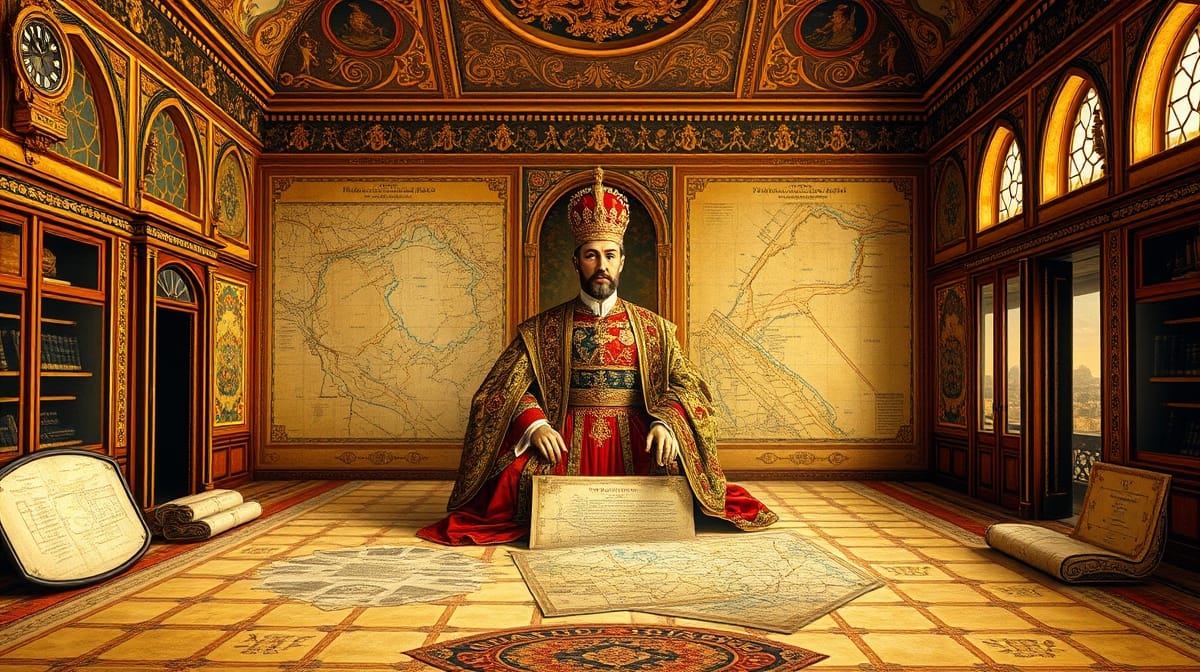
The reign of Abdulhamid II cannot be explained solely by the label of despotism or solely by that of modernization; for while the sultan pursued an authoritarian policy by closing parliament, he also took lasting steps that transformed the Ottoman Empire in education, telegraphy, railways, school networks, and central administration, especially in years of crisis when he brought security-minded decisions and reformist goals under the same roof.
Quick Summary
- Despotism gained strength through central control and censorship.
- Modernization took concrete form in education and communication networks.
- The telegraph linked provincial administration more tightly to Istanbul.
- Railways served both military and economic aims.
- Islamism was used as a tool of legitimacy in foreign policy.
Contents
- Understanding the Reign of Abdulhamid II
- The Despotism Debate: Fear, Security, and Centralization
- Modernization Initiatives: Telegraph, Railway, and Administration
- Education and Bureaucracy: A New Generation of State Cadres
- Islamism, Diplomacy, and Society
- Legacy and Assessment
- Conclusion
Understanding the Reign of Abdulhamid II
When Abdulhamid II ascended the throne in 1876, the state was in a profound crisis. Balkan revolts, financial bankruptcy, and European pressure were all being felt at once. Moreover, Ottoman intellectuals saw constitutional order as the remedy that could prevent the empire’s disintegration.
In this atmosphere, the Ottoman Basic Law was proclaimed and the Chamber of Deputies was opened. Yet the Russo-Ottoman War of 1877-1878 rapidly altered the political balance. In 1878, the sultan suspended parliament indefinitely and concentrated government around Yildiz Palace.
This choice gave rise to the central tension of the period. On one side, constitutional hopes were suspended. On the other, the state was kept standing through tighter rule. For this reason, the subject of democratization movements in the Ottoman Empire experienced a new rupture with this period.
This period is like a complex laboratory in which crisis management and authoritarianization became intertwined.
The Despotism Debate: Fear, Security, and Centralization
Abdulhamid II and Yildiz-Centered Politics
The concept of despotism was used by the period’s opponents to describe the sultan’s rule. This concept is associated especially with censorship, the network of informants, and the continued closure of parliament. From the sultan’s perspective, however, the issue was security and the survival of the state.
Yildiz Palace was not merely a residence in these years. The palace became a center where decisions were gathered and reports from the provinces were evaluated. Thus, the state moved from a bureaucracy dominated by the Sublime Porte toward a palace-centered order.
Censorship and Opposition in the Reign of Abdulhamid II
Press control was one of the harshest practices of the period. Newspapers, books, and theater scripts were closely monitored. The Young Turk opposition in particular tried to overcome this oppressive environment through publications in Europe.
On the other hand, this control did not merely restrict intellectual life. It also changed the administration’s way of reading society. The empire was monitored through mechanisms of loyalty, suspicion, and reporting. As Selim Deringil emphasizes, the language of legitimacy was constructed much more carefully in this period.
Even so, it would be incomplete to explain despotism solely through personal fears. The 1877-1878 war, the Treaty of Berlin, and the losses in the Balkans created a major trauma. These conditions strengthened security-minded reflexes and hardened the administration.
Modernization Initiatives: Telegraph, Railway, and Administration
The reign of Abdulhamid II is remembered not only for authoritarian politics but also for the expansion of modern institutions. Telegraph lines, railways, and provincial administration were the main instruments of this expansion. These fields enabled the state to establish faster contact with the provinces.
The telegraph became one of the most effective symbols of centralization. Istanbul accelerated its receipt of news from distant provinces. In times of crisis, it also became possible for orders to reach the provinces more quickly. Communication thus turned into a direct political power.
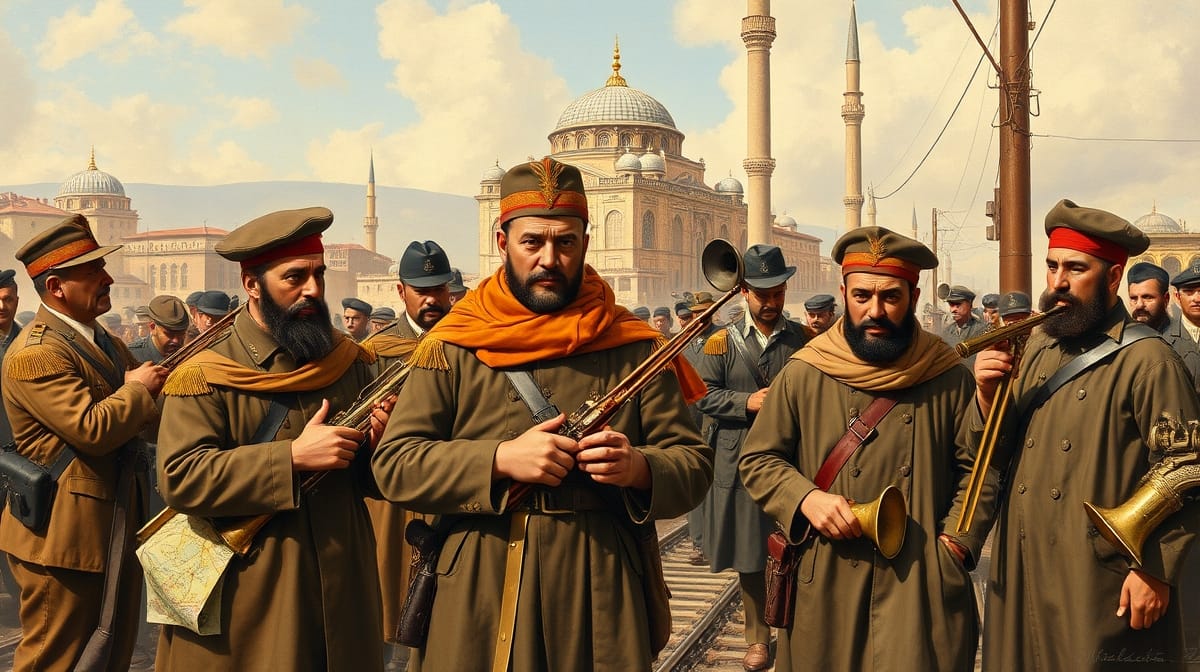
Railways served a similar function. The Anatolian Railway and Hejaz Railway projects facilitated transportation. The Hejaz Railway, whose construction began in 1900, aimed to strengthen the pilgrimage route and imperial bonds.
These projects were not merely tools of economic development. They were also used for military transport, administrative control, and symbolic unity. Caroline Finkel, in describing the late Ottoman period, particularly emphasizes the political significance of these infrastructure initiatives.
The line of modernization was a continuation of earlier reforms. For this reason, the transformation that began with the Tanzimat and Reform Edicts continued with new instruments. This time, however, modernization had a more centralized rather than libertarian character.
Education and Bureaucracy: A New Generation of State Cadres
The Expansion of the Educational Network under Abdulhamid II
Education was one of the most enduring fields of Abdulhamid II’s rule. Schools at the rushdiye, idadi, and sultani levels became widespread. In addition, vocational schools aimed to train the civil servants and specialist cadres needed by the state.
This development did not completely eliminate the classical madrasa order. It did, however, make the modern school network more visible. Schools opened especially in the provinces strengthened the state’s ideological and administrative presence. For this reason, the education system in the Ottoman Empire gained a new dimension.
According to Kemal Karpat, education and population policies influenced the construction of identity in late Ottoman society. Schools were not merely institutions that transmitted knowledge. They were also centers that carried the ideas of loyalty, Ottomanism, and Islamic legitimacy.
Modern Schools and State Reason
Schools such as the Mülkiye, Tıbbiye, and Harbiye strengthened the backbone of the new bureaucracy. Yet the students educated in these schools eventually also became a source of opposition. This situation reveals one of the greatest paradoxes of the period.
The sultan expanded modern educational institutions. But he could not fully control the intellectual world produced by these institutions. As a result, education became both an instrument of state modernization and the intellectual source of opposition.
Islamism, Diplomacy, and Society
Abdulhamid II used the institution of the caliphate as an effective symbol in foreign policy. Especially in regions inhabited by Muslim communities, the prestige of the Ottoman caliph was brought to the fore. This policy was a moral and diplomatic tool in the face of European colonialism.
Islamism in this period was not merely a religious discourse. It was also a strategy for holding the empire together. The Arab provinces, Indian Muslims, and Central Asian connections acquired meaning within this framework. This subject holds a special place among Ottoman intellectual movements.
In addition, the sultan tried to benefit from rivalry among the European states. The balances among Britain, France, Germany, and Russia were watched carefully. The growing closeness with Germany became especially evident in railway and military cooperation.
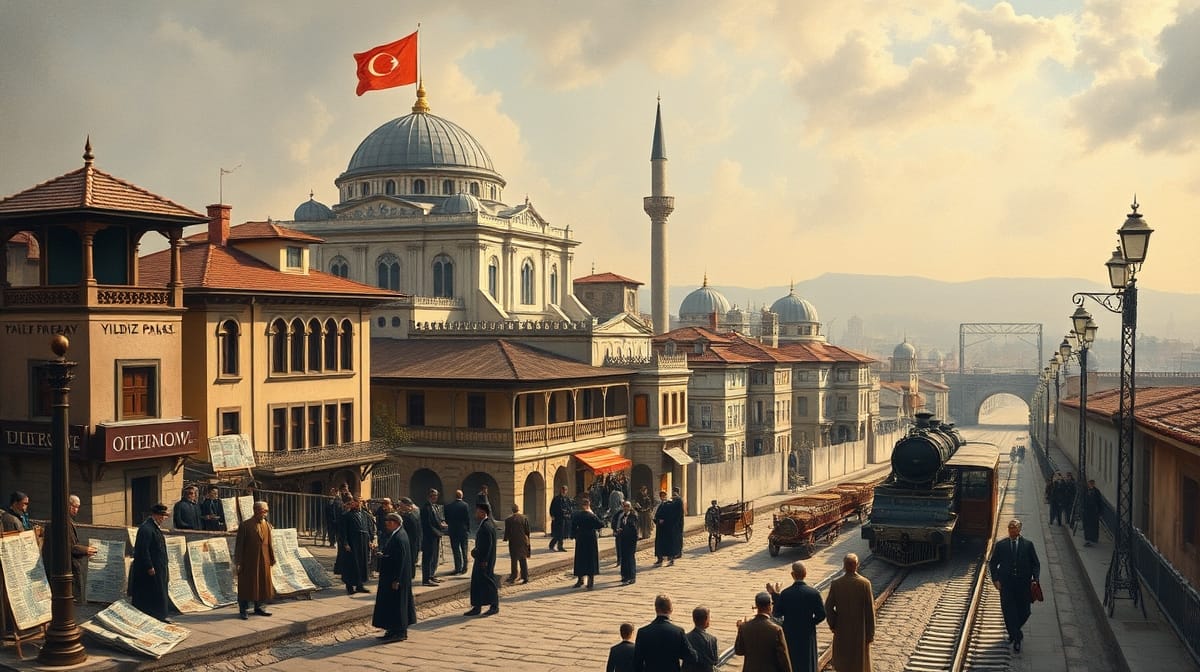
Yet the successes of foreign policy were not unlimited. The Ottoman Empire operated within a narrow space because of debts and territorial losses. In 1881, the Ottoman Public Debt Administration was established. This institution made the issue of fiscal sovereignty even more visible.
Legacy and Assessment
Assessments of the sultan generally gather at two extremes. One view sees him solely as an oppressive ruler. The other regards him as a great modernizer who kept the state alive.
In reality, neither approach is sufficient on its own. For the sultan did not use modern tools for a politics of freedom. He evaluated them more as means of central control, the production of loyalty, and the expansion of state capacity.
For this reason, despotism and modernization do not stand as opposites. On the contrary, in this period they often became two faces of the same mechanism. The telegraph, school, and railway were symbols of progress. Yet the same tools were also used for surveillance and control.
The proclamation of the Second Constitutional Era in 1908 brought this model of government to an end. In 1909, Abdulhamid II was deposed. Afterward, the weight of the Committee of Union and Progress increased in Ottoman politics. This process was an important threshold in the collapse of the Ottoman Empire.
The social and economic perspective compiled by Halil Inalcik and Donald Quataert places this period within a broader framework. Accordingly, late Ottoman history did not consist only of palace decisions. Finance, population, education, and the world economy also shaped the picture.
Ultimately, Abdulhamid II was neither a figure wholly opposed to progress nor a flawless reform hero. His reign shows that Ottoman modernization could take an authoritarian form. In this respect, he occupies a distinct place when the Ottoman sultans in order are examined.
Conclusion
The reign of Abdulhamid II was a historical moment in which despotism and modernization could exist at the same time. To understand it, therefore, censorship, education, the telegraph, the railway, caliphal politics, and conditions of crisis must be evaluated together.
Sources
- Kemal H. Karpat, The Politicization of Islam (2001).
- Selim Deringil, The Well-Protected Domains (1998).
- Caroline Finkel, Osman’s Dream (2005).
- Halil İnalcık & Donald Quataert, An Economic and Social History of the Ottoman Empire (1994).
- TDV İslâm Ansiklopedisi, Abdülhamid II.








2 thoughts on “The Reign of Abdulhamid II: Despotism or Modernization in Reality?”