The Janissaries were one of the most important and most disciplined military corps of the Ottoman Empire. Their founding took place within the framework of the state’s need to grow and consolidate its central authority. The Janissaries were formed in the late 14th century, particularly during the reign of Murad I, as part of the devshirme (child levy) system. Non-Muslim boys collected through the devshirme method were converted to Islam, put through a long training process, and enrolled in the Janissary Corps.
The Janissaries played an active role not only on the battlefield but also in guarding the palace, maintaining internal order, and upholding state authority. Preserving discipline within the palace, ensuring the sultan’s security, and serving as a vanguard force on major campaigns were among their core responsibilities.
Over time, the Janissaries became a powerful group in Ottoman society, both militarily and socially. This corps, initially formed to serve the sultan with unwavering loyalty, gradually turned into a body that acted in pursuit of its own interests. Nevertheless, for a long period it formed the backbone of the Ottoman military system. The Janissaries can be summarized as follows:
- Soldiers recruited through the devshirme system
- A military corps under the sultan’s direct command
- The force safeguarding the palace and the state
- Professional soldiers who received disciplined, regular training
- The main land force of Ottoman military campaigns
Founding of the Janissary Corps
The founding of the Janissary Corps was one of the most critical military innovations of the Ottoman transition from a frontier principality to a full-fledged state. According to most sources, the corps was established during the reign of Murad I, between 1363 and 1365, near Edirne. On the recommendation of Sultan Murad’s vizier Çandarlı Kara Halil Pasha, the practice of setting aside one-fifth of war captives for the state was introduced under the “pencik law” (one-fifth law), and the first infantry unit made up of these boys was named the Janissaries (Yeniçeri, meaning “New Army”). During the founding phase, the spiritual guardianship of the corps was attributed to Hacı Bektaş Veli, which led the Janissaries to form a close bond with the Bektashi order.
Initially numbering around 1,000 soldiers, the corps grew significantly in both size and organization during the reign of Mehmed the Conqueror. At the time of the conquest of Istanbul, the corps’ strength was close to 12,000; during Suleiman the Magnificent’s reign it ranged between 12,000 and 15,000; and by the second half of the 17th century it had reached between 50,000 and 100,000. Originally tasked solely with fighting alongside the sultan, the Janissaries gradually became an indispensable part of palace guard duty, capital security, and state protocol. This structure was one of the fundamental elements that shaped the Ottoman classical age.
The Devshirme System and the Acemi Oğlan Corps
The human resources of the Janissary Corps were built on the devshirme system. Every three to five years, healthy and intelligent-looking boys aged 8 to 18 were collected from the Christian subject population, primarily in the Balkans, according to strict rules. Restrictions built into the system included exemptions for families with only one son, sons of priests, and children from city centers. The boys who were collected were brought to Istanbul, converted to Islam and circumcised, and then placed for a time with Turkish families under the practice known as being sent “to the Turk.” After becoming familiar with the language and customs there, the boys were enrolled in the Acemi Oğlan Corps (Corps of Novices).
The Acemi Oğlan Corps operated out of two main centers, in Gelibolu and Istanbul. There, the boys underwent rigorous military and religious training for roughly five to seven years, while also being put to physical labor in gardens, shipyards, and construction workshops. At the end of this training, a selection ceremony known as “kapıya çıkma” or “bedergâh” was held; those who succeeded were admitted into the Janissary Corps, granted a salary called “ulufe,” and registered to a specific company. Those who showed exceptional intelligence and talent were instead directed to the Topkapı Enderun (Palace School). This system functioned as a disciplined institution that renewed the ranks of the Ottoman Janissaries for centuries.
What Were the Duties of the Janissaries?
The duties of the Janissaries formed one of the cornerstones of the Ottoman Empire’s military and internal security order. Every individual admitted into the Janissary Corps had specific responsibilities, and these duties became increasingly systematized over time. The duties of the Janissaries were not confined to the battlefield alone; they also supported various aspects of state functioning during peacetime.
The Janissaries fought in the front lines during wartime, took the lead in siege warfare, and were tasked with breaking through enemy lines. They also took direct part in protecting the sultan and army commanders during campaigns. For this reason, the performance of the Janissaries on Ottoman campaigns was a decisive factor in the empire’s victories.
During peacetime, the Janissaries were assigned to maintain security in major cities, particularly Istanbul. They intervened in urban incidents and represented state authority in situations such as fires and uprisings. They were also responsible for maintaining order during state protocol ceremonies. The duties of the Janissaries can be listed as follows:
- Fighting on the front lines in battle
- Protecting the sultan and army commanders
- Securing Istanbul and other major cities
- Maintaining order during palace ceremonies
- Undergoing continuous military training
- Upholding state authority during revolts and unrest
A clear degree of specialization also stands out among the duties of the Janissaries during the classical era. The Solak companies served as the sultan’s close bodyguards; the Zağarcı and Sekban companies took part in hunting expeditions. When on campaign, the companies themselves carried out the army’s logistical tasks such as baking bread, setting up tents, and distributing rations. The Janissaries’ gathering around the cauldron was not merely for meals but also for consultation and decision-making; the symbolic act known as “kazan kaldırma” (overturning the cauldron) was a clear sign of discontent within the corps and, in extreme cases, of an impending revolt. In this respect, the Janissaries became an institution that not only fought but also maintained the internal workings of the corps under a shared discipline.
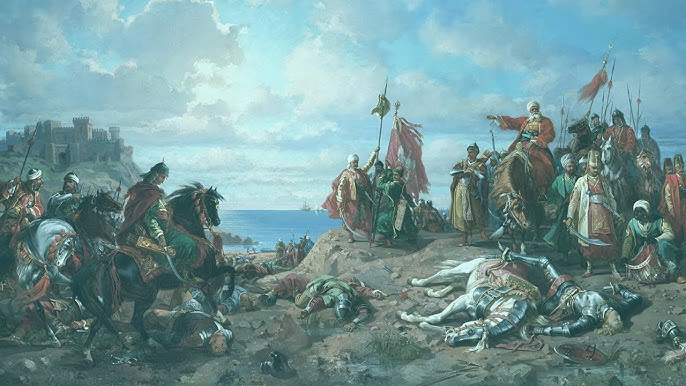
Organizational Structure of the Janissary Corps
In the classical period, the Janissary Corps was divided into three main classes: the Cemaat companies, the Bölük (Agha Companies), and the Sekban Companies. This structure comprised a total of 196 companies, made up of 101 Cemaat companies, 61 Agha Companies, and 34 Sekban Companies. The Cemaat companies formed the corps’ original and largest section, the Agha Companies served in palace duty, and the Sekban Companies were assigned to hunting and special tasks. Each company was headed by a commander with the title “çorbacı” (literally “soup-maker”); special motifs and banners were used as each company’s emblem. These motifs were embroidered not only on cauldrons and banners but also on the doors of the Janissaries’ barracks, reinforcing a sense of loyalty and belonging among the companies through these symbols.
At the top of the corps’ hierarchy stood the Janissary Agha, followed by the Sekbanbaşı, the Kul Kethüdası, and the Zağarcıbaşı. The officer class included çorbacıs, odabaşıs, and aşçıbaşıs. Through its horizontal division into companies and its vertical chain of ranks, the Janissary Corps formed a distinctive institutional structure unlike contemporary European armies. Subunits such as the Atçeken, Tüfekçi, Kapıcı, and Tersaneli were also separated according to their specific duties. The extent to which the Ottoman Janissary organization was regulated in such detail is one of the most important factors explaining the corps’ centuries-long effectiveness.
Weapons and Equipment of the Janissaries
The weapons used by the Janissaries changed significantly from one era to another. In the classical period, their basic weapons were the yatağan (short sword), sword, axe, spear, bow, and arrow. From the reign of Mehmed the Conqueror onward, the musket (tüfenk) entered the corps’ arsenal, becoming widespread during the reigns of Bayezid II and Selim I. In the Battles of Chaldiran (1514) and Mohács (1526), the Janissaries’ firepower with muskets played a decisive role in Ottoman victories. Later, as Europe transitioned to flintlock systems, Janissary muskets remained matchlock for a long time; this became one of the factors that weakened the corps’ military superiority from the 17th century onward.
In terms of uniform, the Janissaries’ most distinctive marker was the “börk,” the headgear they wore. Made of white felt with its tip hanging backward, this headgear became the emblem of the corps. Senior officers wore üsküf and kuka headpieces in different colors and shapes. The kaftans, vests, and shalwar trousers worn over their uniforms were also tailored in cuts specific to the corps. The companies’ banners bore motifs of the zülfikâr (twin-bladed sword) and crescent, predominantly in yellow. The mehter music the Janissaries played while marching, referred to by names such as “tabl-ı misk-i kelam,” represents one of the oldest examples of military band music in history, used both to instill courage in the ranks and to strike a blow to the enemy’s morale.
Who Led the Janissaries?
The head of the Janissaries bore the title “Janissary Agha.” This post carried great significance both militarily and administratively. The Janissary Agha reported directly to the sultan and was responsible for the entire functioning of the Janissary Corps. The head of the Janissaries also held a very high position in state protocol.
The Janissary Agha managed every process related to the corps’ discipline, military training, appointments, and punishments. In wartime, he was responsible for the deployment and command of the Janissaries and, when necessary, provided support to army commanders on campaign. In peacetime, he took part in matters of urban security and public order.
The appointment of the Janissary Agha, the head of the Janissaries, was made directly by the sultan’s will. He was generally chosen from among skilled and experienced officers, with the aim of appointing someone who could preserve the corps’ order. Aghas who failed to fulfill their duties successfully were dismissed by the sultan’s order.
At times, the head of the Janissaries also exerted indirect influence over state administration. Particularly powerful Janissary Aghas were able to gain influence over the sultans. Nevertheless, they were always required to remain subject to the sultan’s will.
The official residence of the Janissary Agha was the building known as Ağakapısı (the Agha’s Gate), located near the Süleymaniye complex; this site served both as the corps’ central office and as a headquarters where judicial matters were handled. The Agha was one of the few high-ranking officials received in the sultan’s presence during council meetings, and he personally led the Janissaries’ salute procession at major ceremonies such as accession celebrations, religious holidays, and the raising of the Sacred Banner. His term in office was not fixed; some Aghas remained in the post for years, while others were replaced within months during periods of unrest within the corps. Notable grand viziers such as Köprülü Mehmed Pasha and Mere Hüseyin Pasha held the post of Janissary Agha at some stage in their careers.
Janissary Revolts and the Auspicious Incident
From the 17th century onward, as discipline within the corps loosened, individuals outside the devshirme system were admitted, and the value of the ulufe salary declined, the Janissaries became a source of political pressure. Osman II’s 1622 attempt to reform the kapıkulu class was suppressed by the Janissaries themselves, and the young sultan was strangled at Yedikule. In 1730, the Patrona Halil Revolt brought an end to the Tulip Era and dethroned Sultan Ahmed III. In 1807, the Kabakçı Mustafa Revolt resulted in the dethronement of Selim III, founder of the Nizam-ı Cedid (New Order) army, and his subsequent murder in 1808.
This unending series of revolts reinforced the belief among Ottoman statesmen that the corps no longer needed reform but abolition. Mahmud II laid siege to the Janissaries who opposed his newly established Eşkinci army at Etmeydanı and Atmeydanı on 15 June 1826, subjected them to cannon fire, and formally abolished the corps. This event went down in history as the “Vaka-i Hayriye” (the Auspicious Incident). The subsequent banning of the Bektashi order, due to its close ties with the Janissaries, shows that the corps was dismantled not only as a military body but also as a social and religious institution. The Auspicious Incident marks the turning point that paved the way for the establishment of a modern Ottoman army, the Asakir-i Mansure-i Muhammediye (the Victorious Soldiers of Muhammad).
Frequently Asked Questions
Who founded the Janissary Corps?
The Janissary Corps was founded during the reign of Murad I, the Ottoman Empire’s third sultan, between 1363 and 1365. On the recommendation of his vizier Çandarlı Kara Halil Pasha, one-fifth of war captives was set aside for the corps under the pencik law, and the corps’ foundation was laid with the spiritual guardianship of Hacı Bektaş Veli. Initially established with about 1,000 soldiers, the corps grew into a permanent force exceeding 12,000 during the reign of Mehmed the Conqueror.
Which religion and order did the Janissaries follow?
Being of devshirme origin, the Janissaries were converted to Islam upon entering the corps. Spiritually, they were affiliated with the Bektashi order; they regarded Hacı Bektaş Veli as their patron saint and were known by the symbol of the “Bektashi crown.” The corps was also referred to as “Ocak-ı Bektaşiyan” (the Bektashi Hearth). This spiritual bond was one of the main reasons why the Bektashi order was banned alongside the Janissary Corps by Mahmud II in 1826.
How were the Janissaries paid?
The Janissaries received a regular salary called ulufe, distributed every three months. This distribution ceremony, known as the “ulufe procession,” took place on council days, with the sultan watching the ceremony from the Tower of Justice. Each company’s register listed names and daily pay amounts, and the treasurers paid the ulufe in akçe (silver coin). From the 16th century onward, the devaluation of the akçe created problems with the ulufe payments and became a significant economic cause behind frequent revolts.
How many Janissaries were there?
The number of Janissaries varied greatly across different periods. Under Murad I there were roughly 1,000; under Mehmed the Conqueror, between 10,000 and 12,000; and under Suleiman the Magnificent, between 12,000 and 15,000. By the second half of the 17th century this figure had reached 50,000 to 70,000, and by the mid-18th century it nominally exceeded 100,000. However, these figures are largely based on the salary registers known as “esamî,” so the actual number of fighting soldiers was considerably lower.
When was the Janissary Corps abolished?
The Janissary Corps was abolished by Mahmud II on 15 June 1826 in the event known as the Auspicious Incident. The Janissaries, who opposed the newly formed Eşkinci army, were subjected to cannon fire while gathered at Etmeydanı; the revolt was violently crushed and the corps was brought to an end. A modern army, the Asakir-i Mansure-i Muhammediye, was established in its place, bringing to a close the Ottoman Empire’s roughly 460-year-old military institution.