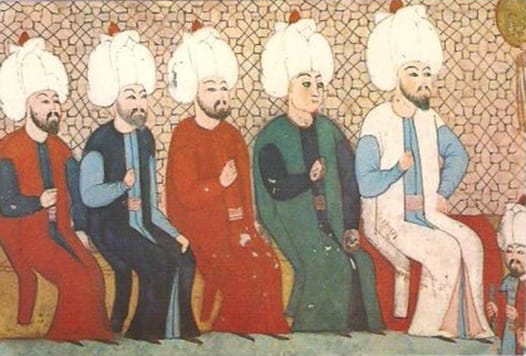
The dome viziers were the viziers who sat with the grand vizier in the Imperial Council (Divan-ı Hümayun) at Topkapı Palace and took part in the state’s most important decisions. They took their name from the domed hall where the council met. Their number usually ranged from three to seven and rose to as many as nine in times of war. In this article we look at who they were, what they did and how the institution changed over time, with sources.
Quick Summary
- The dome viziers were senior viziers serving in the council in Istanbul.
- The council met in the domed hall of Topkapı Palace.
- The sultan could listen to the meetings from behind a latticed window.
- The number of viziers rose to nine during the long wars after 1578.
- In the second half of the seventeenth century, real decision-making moved to the Sublime Porte.
Contents
- Who were the dome viziers?
- Where is the Kubbealtı?
- The number of viziers
- Their place and duties in the council
- Matters discussed in the council
- Privileges of the viziers
- Meeting order and the arz
- Who became a vizier?
- The rise of the Sublime Porte
- Frequently asked questions
Who Were the Dome Viziers?
According to the TDV Encyclopedia of Islam, two categories of vizier emerged over time. The first were the viziers who served in the Imperial Council in Istanbul and were called “inner” (dâhil) or dome viziers (kubbe veziri). They were also called “kubbenişîn”, meaning those who sit under the dome. The second were the viziers serving in the provinces, called “outer” (hâriç) or provincial viziers.
After the grand vizier, the dome viziers were the highest-ranking officials of the state. They were referred to by rank as the second vizier, the third vizier and so on. When a grand vizier died or was dismissed, the new grand vizier was usually chosen from among them. For an overall picture of the state’s central government, see our article what was the Divan-ı Hümayun?
Where Is the Kubbealtı?
The TDV Encyclopedia of Islam defines this place as the building where council meetings were held, on the left side of the courtyard between the Gate of Salutation (Bâbüsselâm) and the Gate of Felicity (Bâbüssaâde) in Topkapı Palace. This building, which can still be visited in the palace’s second courtyard, was the heart of government.
According to the encyclopedia, a similar council hall also existed in the Edirne Palace, where some sultans stayed for long periods. This shows that the council was an institution that moved together with the sultan.
The Latticed Window: The Sultan’s Unseen Presence
The most striking feature of the council hall is a latticed window opening onto the meeting room. According to the TDV Encyclopedia of Islam, the sultan could listen to the deliberations from behind this window whenever he wished. The viziers could not know whether the sultan was there or not. The encyclopedia notes that this led members to make extremely just and cautious decisions.
How Many Dome Viziers Were There?
The number of viziers changed from period to period. According to the TDV Encyclopedia of Islam, in the periods when the council kept its function, the number of dome viziers usually ranged from three to seven. In the founding period, by contrast, the state had only a single vizier.
According to the encyclopedia, during the long war with the Safavids that began in 1578, the number of dome viziers rose to nine. The burden of command and administration that the war required created a need for more senior officials. This increase also reduced the prestige of the vizierate.
Their Place and Duties in the Council
According to the TDV Encyclopedia of Islam, the core members of the council were the grand vizier, the dome viziers, the kadiaskers of Rumelia and Anatolia, the nişancı (chancellor) and the defterdars (treasurers) of Rumelia and Anatolia. When he was in Istanbul, the beylerbeyi of Rumelia also attended. The agha of the Janissaries, once raised to the rank of vizier, could also be among the members.
- Counsel: They advised the grand vizier on political, military and administrative matters.
- Cases: They took part in examining the cases brought to the council.
- Campaign command: On some campaigns they commanded the army as serdar.
- Deputyship: When the grand vizier went on campaign, they stayed in Istanbul in his place.
The Dome Viziers and the Grand Vizier
The dome viziers were both the grand vizier’s assistants and his possible rivals. Because the office of grand vizier was usually filled from their ranks, there was fierce competition among the viziers. This rivalry was one of the main causes of palace intrigues and sudden dismissals. For the grand viziers of the period, see our article list of Ottoman grand viziers.
What Matters Were Discussed in the Council?
The Imperial Council was not just a body where great questions such as war and peace were discussed. Many matters concerning the daily running of the state were also decided here. The viziers had a say in almost all of them.
- Political affairs: Receiving ambassadors, treaties and relations with foreign states.
- Military affairs: Campaign preparations, fortification of castles and appointments of commanders.
- Financial affairs: Tax arrangements, the budget and the monitoring of treasury revenues.
- Judicial affairs: Complaints from the people and high-level cases.
A striking feature of the council was that ordinary people could also bring their complaints to it. A villager who believed he had been wronged could apply to the council with a petition. This practice was a concrete reflection of the idea that the sultan watched over justice directly.
Privileges and Symbols of the Viziers
The vizierate was one of the highest ranks of the state and was expressed through certain visible symbols. The best known of these was the tuğ, the horsetail standard. Viziers carried three tuğs, while beylerbeyis had two and sancakbeyis one. The number of tuğs made the bearer’s rank clear even from a distance.
Viziers held high-income has revenues and maintained large retinues in their own mansions. The TDV Encyclopedia of Islam also counts among the viziers’ privileges the right to apply directly to the grand vizier and the nişancı for the issuing of a ferman. These privileges turned the viziers into powerful political actors within the state.
Meeting Order and Going to the Arz
According to the TDV Encyclopedia of Islam, in the sixteenth century the council met sometimes four and sometimes five days a week. Meeting days ran from Saturday to Tuesday. At the beginning of the seventeenth century the number of meetings fell to two a week.
When the meeting ended, the members went one by one into the sultan’s presence and reported on the matters discussed. According to the encyclopedia, this procedure was called “arza çıkmak”, going to the arz. Some matters could not be finalized without being presented to the sultan. The days of the arz were Tuesday and Saturday.
Who Became a Dome Vizier?
According to the encyclopedia, words such as paşa, sahip, âsaf, vekil, nâzır and lala were used in the sources as synonyms for vizier. In the fourteenth century, viziers were mostly chosen from among the ulema or kadis. Contrary to what the chronicles record, the first vizier was not Orhan Bey’s brother but Alâeddin Pasha, who came from the ulema. Hacı Pasha, meanwhile, is named as vizier in Orhan Bey’s deed of grant (temlikname) dated July 1348.
In the early period, viziers usually came from learned and long-established families. The Çandarlı family was the best-known example; its members served as viziers and grand viziers between 1385 and 1453. According to the TDV Encyclopedia of Islam, the arrest and execution in 1453 of the powerful grand vizier Çandarlı Halil on the orders of Mehmed the Conqueror amounted to a revolution in the institution of the vizierate.
After this date, most viziers were chosen from among statesmen of kul origin, raised through the devşirme system and educated in the palace. In this way the viziers became bound not to long-established families but directly to the sultan. For the life of Zağanos Pasha, one of the important viziers of this period, see our article who was Zağanos Pasha?
The road to the vizierate often passed through the office of beylerbeyi. An administrator who proved himself as beylerbeyi of Rumelia or Anatolia could rise to the rank of dome vizier. In some periods, military posts such as kapudan pasha and agha of the Janissaries were also granted together with the rank of vizier. According to the encyclopedia, when the navy became vital under Suleiman the Magnificent, the kaptan-ı derya was chosen from among the dome viziers.
Governors with the rank of vizier also served in the frontier provinces. In the east, provinces such as Tabriz, Shirvan and Erzurum, and in the west Buda, Bosnia and Belgrade, were entrusted to vizier-governors with full authority. In an emergency these governors could call the governors of neighboring provinces to their aid. According to the encyclopedia, viziers were among the wealthiest members of Ottoman society.
The Palace Council Loses Its Importance: The Rise of the Sublime Porte
Over time the center of state affairs shifted from the palace to the grand vizier’s residence. According to the TDV Encyclopedia of Islam, the grand vizier held a council called the “ikindi divanı” (afternoon council) in his own office to discuss less important matters. This place, called Paşakapısı or the Sublime Porte (Babıâli), became in the second half of the seventeenth century the real council where the country’s affairs were discussed.
With this change, the council in the palace gradually turned into a ceremonial meeting. Although the title of dome vizier survived, it lost its former political weight. The government of the state passed into the hands of the bureaucracy gathered at the Sublime Porte. According to the encyclopedia, at the beginning of the eighteenth century the title of vizier was also given to palace aghas such as the silahdar and the çavuşbaşı; thus “armchair viziers” (koltuk vezirleri) appeared, and the title lost its former grandeur.
Frequently Asked Questions
Who were the dome viziers?
They were senior viziers who served with the grand vizier in the Imperial Council in Istanbul. They were named after the domed hall where the meetings were held.
How many dome viziers were there?
Their number usually ranged from three to seven. During the long war period after 1578, it rose to nine.
What is the difference between a dome vizier and a provincial vizier?
Dome viziers served in the council in Istanbul. Provincial viziers were administrators who held the rank of vizier but served in the provinces.
Conclusion
In the classical period of Ottoman government, the dome viziers formed the core of the state’s decision-making machinery. The decisions taken in the domed hall of Topkapı Palace took shape under the watch of the sultan behind the latticed window. After the seventeenth century, with the rise of the Sublime Porte, the institution became ceremonial.
Sources
- TDV Encyclopedia of Islam, entry “Dîvân-ı Hümâyun” (Imperial Council)
- TDV Encyclopedia of Islam, entry “Vezir” (Vizier)
- TDV Encyclopedia of Islam, entry “Kubbealtı”
- TDV Encyclopedia of Islam, entry “Kubbe Veziri” (Dome Vizier)
- İsmail Hakkı Uzunçarşılı, Osmanlı Devletinin Merkez ve Bahriye Teşkilâtı [The Central and Naval Organization of the Ottoman State].