The most influential development in the decline of the Silk and Spice Roads was the Geographical Discoveries. In 1498 the Portuguese sailed around the southern tip of Africa and reached India. Goods from the East could thus be carried directly to Europe by sea. This process, however, did not happen all at once. The caravan trade passing through Ottoman lands remained lively throughout the sixteenth century.
Quick Summary
- The most influential development was the Geographical Discoveries.
- The Silk and Spice Roads were land and sea routes linking Asia to the Mediterranean.
- Vasco da Gama reached India by sea in 1498.
- Bursa remained an important depot for Eastern goods until the seventeenth century.
- The decisive decline came in the seventeenth century, when ocean trade passed to the Netherlands and England.
Contents
- The roads and their routes
- Caravanserais
- Trade in Ottoman lands
- Why did Europeans look for a new route?
- The Geographical Discoveries and the Cape of Good Hope
- Ottoman policy in the Indian Ocean
- Other causes
- Consequences
- Frequently asked questions
What Were the Silk and Spice Roads?
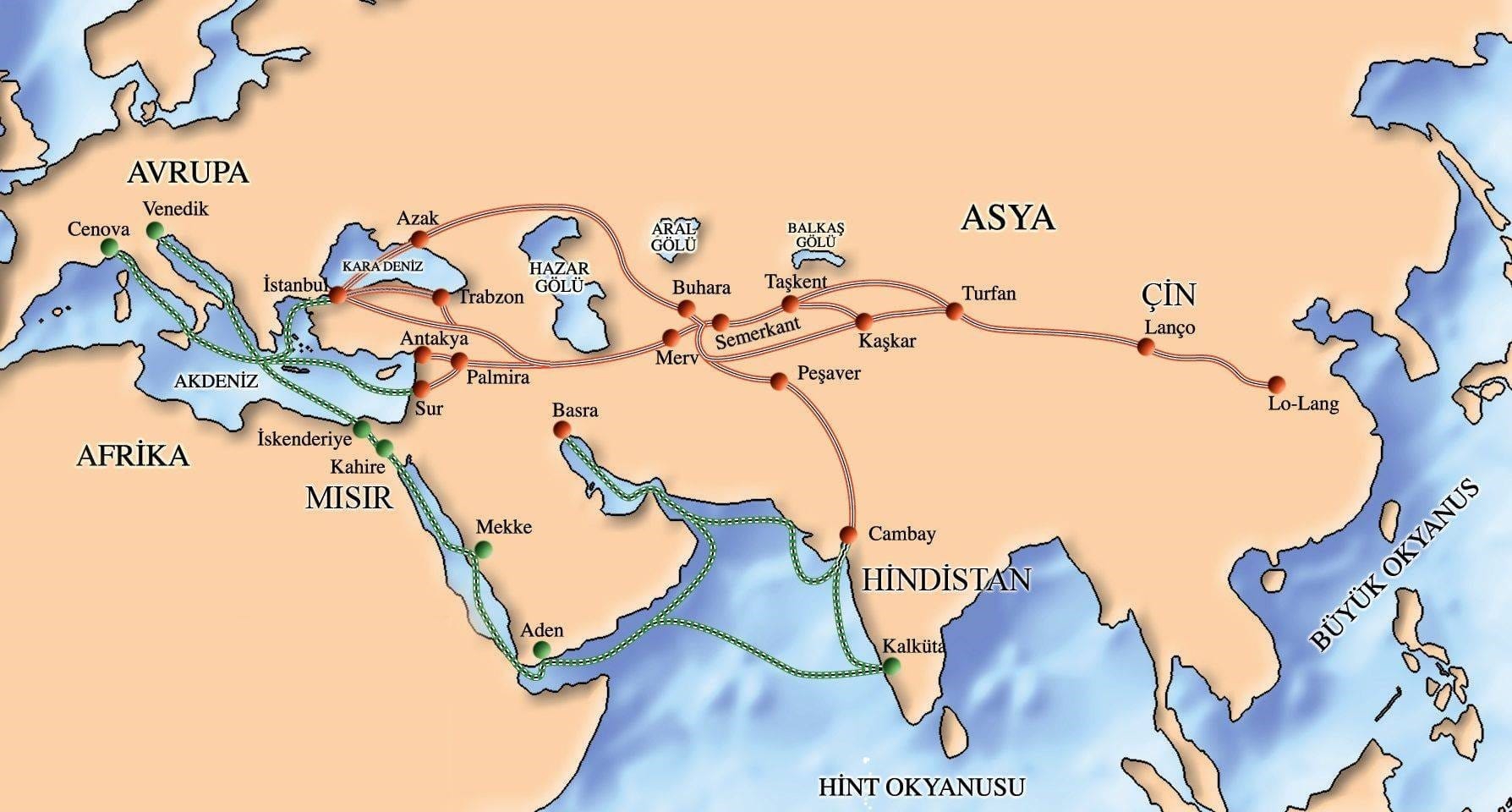
The Silk and Spice Roads were a network made up of many interconnected routes. According to the TDV Encyclopedia of Islam, the name “Silk Road” was coined by the German geographer Ferdinand von Richthofen. The name comes from the fact that silk was the most valuable good carried westward from China. According to the encyclopedia, the oldest route was the “fur road,” which passed south of Siberia.
The main route, however, linked China with Mesopotamia via Central Asia and Iran. From there the road reached the ports of Antioch and Tyre on the Mediterranean coast. According to the encyclopedia, the oldest record of this route is a cuneiform tablet. The tablet, dating from the seventh century BC, describes the section of the road between Mesopotamia and Hamadan. Along with silk, caravans carried ivory, cotton, silver, copper and precious stones.
The Spice Road carried the goods of India and Southeast Asia to the West. According to the encyclopedia, goods arriving at the ports of Sind and Gujarat were carried by two routes. Some went to the Persian Gulf. Others reached the Egyptian port of Alexandria via Aden and the Red Sea. Spices such as pepper, cloves and cinnamon were sold at very high prices in Europe.

Caravanserais and the Safety of the Roads
Long overland journeys required safe places to stay. According to the TDV Encyclopedia of Islam, walled facilities along the roads were built for this purpose. In the Seljuk caravanserais of Anatolia, drums were beaten from the towers in the evening. The sound announced that the time for closing the gates had come. In these buildings caravans both rested and stored their loads safely.
According to the encyclopedia’s entry “Kervansaray,” these buildings are also referred to in the sources as “han” and “ribat.” The Alara Han (1231–1232), the Ağzıkara Han (1236–1237) and the Karatay Han (1240–1241) are important examples of this tradition. These hans show how important the trade passing through Anatolia was for the Seljuks. We discussed the commercial buildings within cities in our article on Ottoman commercial spaces.
The Caravan Trade in Ottoman Lands
The Ottoman state controlled important cities at the western ends of the Silk and Spice Roads. According to the entry “Bursa” in the TDV Encyclopedia of Islam, caravans from Iran increasingly headed for Bursa. The main road to Bursa passed through Tabriz, Erzurum and Tokat. The Tabriz caravans brought the precious silks of regions such as Gilan and Astarabad. In this way the first Ottoman capital became an international silk market.
The encyclopedia describes the scale of this trade in figures. In 1479, for example, the value of the silk coming from Iran had reached 150,000 Venetian gold coins. The annual tax collected on imported goods in the city was 140,000 ducats in 1487. In 1502 more than a thousand looms were at work in Bursa.
European merchants also had a place in this market. According to the encyclopedia, in 1432 spices from Damascus were sold in Bursa to the Genoese of Galata. Maringhi, the agent of the Florentine Medici family, wrote in 1501 that one load of silk brought a profit of 70–80 ducats. The French traveler Belon also noted in 1548 that the city had won great fame thanks to its silk industry.
In the spice trade, however, Bursa could not compete with Egypt. According to the encyclopedia, the reason was the high prices in the city. Even so, Bursa remained an important depot for Eastern goods until the seventeenth century. The Balkans, Eastern Europe and Istanbul obtained these goods largely from Bursa.
Why Did Europeans Look for a New Route?
Eastern goods passed through many hands before reaching Europe. Every middleman and every customs post raised the price a little more. That is why Europeans paid very high prices for goods coming along the Silk and Spice Roads. In the fifteenth century most of the spices passed through the ports of Mamluk Egypt. Venetian merchants bought these goods in Alexandria and Beirut and distributed them across Europe.
To bypass these middlemen, Portugal advanced southward along the coasts of Africa. According to the entry “Portekiz” (Portugal) in the TDV Encyclopedia of Islam, the country established itself on the Gold Coast in the reign of John II (1481–1495). In the same period Bartolomeu Dias rounded the Cape of Good Hope at the southern tip of Africa. Christopher Columbus, who set out on behalf of Spain, reached America in 1492. Columbus had in fact aimed to reach Asia from the west.
The Geographical Discoveries and the Cape of Good Hope
The real turning point came in 1498. According to the encyclopedia, in that year Vasco da Gama reached Calicut in India. He was the first person to get there from Europe by sea. Portugal soon seized trading centers such as Goa (1510) and Malacca (1511). By taking Hormuz and Socotra, it also tried to control the entrances to the Persian Gulf and the Red Sea.
Spices could thus be carried directly to Lisbon without calling at Mediterranean ports. This threatened the customs revenues of the states along the Silk and Spice Roads. The earnings of intermediary cities such as Venice also declined. We discussed the subject in detail from the Ottoman perspective in our article on the impact of the Geographical Discoveries on the Ottomans.
Ottoman Policy in the Indian Ocean
The Ottomans did not stand by and watch this development. According to the encyclopedia, when the Ottoman armies entered Egypt, the Red Sea trade had come almost to a standstill. In 1517 the Portuguese landed troops at Jeddah. Selman Reis repelled this attack.
The fleet of Hadım Süleyman Pasha took Aden in 1538 and besieged Portuguese-held Diu. The siege failed, but the Ottomans held on to Yemen, which was important for the Red Sea. In 1552 Piri Reis also sailed out of Suez and moved against Hormuz. According to the encyclopedia, he took Muscat but could not seize the inner fortress of Hormuz.
According to many historians, Portugal was unable to establish a complete monopoly. The spice trade conducted via the Red Sea revived in the middle of the sixteenth century. These developments show that the Silk and Spice Roads did not collapse with a single blow. The decline proceeded slowly.
Other Causes
The ocean routes were not the only cause. According to the TDV Encyclopedia of Islam, endless wars broke out among the Mongol communities in the sixteenth century. These wars took place around Lake Issyk-Kul and in East Turkestan. The land route lost its security, and caravans could no longer come and go.
The wars between the Ottomans and the Safavids also frequently cut the road from Iran to Anatolia. According to the encyclopedia, Shah Abbas tried to change the route of the silk trade in the years 1599–1628. This attempt affected the Bursa trade negatively for a while. According to the encyclopedia, the same situation encouraged silk production in and around Bursa. We described the background of these conflicts in our article on the Ottoman–Iranian wars.
The decisive break came in the seventeenth century. The English East India Company was founded in 1600 and the Dutch East India Company in 1602. With their powerful fleets these companies tied Asian trade to the ocean routes. According to the encyclopedia, in the eighteenth century the competition of İzmir also shook Bursa’s former importance.
Consequences
The decline of the Silk and Spice Roads deeply affected world trade. Over time the center of gravity of trade shifted from the Mediterranean to the Atlantic coasts. Port cities such as Lisbon, Amsterdam and London rose. The former vitality of the caravan cities, meanwhile, diminished. In the long run the customs revenues the Ottomans drew from overland trade also declined.
Still, this process was a slow transformation spread over several generations. The answer expected in exams is “the Geographical Discoveries.” It is also necessary to know, however, that the effect emerged over time.
Frequently Asked Questions
What development caused the Silk and Spice Roads to lose their importance?
The Geographical Discoveries did. The rounding of the Cape of Good Hope in particular was decisive. With Vasco da Gama’s arrival in India in 1498, Eastern goods began to be transported by sea.
Who named the Silk Road?
The name was given in the nineteenth century by the German geographer Ferdinand von Richthofen. It comes from silk, the most valuable good carried along the road.
Where did the Spice Road run?
It began in India and Southeast Asia. Goods reached the ports of Syria and Egypt via the Persian Gulf or the Red Sea. From there they went on to Europe across the Mediterranean.
What did the Ottomans do against Portugal?
They sent fleets to the Red Sea and the Indian Ocean. Hadım Süleyman Pasha besieged Diu in 1538. Piri Reis led a campaign against Hormuz in 1552.
Did the Silk and Spice Roads lose their importance immediately?
No. The caravan trade in Ottoman lands remained lively throughout the sixteenth century. The real decline came in the seventeenth century, when ocean trade passed into the hands of the Netherlands and England.
Conclusion
The Silk and Spice Roads lost their former importance in a process that began with the Geographical Discoveries. The Cape of Good Hope route made it possible to carry Eastern goods to Europe by sea. The Ottomans resisted Portugal in the Red Sea, and the caravan trade remained strong for some time. The decisive decline, however, came in the seventeenth century.
Sources
- TDV Encyclopedia of Islam, entry “İpek Yolu” (Silk Road)
- TDV Encyclopedia of Islam, entry “Bursa”
- TDV Encyclopedia of Islam, entry “Kervansaray” (Caravanserai)
- TDV Encyclopedia of Islam, entry “Portekiz” (Portugal)
- TDV Encyclopedia of Islam, entry “Pîrî Reis”
- Halil İnalcık and Donald Quataert (eds.), An Economic and Social History of the Ottoman Empire, 1300–1914.








1 thought on “What Development Caused the Silk and Spice Roads to Lose Their Importance?”