Foremost among the places conquered by Osman Bey are Karacahisar (1288), Bilecik, İnegöl, Yarhisar and Yenişehir. After the victory at Koyunhisar (Bapheus) in 1302, Lefke, Mekece, Akhisar and Geyve in the Sakarya valley were also taken. Bursa was placed under siege, but it surrendered only after the founding bey’s death, in 1326, under Orhan Bey.
Quick Summary
- The first raids were made in 1284–1285 against the fortress of Kulaca near İnegöl.
- Karacahisar was taken in 1288 and became the center of the beylik.
- According to the chronicles, Bilecik was conquered in 1299; this year is also remembered as the year of the beylik’s independence.
- On 27 July 1302 Byzantine forces were defeated at Koyunhisar (Bapheus).
- The Sakarya campaign of 1304 took Lefke, Mekece, Akhisar and Geyve.
- Bursa was kept under blockade from 1303 and surrendered in 1326.
Contents
- Chronology of the conquests
- The first raids: Kulaca
- The conquest of Karacahisar
- Bilecik, İnegöl, Yarhisar and Yenişehir
- The Battle of Koyunhisar (Bapheus)
- The victory at Dimbos and the siege of Bursa
- The Sakarya campaign
- Frequently asked questions
Places Conquered by Osman Bey: A Chronology
The table below shows the main conquests mentioned in the sources in chronological order. Since some of the early dates are based on chronicles, they should be regarded as approximate.
| Year | Place | Significance |
|---|---|---|
| 1284–1285 | Fortress of Kulaca | The first raid, near İnegöl |
| 1288 | Karacahisar | The beylik’s first center |
| 1288–1299 | Göynük, Gölpazarı, İnegöl, Yarhisar | Local tekfurs eliminated |
| 1299 | Bilecik, Yenişehir | The year of independence in the chronicles |
| 1302 | Koyunhisar (Bapheus) | The first great victory over a Byzantine army |
| 1303 | Dimbos | The tekfurs of the Bursa plain defeated |
| 1304 | Lefke, Mekece, Akhisar, Geyve | The Sakarya valley brought under control |
| 1326 | Bursa | Surrendered under Orhan Bey |
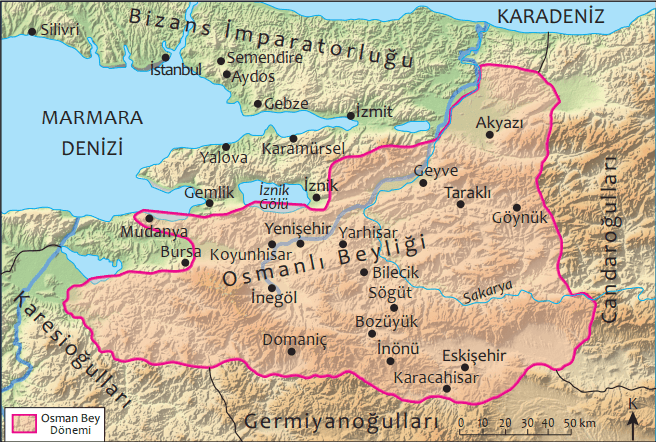
The First Raids: Kulaca
According to the entry “Osman I” in the TDV Encyclopedia of Islam, in the early years of the beylik at Söğüt the Byzantine frontier began at Bilecik. The local tekfurs (Byzantine lords) of the region recognized the Seljuk sultan and lived in peace with the Turkmens. Osman Bey, as an alp (warrior), was among the leaders who organized raids for gaza.
According to the encyclopedia, the first raid was a night attack against the Greeks of İnegöl. In this raid the small fortress of Kulaca near İnegöl was plundered and set on fire. The encyclopedia places this event in 1284–1285. Today the ruins of a castle can be seen near the village of Kulaca in İnegöl; Orhan Bey later had a mosque built there.
The Conquest of Karacahisar
About two years after the Kulaca raid, it was the turn of the region’s second great tekfur. According to the encyclopedia, the Turkmen revolts in Anatolia created a suitable setting for moving against the tekfur of Karacahisar. The fortress was taken in 1288 and made the center of the beylik. According to tradition, with this important conquest Osman Bey rose to the rank of sancakbeyi on the frontier.
The chronicles also relate that the Friday sermon (hutbe) was read in Osman Bey’s name at Karacahisar. However, the TDV Encyclopedia of Islam states that these claims of independence were added much later by authors who believed the dynasty began with him. The report of the sermon should therefore be treated not as certain information but as a narrative of a later period.
Karacahisar stood at a strategic point on the Eskişehir plain. Osman Bey gave its subaşılık (military governorship) to his brother Gündüz Alp. We discussed how the beylik’s centers changed over time in our article on the first capital.
Bilecik, İnegöl, Yarhisar and Yenişehir
According to the TDV Encyclopedia of Islam, between 1288 and 1299 the local tekfurs who paid tribute to the Seljuk sultan were eliminated one by one. The tekfurs of Göynük, Gölpazarı, Bilecik, Yenişehir, İnegöl and Yarhisar submitted in this period. The beylik thus came to dominate a wide area stretching from Eskişehir to Bilecik and Yenişehir.
The most powerful of these tekfurs was the tekfur of Bilecik. According to the encyclopedia, the chronicles record 1299 as the year of the conquest of Bilecik and of the beylik’s independence. According to a famous story in the chronicles, Bilecik was taken in a surprise attack during the wedding of the tekfur of Yarhisar. The Byzantine historian Pachymeres also writes that Osman Bey took Belokome, that is, Bilecik.
The conquered places were distributed among the companions who had taken part in the campaigns. According to the encyclopedia, İnönü was given to his son Orhan, Yarhisar to Hasan Alp and İnegöl to Turgut Alp. The fact that the region was long called “Turgut-ili” bears the trace of this distribution. Yenişehir, thanks to its proximity to İznik (Nicaea), became a center opening onto new targets.
The Battle of Koyunhisar (Bapheus)
Having settled at Yenişehir, the beylik now began to threaten İznik, an important Byzantine city. According to the encyclopedia, before the siege the tekfurs of Marmaracık and Koyunhisar were brought into submission in order to secure the rear of Yenişehir. Köprühisar, at the junction of the roads leading from Bilecik and Yenişehir to İznik, was also seized. A Byzantine force that set out to relieve İznik was then met at Koyunhisar. The contemporary Byzantine historian Pachymeres dates the battle to 27 July 1302, while Ottoman sources give 1301–1302.
This battle, also known as Bapheus, is the first great victory the beylik won against the regular forces of Byzantium. The encyclopedia stresses that Pachymeres’ record brings Osman Bey onto the stage of history for the first time in a contemporary source. After the victory, people from the Byzantine villages of the region began to flee and take refuge in Constantinople.
İznik, meanwhile, was placed under a long blockade. According to the encyclopedia, a siege tower (havale kulesi) was built on the mountain slope facing Yenişehir, and a small force under the command of Taz (Diraz) Ali was stationed in it. Today the village of Diraz Ali lies to the left of the road from İznik to Yenişehir. The video below on the wars of the period also summarizes this process.
The Victory at Dimbos and the Siege of Bursa
The victory at Koyunhisar alarmed the tekfurs of the Bursa plain. According to the TDV Encyclopedia of Islam, the tekfurs of Adranos, Bidnos, Kestel and Kite joined together in an alliance to attack the beylik. Relying on Aşıkpaşazade, the encyclopedia places this battle in 1303. The two sides fought from the Yenişehir plain as far as the narrow Dimbos Pass.
Victory went to the beylik. The tekfur of Kestel was killed on the battlefield, and the tekfurs of Bursa and Adranos fled to their fortresses. The tekfur of Kite was pursued as far as the Ulubat Bridge. According to the encyclopedia, among those who fell as martyrs in the battle was Aydoğdu, the son of Gündüz Alp.
After this victory Bursa was placed under blockade. According to the encyclopedia, two siege towers named Aktimur and Balabancık were built to isolate the city from its surroundings. Bursa remained under siege for twenty-three years and surrendered only in 1326, under Orhan Bey. According to the encyclopedia, after these victories the army’s campaign strength reached 5,000 men with the gazis who came from Paphlagonia and other parts of Anatolia.
When Osman Bey died in 1324, Orhan Bey was busy besieging Bursa. In accordance with his will, after the city was taken he was buried in the old monastery known as the Gümüşlü Kubbe (Silver Dome) in the citadel. When this building collapsed in the earthquake of 1855, the present tomb was built in 1863 by Sultan Abdülaziz. We described the subsequent expansion in our article on the reign of Orhan Gazi.
The Sakarya Campaign
In 1304 a new campaign was organized toward the Sakarya valley. According to the TDV Encyclopedia of Islam, the first conquest along the way was the fortress of Leblebüci. Then the tekfurs of Lefke (Osmaneli) and Çadırlı submitted and became nökers, that is, comrades-in-arms, of Osman Bey. The tekfur of Mekece also submitted.
The tekfur of Akhisar resisted, but after his defeat he took refuge in the fortress of Karaçepüş. The fortress of Geyve, found empty, was taken, and Tekfurpınarı was also seized. According to the encyclopedia, this campaign closed the road from Byzantium to İznik, leaving only the Gemlik road open to the city. Karaçepüş, however, could not be taken in this campaign; the following year Orhan Bey was sent to this region.
The campaigns were not limited to the conquest of fortresses. The participation of local leaders such as Köse Mihal allowed the beylik to gain cadres who knew the region. According to the encyclopedia, in the raids toward Mudurnu, Göynük and Taraklı Yenicesi there was also cooperation with Samsa Çavuş, who knew the area.
Frequently Asked Questions
What are the places conquered by Osman Bey?
The main ones are Kulaca, Karacahisar, Bilecik, İnegöl, Yarhisar, Yenişehir, Lefke, Mekece, Akhisar and Geyve. Bursa was besieged in his time and taken in 1326.
What was the first place conquered?
The first raid was made against the fortress of Kulaca near İnegöl. The first important conquest of a fortress was that of Karacahisar in 1288.
Who conquered Bursa?
Bursa was placed under blockade in Osman Bey’s time. The city, however, surrendered in 1326, under his son Orhan Bey.
Why are the places conquered by Osman Bey important?
These conquests opened the way to the siege of İznik and Bursa, the last important cities of Byzantium in Anatolia. Centers such as Yenişehir and Bilecik became both administrative and military bases of the beylik.
Why is the Battle of Koyunhisar important?
It is the first great victory the beylik won against the regular forces of Byzantium. Thanks to Pachymeres’ record, the beylik appears on the stage of history for the first time in a contemporary source.
Conclusion
The places conquered by Osman Bey turned a small frontier beylik into a power that threatened Byzantium. The process that began with the Kulaca raid grew stronger with the conquests of Karacahisar and Bilecik. The victories at Koyunhisar and Dimbos opened the way to the siege of İznik and Bursa. On these foundations Orhan Bey would turn the beylik into a state. You can read about the founder’s life in our article Who was Osman Gazi? and about his epithet in our article Osman Bey’s epithet.
Sources
- TDV Encyclopedia of Islam, entry “Osman I”
- TDV Encyclopedia of Islam, entry “Orhan”
- Halil İnalcık, “Osmanlı Beyliği’nin Kurucusu Osman Beg” (Osman Beg, the Founder of the Ottoman Beylik), Belleten, LXXI/261 (2007), pp. 479–536.
- Aşıkpaşazade, Tevârîh-i Âl-i Osman (History of the House of Osman).