The reasons for the opening of the Caucasian Front fall under four main headings. The first was the Russian attack, the second Germany’s war plan. The Ottomans also wanted to recover Kars, Ardahan and Batum, which they had lost in 1878. The idea of Turanism played a role in the process as well. The front opened in November 1914 and soon became the scene of a great disaster with the Sarıkamış Operation.
Quick Summary
- The reasons for the opening of the Caucasian Front were the Russian attack, Germany’s expectations, the lost territories and Turanism.
- Russian troops crossed the border on 1 November 1914, and the front was opened in practice.
- Germany wanted to prevent Russian forces from being shifted to Europe.
- The Sarıkamış Operation began on 22 December 1914 and ended with heavy losses.
- Kars, Ardahan and Batum were recovered in 1918 through the Treaty of Brest-Litovsk.
Contents
- The main reasons
- How was the front opened?
- Germany’s war plan
- The question of Kars, Ardahan and Batum
- Turanism and Enver Pasha
- The Sarıkamış Operation
- How did the war continue?
- The results of the front
- Frequently asked questions
What Were the Reasons for the Opening of the Caucasian Front?
In textbooks, the reasons for the opening of the Caucasian Front are usually listed as follows:
- Russia’s attack on Eastern Anatolia and its aims regarding the Straits.
- Germany’s wish to keep the Russian army busy in the east.
- The idea of recovering Kars, Ardahan and Batum, which had been ceded to Russia in 1878.
- Turanism, that is, the ideal of reaching the Turkic and Muslim communities under Russian rule.
- The growing importance of the Baku oil fields in the later years of the war.
Not all of these reasons carry the same weight. The event that directly triggered the opening of the front was Russian troops crossing the border. The other reasons explain why the Ottomans did not settle for defence but launched a major offensive. For this reason, the opening of the Caucasian Front cannot be explained by the Ottoman decision alone.
How Was the Front Opened?
On 2 August 1914 the Ottomans had signed a secret treaty of alliance with Germany. Even so, they did not enter the war at once but declared armed neutrality. In the same month, two German cruisers fleeing the British navy took refuge at the Dardanelles. According to the encyclopedia, the government solved the problem by buying these ships. They were renamed Yavuz and Midilli, but their German crews stayed on board.
The Ottoman state entered the war through a fait accompli. According to the TDV Encyclopedia of Islam, the Ottoman fleet under the German Admiral Souchon sailed into the Black Sea on 27 October 1914. The squadron, which included Yavuz and Midilli, sank Russian ships. The ports of Sevastopol and Novorossiysk were shelled. Thereupon Russia declared war on the Ottoman state on 2 November 1914.
Russian troops, meanwhile, crossed the border on 1 November 1914 and began to advance towards Erzurum. According to the encyclopedia, the Russians wanted to carry the war onto Ottoman soil with a limited operation. In this way they also aimed to prevent the Muslims of the region from rising in resistance. The Third Army met this attack near Köprüköy. After the Battle of Köprüköy on 6–9 November, the Russians withdrew to a line close to the border.
Germany’s War Plan
The Ottomans entered the war as an ally of Germany and Austria-Hungary. According to the TDV Encyclopedia of Islam, the Turkish operational plan rested on easing the burden on the allies in Europe. To this end, Russia was to be attacked in the east and Britain at the Suez Canal. We described the result of the same strategy in the west in our article on the importance of the Gallipoli Campaign for the Ottomans.
The encyclopedia’s entry on the Sarıkamış Operation explains this point more clearly. Under the plan directed by the German headquarters, the main task of the forces in the east was clear. They were to prevent the Russians from shifting new forces to the European front. That is why Germany’s expectation stands out among the reasons for the opening of the Caucasian Front. The German officer Bronsart von Schellendorf, chief of the general staff of the Turkish armies, also supported the idea of an encirclement.
The Question of Kars, Ardahan and Batum
The question of lost territory also holds an important place among the reasons for the opening of the Caucasian Front. According to the TDV Encyclopedia of Islam, these three sanjaks are called “elviye-i selâse”. The Ottomans had lost the Russo-Ottoman War of 1877–1878 (the War of ’93). In return, Russia demanded a heavy war indemnity. Through the Treaty of Berlin (13 July 1878), Kars, Ardahan and Batum were ceded to Russia.
According to the encyclopedia, 120,000 people migrated from this region into the interior of Anatolia within three years. This loss remained an unhealed wound in Ottoman public opinion. We discussed the background of the long rivalry with Russia in our article on the Ottoman-Russian wars.
Turanism and Enver Pasha
Enver Pasha, Deputy Commander-in-Chief and Minister of War at the start of the war, dreamed of a great victory in the east. Liberating the Turkic and Muslim communities under Russian rule was part of this dream. According to the encyclopedia, this was also the only front that Enver Pasha personally commanded during the war. According to the encyclopedia, it was thought that during the operation the whole of the Caucasus would be freed from the “Muscovite yoke”. This idea was linked to Turanism, a broader form of Turkism.
This ideal is also the most debated of the reasons for the opening of the Caucasian Front. Some historians think that Turanism pulled military decisions away from realism. Indeed, when the first news of success arrived, newspapers wrote that “the road to Turan has been opened”. We described the intellectual life of the period in our article on Ottoman intellectual movements.
The Sarıkamış Operation
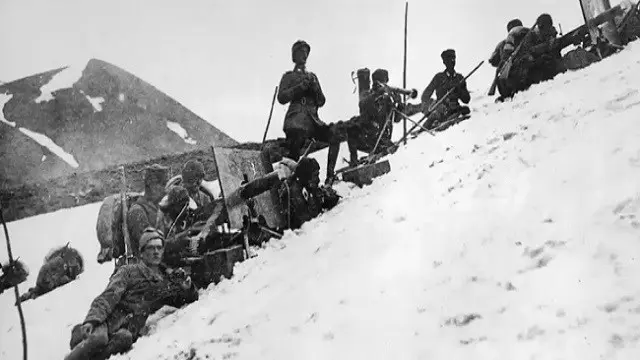
The success at Köprüköy turned Enver Pasha towards a bigger goal. Hasan İzzet Pasha, commander of the Third Army, opposed a winter offensive because of the lack of winter equipment. According to the encyclopedia, after his resignation Enver Pasha took command of the army himself. The operation began on 22 December 1914. Its aim was to take Sarıkamış, the supply base of the Russian army, and to encircle the Russian forces.
According to the encyclopedia, the combat strength of the Third Army was 96,550, while the Russian army facing it numbered around 65,000. Despite this numerical superiority, the supply situation was very poor. The Russians met their needs through the Kars–Sarıkamış railway. The nearest Ottoman railway station, by contrast, lay 600 kilometres behind the front.
The ships carrying winter clothing had been sunk in the Black Sea by the Russian fleet. Even women and children carried provisions to the front on their backs.
At first the operation advanced promisingly. On the evening of 25 December, however, the corps of Ali İhsan Latif Pasha halted its attack, and the Russians gained time. The units of Hafız Hakkı Bey suffered heavy losses while crossing the Allahuekber Mountains. The Russians launched a counteroffensive on 1 January 1915. The order to retreat was given on 4 January.
The number of losses was long disputed. According to the encyclopedia’s entry on Sarıkamış, the widespread figure of 90,000 dead is not correct. When the snow melted, the Russians buried 23,000 fallen soldiers in mass graves. The encyclopedia states that the total number of dead was around 30,000 and that about 20,000 soldiers were taken prisoner. The army did not recover from this blow for a long time.
How Did the War Continue?
After Sarıkamış, the army in the east fell back on the defensive. In the winter of 1916 the Russian army launched a major offensive. According to the encyclopedia, the Russians entered Erzurum on 16 February 1916. Trabzon was also occupied on 18 April 1916. With the fall of Erzincan as well, most of Eastern Anatolia came under Russian occupation.
The situation changed in 1917 with the revolution in Russia. The Bolshevik government wanted to leave the war. The Armistice of Erzincan was signed in December 1917. Through the Treaty of Brest-Litovsk on 3 March 1918, Russia returned Kars, Ardahan and Batum to the Ottomans. The units of Kâzım Karabekir Pasha retook Erzurum on 12 March 1918.
A referendum held in June 1918 confirmed the union of the three sanjaks with the Ottoman state. In the summer of 1918, Ottoman troops also advanced into Azerbaijan. The Caucasian Army of Islam entered Baku in September 1918. However, the Armistice of Mudros, signed on 30 October 1918, changed everything. The Ottoman army had to withdraw to the borders of 1914.
The Results of the Front
There is a wide gap between the reasons for the opening of the Caucasian Front and its results. In a war begun with great ambitions, the Ottomans first suffered heavy losses. The important cities of Eastern Anatolia remained under occupation for about two years. The people of the region endured great migrations and suffering. We discussed the overall outcome of the war in our article on the collapse of the Ottoman Empire.
The question of Kars and Ardahan was settled during the National Struggle. According to the encyclopedia, Kâzım Karabekir Pasha retook Kars on 30 October 1920. The treaties of Moscow (16 March 1921) and Kars (13 October 1921), signed afterwards, set today’s border. Kars and Ardahan remained in Turkey, while Batum was left to Georgia.
Frequently Asked Questions
What were the reasons for the opening of the Caucasian Front?
The main reason was the Russian attack. Germany’s wish to keep the Russian army in the east also played a part. The idea of recovering Kars, Ardahan and Batum and Turanism were the other reasons.
What was Germany’s role among the reasons for the opening of the Caucasian Front?
Germany wanted to prevent Russian forces from being shifted to the fronts in Europe. For this reason it supported an Ottoman attack on Russia in the east.
Why did the Sarıkamış Operation fail?
Harsh winter conditions, inadequate winter clothing and weak supply lines were the main reasons. Command errors and the long marches of exhausted units also hastened the defeat.
When were Kars, Ardahan and Batum recovered?
The three sanjaks were returned to the Ottomans through the Treaty of Brest-Litovsk on 3 March 1918. Kars, lost again after Mudros, was retaken by Kâzım Karabekir Pasha on 30 October 1920.
Conclusion
The reasons for the opening of the Caucasian Front were the Russian attack, Germany’s war plan, the wish to recover lost territories and the ideal of Turanism. The front was opened with these aims, but it was shaken by a heavy defeat at Sarıkamış. The revolution in Russia brought a brief recovery. A lasting solution, however, was found during the National Struggle.
Sources
- TDV Encyclopedia of Islam, entry “Sarıkamış Harekâtı” (Sarıkamış Operation)
- TDV Encyclopedia of Islam, entry “Birinci Dünya Savaşı” (First World War)
- TDV Encyclopedia of Islam, entry “Elviye-i Selâse” (The Three Sanjaks)
- TDV Encyclopedia of Islam, entry “Enver Paşa” (Enver Pasha)
- TDV Encyclopedia of Islam, entry “Erzurum”
- TDV Encyclopedia of Islam, entry “Trabzon”
- TDV Encyclopedia of Islam, entry “Kars”