Ali Qushji’s contributions to science are seen above all in astronomy and mathematics. At the Samarkand Observatory he took part in preparing Ulugh Beg’s star tables. He re-measured the latitude and longitude of Istanbul and wrote textbooks on astronomy and arithmetic. By teaching at the Hagia Sophia Madrasa under Mehmed the Conqueror, he brought about a revival of the mathematical sciences in the Ottoman state.
Quick Summary
- His real name was Ala al-Din Ali; because his father was Ulugh Beg’s chief falconer, he was called “Qushji” (bird-keeper).
- In Samarkand he studied under Ulugh Beg, Qadizada al-Rumi and al-Kashi.
- He is one of the three astronomers named in the preface of the Zij of Ulugh Beg.
- He set the longitude of Istanbul at 59 degrees and its latitude at 41 degrees 14 minutes.
- Al-Risala al-Fathiyya, which he dedicated to Mehmed the Conqueror, was translated into Turkish in 1548 and 1824.
- He died in Istanbul in 1474 and was buried near the tomb of Eyüp Sultan.
Contents
- Who was Ali Qushji?
- The Samarkand years
- His arrival in Istanbul
- His contributions to astronomy
- His contributions to mathematics
- The debate on the earth’s motion
- His works
- His place in Ottoman science
- Frequently asked questions
Who Was Ali Qushji?
According to the TDV Encyclopedia of Islam, Ali Qushji’s real name was Ala al-Din Ali, and his father’s name was Muhammad. He is thought to have been born in Samarkand in the early 15th century. Because his father was the chief falconer of the Timurid ruler Ulugh Beg, he became known by the nickname “qushji”, bird-keeper.
Besides astronomy and mathematics, Ali Qushji also wrote works on kalam and grammar. According to the encyclopedia, most of his works are commentaries and glosses. Ali Qushji’s contributions to science are therefore tied not only to new calculations but also to a tradition of teaching. His commentary on the Tajrid in the field of kalam became one of his most widely read works.
The Samarkand Years
According to the encyclopedia, Ali Qushji acquired his basic knowledge of mathematics and astronomy from Ulugh Beg, Qadizada al-Rumi and Ghiyath al-Din Jamshid al-Kashi. Qadizada, who came from Bursa, may have formed the link between Ulugh Beg and Ali Qushji. According to tradition, Ali Qushji went secretly to Kerman for a time. There he wrote a treatise on the phases of the Moon and presented it to Ulugh Beg. According to the encyclopedia, it was also there that he read al-Tusi’s Tajrid and wrote a commentary on it.
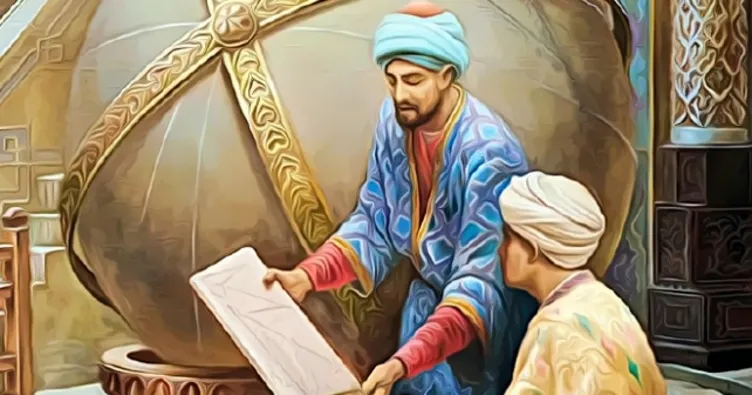
According to the TDV Encyclopedia of Islam, construction of the Samarkand Observatory began in 1420–1421. Ulugh Beg headed the observatory in person and took part in the observations. According to the encyclopedia, the preface of the Zij of Ulugh Beg names three astronomers for their contributions: al-Kashi, Qadizada al-Rumi and Ali Qushji. The remains of the observatory were uncovered in excavations carried out in 1908.
According to the encyclopedia, the work in Samarkand was closely connected with the legacy of Nasir al-Din al-Tusi’s Maragha Observatory. When al-Kashi came to Samarkand, he too presented Ulugh Beg with a work completing the Ilkhanid zij. The older roots of the zij tradition reach back to Indian astronomy. We discussed this connection in our article on the ancient Indian picture of the world.
According to the encyclopedia, Ulugh Beg also sent Ali Qushji to China. On his return, Ali Qushji calculated the surface area of the earth and the length of one degree of meridian. This mission also shows the breadth of Ulugh Beg’s scientific interests. Among Ali Qushji’s contributions to science, these measurements are also important for geography. We compiled the pioneers of geography in our article on famous geographers.
His Arrival in Istanbul
When Ulugh Beg was killed in 1449, Ali Qushji was left without a patron. According to the TDV Encyclopedia of Islam, he set out to make the pilgrimage and stopped in Tabriz. The Aq Qoyunlu ruler Uzun Hasan sent him as an envoy to Mehmed the Conqueror. Mehmed, admiring his learning, invited him to Istanbul.
According to the encyclopedia, Mehmed took Ali Qushji along on his campaign against Uzun Hasan in 1473. On the way back he appointed him professor at the Hagia Sophia Madrasa. This appointment brought new life to the study of astronomy and mathematics in Istanbul. According to the encyclopedia, even scholars attended his lectures.
According to tradition, Ali Qushji was charged, together with Molla Hüsrev, with arranging the curriculum of the Sahn-ı Seman madrasas. His influence was great in giving mathematics and astronomy courses more weight in the madrasas. We described the Ottoman madrasa system in our article on the Ottoman education system.
Ali Qushji’s Contributions to Science: Astronomy
One of the most concrete of Ali Qushji’s contributions to science is his re-measurement of the position of Istanbul. According to the encyclopedia, he corrected the city’s longitude, previously accepted as 60 degrees, to 59 degrees. He set its latitude at 41 degrees 14 minutes. There is also a sundial made by him at the Fatih Mosque. These measurements were important for placing the city correctly on maps.
Ali Qushji wrote a Persian commentary on Ulugh Beg’s zij. According to the encyclopedia, this commentary contains all the information needed for a zij. In later centuries the Zij of Ulugh Beg was also translated into Latin and Sanskrit. Ali Qushji’s grandson Mirim Çelebi was also among the astronomers who wrote commentaries on this zij.
“Al-Risala al-Fathiyya”, which he presented to Mehmed the Conqueror, became an astronomy book taught for a long time in Ottoman madrasas. According to the encyclopedia, the work was translated into Turkish in Aleppo in 1548 by order of Suleiman the Magnificent. Seyyid Ali Pasha, head professor of the Mühendishane, translated it again in 1824 under the title “Mir’at al-Alam”.
His Contributions to Mathematics
Ali Qushji wrote two important works on arithmetic. The Persian “Risala fi’l-Hisab” consists of three parts. The Arabic “al-Risala al-Muhammadiyya”, made up of an introduction and five parts, is dedicated to Mehmed the Conqueror. According to the encyclopedia, whether these two works are translations of each other is disputed. A copy of the Muhammadiyya in the author’s own hand is held in the Süleymaniye Library.
Ali Qushji’s contributions to science also continued through his students. According to the encyclopedia, the most famous of the students he trained were his grandson Mirim Çelebi and Molla Lutfi. These students played a role in carrying the mathematical sciences in the Ottoman state into the 16th century.
The Debate on the Earth’s Motion
The most debated of Ali Qushji’s contributions to science are his views on the motion of the earth. According to the studies of the historian of science F. Jamil Ragep, Ali Qushji put forward an important claim in his commentary on al-Tusi’s Tajrid. In his view, it could not be proved by observation that the earth does not rotate. He argued that astronomy could be done without being bound to Aristotelian physics.
This view does not amount to asserting definitively that the earth rotates. It is, however, remarkable for questioning the general consensus of the time. Ragep regards this view as part of an effort to make astronomy independent of philosophy. Some researchers are also examining the connection between these debates and developments in Europe. The subject is still debated today.
Which Works Did Ali Qushji Write?
The TDV Encyclopedia of Islam groups Ali Qushji’s works into three categories: astronomy and mathematics, kalam and legal theory, and grammar. The main ones are:
- Risala fi’l-Hay’a: a Persian treatise on astronomy; Molla Perviz translated it into Turkish.
- Al-Risala al-Fathiyya: an Arabic astronomy book dedicated to Mehmed the Conqueror.
- Al-Risala al-Muhammadiyya: an arithmetic book dedicated to Mehmed the Conqueror.
- Sharh-i Zij-i Ulugh Beg: a Persian commentary on Ulugh Beg’s zij.
- Al-Sharh al-Jadid ala’l-Tajrid: his famous commentary on al-Tusi’s work of kalam.
- Unqud al-Zawahir: a work on lexicography, morphology and etymology.
According to the encyclopedia, a long scholarly debate took place between Jalal al-Din al-Dawani and Sadr al-Din al-Shirazi over the commentary on the Tajrid. This too shows that Ali Qushji’s contributions to science were intertwined with debates in kalam. According to the encyclopedia, it is not certain that a commentary written on a work by Qutb al-Din al-Shirazi is his.
His Place in Ottoman Science
Ali Qushji’s arrival in Istanbul meant the transfer to the Ottomans of the astronomical tradition that had developed in Samarkand and Maragha. His grandson Mirim Çelebi and his students carried this tradition into the 16th century. The observatory that Taqi al-Din founded in Istanbul in 1577 also drew on this legacy. We described Mehmed the Conqueror’s patronage of scholars in our article on Ottoman sultans and cultural heritage.
Frequently Asked Questions
What were Ali Qushji’s contributions to science?
He took part in the work of the Samarkand Observatory, measured the latitude and longitude of Istanbul and wrote books on astronomy and arithmetic. Through his lectures at the Hagia Sophia Madrasa he revived the mathematical sciences in the Ottoman state.
Which is the most important work among Ali Qushji’s contributions to science?
“Al-Risala al-Fathiyya”, which he dedicated to Mehmed the Conqueror, is his most influential work in astronomy. It was translated into Turkish in 1548 and 1824.
Under which sultan did Ali Qushji come to Istanbul?
He came under Mehmed the Conqueror. Mehmed, who met him when he came as the envoy of the Aq Qoyunlu ruler Uzun Hasan, invited him to Istanbul.
Where did Ali Qushji die?
According to the TDV Encyclopedia of Islam, he died in Istanbul on 15 December 1474 and was buried near the tomb of Eyüp Sultan.
Why was Ali Qushji called “Qushji”?
His father was Ulugh Beg’s chief falconer. The chief falconer was the official responsible for the ruler’s hunting birds. That is why the family became known by the nickname “qushji”.
Conclusion
Ali Qushji’s contributions to science stand out above all for carrying the astronomical tradition of Samarkand to Istanbul. He was trained at Ulugh Beg’s observatory, measured the position of Istanbul and wrote textbooks that were taught for a long time. His views on the motion of the earth also continue to attract the interest of historians of science. Ali Qushji is regarded as one of the founding figures of the history of Ottoman science. Manuscript copies of his works are preserved today in the libraries of Istanbul.
Sources
- TDV Encyclopedia of Islam, entry “Ali Kuşçu” (Ali Qushji)
- TDV Encyclopedia of Islam, entry “Semerkant Rasathanesi” (Samarkand Observatory)
- TDV Encyclopedia of Islam, entry “Uluğ Bey” (Ulugh Beg)
- F. Jamil Ragep, “Tūsī and Copernicus: The Earth’s Motion in Context”, Science in Context 14 (2001).
- Ekmeleddin İhsanoğlu (ed.), Osmanlı Astronomi Literatürü Tarihi [History of Ottoman Astronomical Literature].