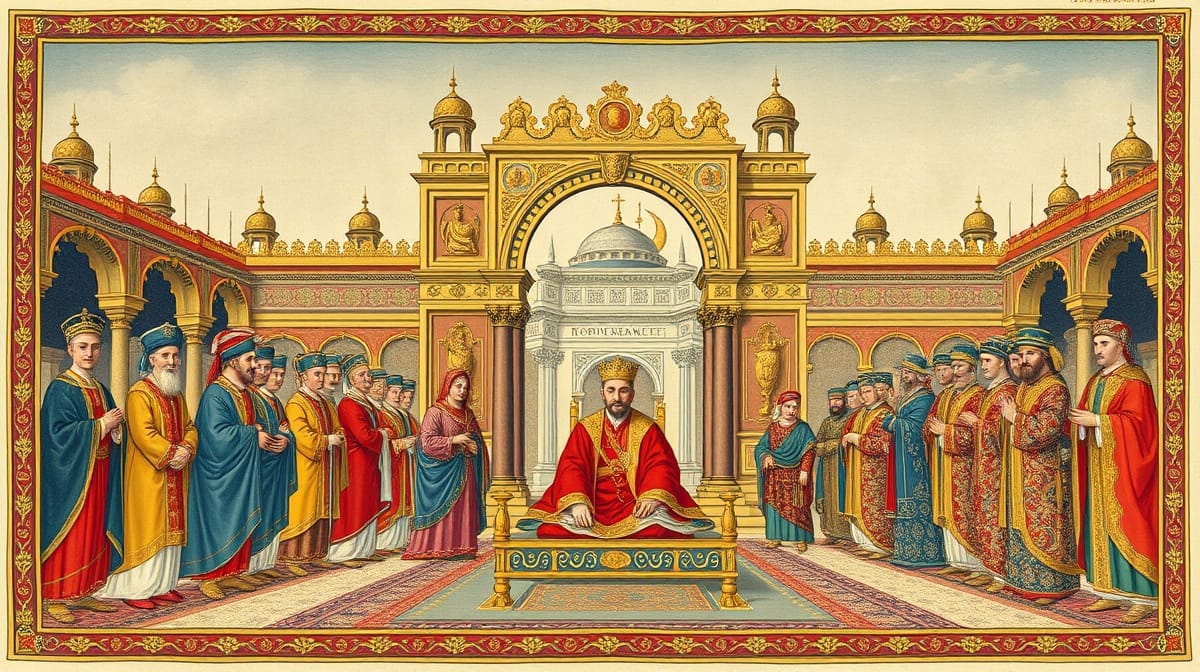
Cülus Bahşişi was the monetary gift distributed by a newly enthroned Ottoman sultan to state officials, especially the kapıkulu troops, when announcing his accession; the practice was regarded both as a display of loyalty and as an instrument of political legitimacy.
Quick Summary
- Cülus refers to the sultan’s enthronement ceremony.
- Bahşiş was a monetary gift given especially to the kapıkulu troops.
- The practice reinforced loyalty and announced the new reign.
- If payment was delayed, military unrest and crises could arise.
- Over time, it became a heavy burden on the treasury.
Contents
- What Was Cülus Bahşişi?
- The Cülus Ceremony and Palace Protocol
- To Whom Was Cülus Bahşişi Given?
- Early Practices and Historical Development
- Political Meaning and Legitimacy
- Economic Burden and Crises
- Conclusion
What Was Cülus Bahşişi?
Cülus, a word of Arabic origin, means sitting or ascending the throne. In Ottoman history, it refers to the new sultan’s formal assumption of sovereign authority. The money distributed during this ceremony was called Cülus Bahşişi. In this way, the new ruler delivered his first message to the military and administrative groups at the center of the state.
This gratuity was not an ordinary gift. On the contrary, it was the visible sign of the political bond established between the enthroned sultan and the kapıkulu corps. The Janissaries in particular regarded this payment as something like a customary right. For this reason, the practice gradually became one of the most sensitive parts of palace protocol.
According to Halil İnalcık, the Ottoman sultanate did not rest solely on dynastic inheritance. It also required the acceptance of the army, the ulema, and the palace bureaucracy. The cülus ceremony was an important stage on which this acceptance was performed. Cülus Bahşişi was the most concrete element of that stage.
The Meaning of the Concept of Cülus
Cülus describes the official process that began when the new ruler sat upon the throne. In the Ottoman Empire, this process was conducted at Topkapı Palace according to fixed rules. The sultan’s accession was not considered merely a change within the family. It also meant the renewal of the entire state order.
For this reason, news of the cülus was announced quickly. Military units in the capital, state dignitaries, and the ulema declared their allegiance to the new ruler. Firmans were then sent to provincial administrators. In addition, the new sultan’s name was read in the khutba, and coins were minted in his name.
What Did Cülus Bahşişi Mean?
Cülus Bahşişi served as a guarantee given by the new sultan to the military class. This payment was different from the soldiers’ salary, known as ulufe. Ulufe was a regular wage; bahşiş was a special payment tied to accession to the throne. Over time, however, soldiers came to regard this special payment as an unchanging right.
On the other hand, the meaning of the gratuity was not limited to money alone. Through this gift, the sultan sent his soldiers the message: “my reign has begun, and I am watching over you.” The soldiers, in turn, recognized the new ruler by showing loyalty. Thus money, ceremony, and politics operated simultaneously.
The Cülus Ceremony and Palace Protocol
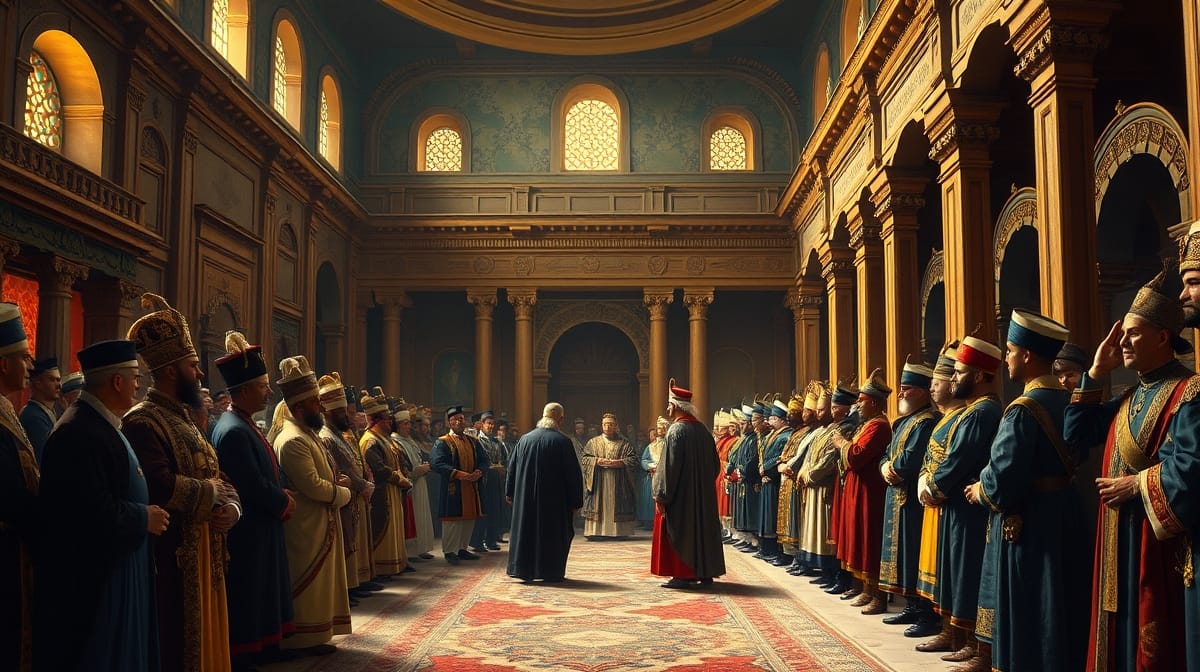
In the Ottoman Empire, the cülus ceremony was generally held after the death or deposition of the previous sultan. The new sultan sat on the throne set up before the Bâbüssaâde at Topkapı Palace. State dignitaries appeared before him in a fixed order and declared their allegiance. During this process, the language of the ceremony was chosen with great care.
İsmail Hakkı Uzunçarşılı, in describing the palace organization, draws attention to the hierarchical structure of this protocol. Viziers, kazaskers, the sheikh al-Islam, the Janissary agha, and other officials took part in the ceremony. Everyone’s place to stand and order of approach were predetermined. This arrangement was the staged reflection of Ottoman central authority.
Cülus at Topkapı Palace
Topkapı Palace was the principal venue for cülus ceremonies. The area before the Bâbüssaâde was a powerful symbolic space where the sultan became visible. The new ruler sat on the throne there and received the leading figures of the state. This scene displayed the continuity of the dynasty to the people and the army.
Yet the ceremony did not remain confined within the palace walls. When news of the cülus spread through Istanbul, a new era began in the city. Artisans, the ulema, soldiers, and the public learned of the change in a short time. The sword-girding ceremony at Eyüp Sultan was also a separate stage that completed the spiritual dimension of sovereignty.
Bay’a and the Display of Loyalty
In the cülus ceremony, bay’a was one of the key concepts of the political order. State dignitaries recognized the new sultan and demonstrated their allegiance. At this moment, Cülus Bahşişi was perceived as the material counterpart of bay’a. For the kapıkulu troops in particular, this bond was very strong.
By contrast, bay’a was not a one-sided act of loyalty. The sultan was also deemed to have accepted responsibility for protecting the soldiers’ rights. For this reason, when the gratuity was not paid, the problem was not merely economic. Soldiers could interpret it as the new ruler’s failure to keep his word.
To Whom Was Cülus Bahşişi Given?
Cülus Bahşişi was given first and foremost to the kapıkulu corps. At the center of this group were the Janissaries. In addition, sipahis, armorers, artillerymen, and other kapıkulu classes also received a share of the payment. Palace officials and some bureaucrats could also receive gratuities according to their rank and duties.
The Janissaries were the most influential group in this matter. This was because the balance of military power in Istanbul depended to a large extent on their attitude. The question who were the Janissaries and what did they do in the Ottoman Empire? is therefore closely connected to the issue of cülus. A sultan could not make a comfortable beginning without securing their support.
The Janissaries and Cülus Bahşişi
The Janissaries were the military group most sensitive about Cülus Bahşişi. For them, the gratuity was an ordinary payment expected at a change of sultan. Moreover, this payment was not measured only by its monetary value. It was a tradition that recalled the corps’ weight within the state.
Especially in the classical period, the Janissary Corps was the backbone of the sultan’s central army. For this reason, the new ruler valued the corps’ loyalty. In later centuries, however, the corps became increasingly involved in politics. Thus Cülus Bahşişi sometimes turned into an instrument of bargaining and pressure.
The Share of State Dignitaries
The gratuity was not simply a crude payment distributed to soldiers. The palace and central bureaucracy could also receive certain gifts during this process. Office, rank, and degree of closeness affected the share received. This situation reveals the detailed structure of Ottoman protocol.
The presence of viziers and the ulema at the ceremonies was also important. Having knowledge of the Imperial Council and Ottoman state administration makes this hierarchy more comprehensible. This is because cülus made all the central organs of the state visible at the same time.
Early Practices and Historical Development
Sources place different emphases on the exact beginning of the practice of Cülus Bahşişi. Nevertheless, the tradition developed from the early Ottoman period onward. As the centralized state order grew stronger during the reign of Mehmed II, ceremonies also became more clearly defined. This development was closely connected to the structure of the classical Ottoman palace.
Historians such as Mustafa Nuri Pasha and Ahmed Cevdet Pasha emphasize that Ottoman institutions became traditionalized over time. Practices that were more flexible in the early period were regulated as the empire grew. Cülus also shared in this transformation. Thus the gratuity became an expected part of state tradition.
The Age of Mehmed II and Centralization
The reign of Mehmed II was an era in which central administration grew stronger in the Ottoman Empire. After the conquest of Istanbul, the palace, bureaucracy, and military order gained a new framework. Mehmed II and the conquest of Istanbul stood at the center of this transformation. In this period, the symbols of sovereignty became more distinct.
Alongside this, cülus ceremonies also acquired a more effective political language. The sultan’s accession was not merely a transfer of inheritance within the dynasty. It now meant the reapproval of the imperial order. Cülus Bahşişi represented the material aspect of this approval.
Suleiman the Magnificent and the Classical Period
The reign of Suleiman the Magnificent is one of the strongest examples of the classical Ottoman order. During this period, palace protocol, the military system, and the legal structure matured. The Ottoman order during the reign of Suleiman the Magnificent is important in this respect. The cülus tradition gained meaning within such a state structure.
Expectations among military and administrative circles rose especially during major changes of sultan. The strength of the new ruler was measured by the decisiveness he showed in the first days. For this reason, timely distribution of the gratuity was important. Delay could give rise to rumors and unrest at the center.
Political Meaning and Legitimacy
Cülus Bahşişi shows that legitimacy in the Ottoman Empire was not established by lineage alone. The sultan, of course, had to belong to the Ottoman dynasty. But this was not enough. When the ulema, the army, and state dignitaries recognized the new ruler, the sultanate appeared more secure.
For this reason, the gratuity created the effect of a kind of political contract. The sultan bestowed favor upon the army, and the army showed loyalty. Halil İnalcık’s assessments of Ottoman central authority are important for understanding this reciprocal relationship. The Ottoman system used ceremony and the balance of interests together.
The Ottoman cülus ceremony was not merely a moment of sitting upon the throne; it was the realignment of the state around the new sultan.
Dynastic Continuity
Dynastic continuity was of great importance in the Ottoman State. Even when the sultan died, the message that the state continued was delivered immediately. The cülus ceremony was the most powerful stage for this message. In this way, an attempt was made to reduce the sense of vacuum and uncertainty.
This ceremony became especially sensitive during periods of throne struggles and rivalry among brothers. The content titled who were the Ottoman sultans in order? is useful for seeing the chronology of these changes. Each new sultan had to secure acceptance of his own rule quickly. Cülus Bahşişi was one of the powerful tools in this process.
The Role of the Military Class
The kapıkulu troops were not merely warriors in Ottoman central politics. They were also influential actors in the order of the capital. For this reason, their attitude during changes of sultan was carefully observed. Cülus Bahşişi aimed to keep this attitude positive.
Yet the growing power of the military class created problems in the long term. The Janissaries sometimes used the gratuity as a pretext to increase their demands. The amount of the payment and the manner of its distribution also became matters of dispute. This situation increased the tension between state authority and the military group.
Economic Burden and Crises
Cülus Bahşişi gradually became a heavy expense for the Ottoman treasury. In particular, the growth in the number of kapıkulu troops increased the total amount of the payment. This burden, manageable in the classical period, began to appear more problematic as fiscal balances deteriorated. Thus a ceremonial tradition became directly connected to financial crisis.
As emphasized in the economic history studies of Suraiya Faroqhi and Halil İnalcık, Ottoman finances were strongly affected by military expenditures. Cülus payments were one of these items of expenditure. If the treasury was not ready, borrowing or the search for additional resources came onto the agenda. This placed pressure on the new reign in its very first days.
What Happened If Payment Was Delayed?
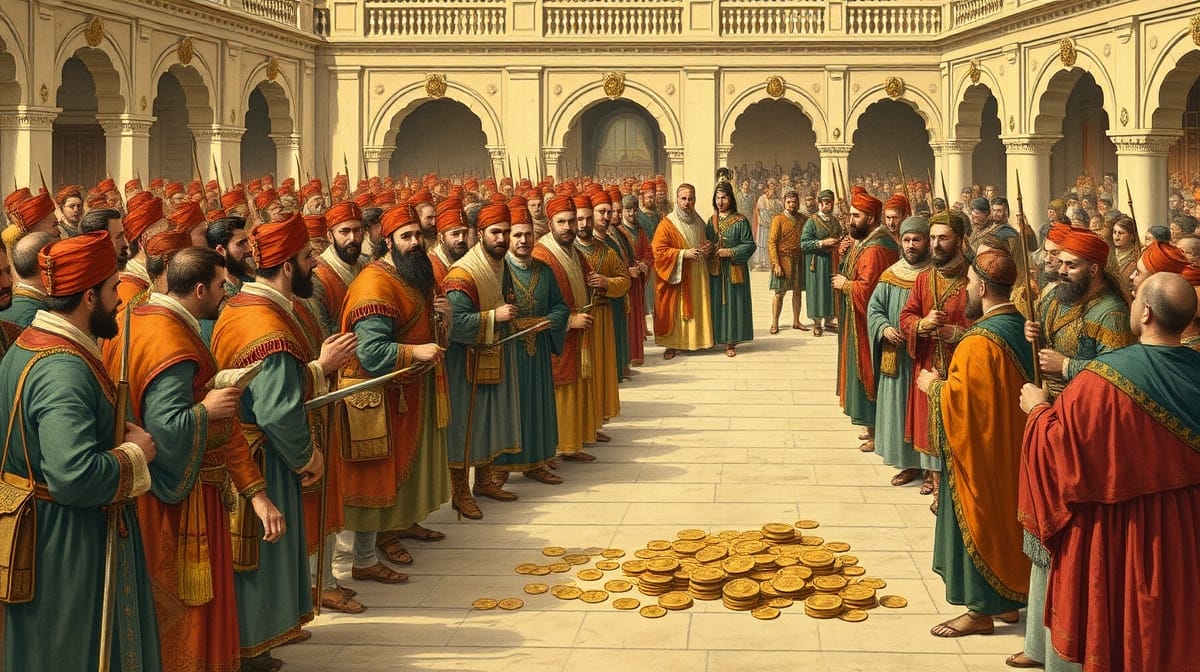
When Cülus Bahşişi was delayed, discontent emerged among the soldiers. The Janissaries could view this delay as a violation of their rights. Rumors would also spread quickly, and it could be said that the sultan was weak. For this reason, the palace tried to make the payment as quickly as possible.
Nevertheless, not every period had the same financial means. Wars, preparations for campaigns, and changes in the value of money strained the treasury. This pressure became especially visible during the periods of stagnation and decline. The causes of the Ottoman Period of Stagnation help explain this background.
Rebellions and an Instrument of Pressure
Cülus Bahşişi became, in some periods, one of the justifications for military pressure. The Janissaries could pressure the palace over the amount of the payment or the way it was distributed. This attitude became more effective especially when central authority weakened. Thus the tradition turned into part of political crisis.
Ahmed Cevdet Pasha, when describing the deterioration of the Ottoman order, frequently refers to the military corps’ intervention in politics. In this context, the issue of the gratuity is not merely a financial topic. It is also an area in which state discipline was tested. For this reason, Cülus Bahşişi is an important indicator for understanding Ottoman crises.
Change After the Tanzimat
After the Janissary Corps was abolished in 1826, the old balance surrounding cülus changed to a great extent. This was because the most powerful recipient of the gratuity had disappeared. Even so, enthronement ceremonies did not vanish completely. Palace protocol was reshaped according to the modernizing structure of the state.
During the Tanzimat and Islahat periods, attempts were made to manage finance through more regular institutions. The Tanzimat and Islahat Edicts in the Ottoman Empire are important for understanding this transformation. Military payments were now moved into a bureaucratic framework different from the old corps negotiations. Yet the symbolic meaning of cülus continued.
Modernization and Protocol
In the period of modernization, the sultan’s visibility increased through different means. Ceremonies, newspapers, firmans, and official announcements were among these means. Cülus still announced the beginning of a reign. But the pressure over gratuities was no longer as harsh as it had been under the old kapıkulu order.
In addition, the symbols of sultanate retained their importance in the new period. Sword-girding, the khutba, coinage, and official congratulations continued. These practices emphasized the continuity of the state. As a result, the language of ceremony changed, but the need for legitimacy endured.
Conclusion
Cülus Bahşişi shows that accession to the throne in the Ottoman Empire was not only a ceremony but also a matter of politics, loyalty, and finance. Through this payment, the new sultan reassured the military class and made his authority visible. Yet the growing financial burden over time turned the tradition into an element that produced crises. As a result, Cülus Bahşişi is a key concept for understanding the Ottoman conception of sovereignty.
Sources
- Halil İnalcık, Devlet-i Aliyye.
- İsmail Hakkı Uzunçarşılı, The Palace Organization of the Ottoman State.
- Ahmed Cevdet Pasha, Tarih-i Cevdet.
- Caroline Finkel, Osman’s Dream.
- TDV Encyclopedia of Islam, entry on Cülûs.





8 thoughts on “What Was Cülus Bahşişi? Ottoman Enthronement Ceremonies and Their Meaning”