During the reign of Murad III, the Ottoman Empire underwent a significant transformation marked by expanding war fronts, the growing importance of palace-centered politics, mounting fiscal pressure, and an enlarging bureaucracy; the period from 1574 to 1595 was not simply a “stagnation” in which the classical order came to an end, but a complex era of change in which the empire sought to adapt to new conditions.
)
Quick Summary
- Murad III ascended the throne in 1574 and ruled until 1595.
- As the eastern campaigns expanded, prolonged wars significantly increased the fiscal burden.
- Palace circles and harem networks became more visible in state politics.
- The depreciation of the akçe placed pressure on soldiers’ pay and the urban economy.
- Classical institutions did not disappear, but the pressure to adapt to new conditions increased.
Table of Contents
- Accession and Political Legacy
- Palace Politics Under Murad III
- War with Iran and the Eastern Frontier
- War with Austria and the Western Front
- Fiscal Order and the Akçe Crisis
- Army, Timar, and Social Change
- Culture, Art, and the Palace
- Historical Significance of the Period
- Conclusion
Accession and Political Legacy
Murad III ascended the throne in December 1574 after the death of Selim II. He had spent his years as a prince in Manisa and gained experience governing a sanjak. When he came to the throne, the state still retained the strong institutional legacy shaped during the reign of Suleiman I. However, the cost of warfare and the structure of palace politics had begun to change.
In the early years of the new sultan’s reign, Sokollu Mehmed Pasha continued to serve as grand vizier. This preserved, for a time, the continuity of government inherited from the reign of Selim II. Sokollu’s assassination in 1579, however, created an important turning point. In the years that followed, changes of grand vizier became more frequent, and different networks of influence around the palace became more pronounced.
It is inadequate to explain these developments solely as a “weakening of central authority.” The state’s decision-making mechanism was expanding and being redistributed among different actors. While the Imperial Council and central administration retained their importance, advisory channels within the palace also gained strength. The period should therefore be seen as a phase in which the form of government was being rebalanced.
How Did Palace Politics Change Under Murad III?
Murad III and the Balance of Power Around the Palace
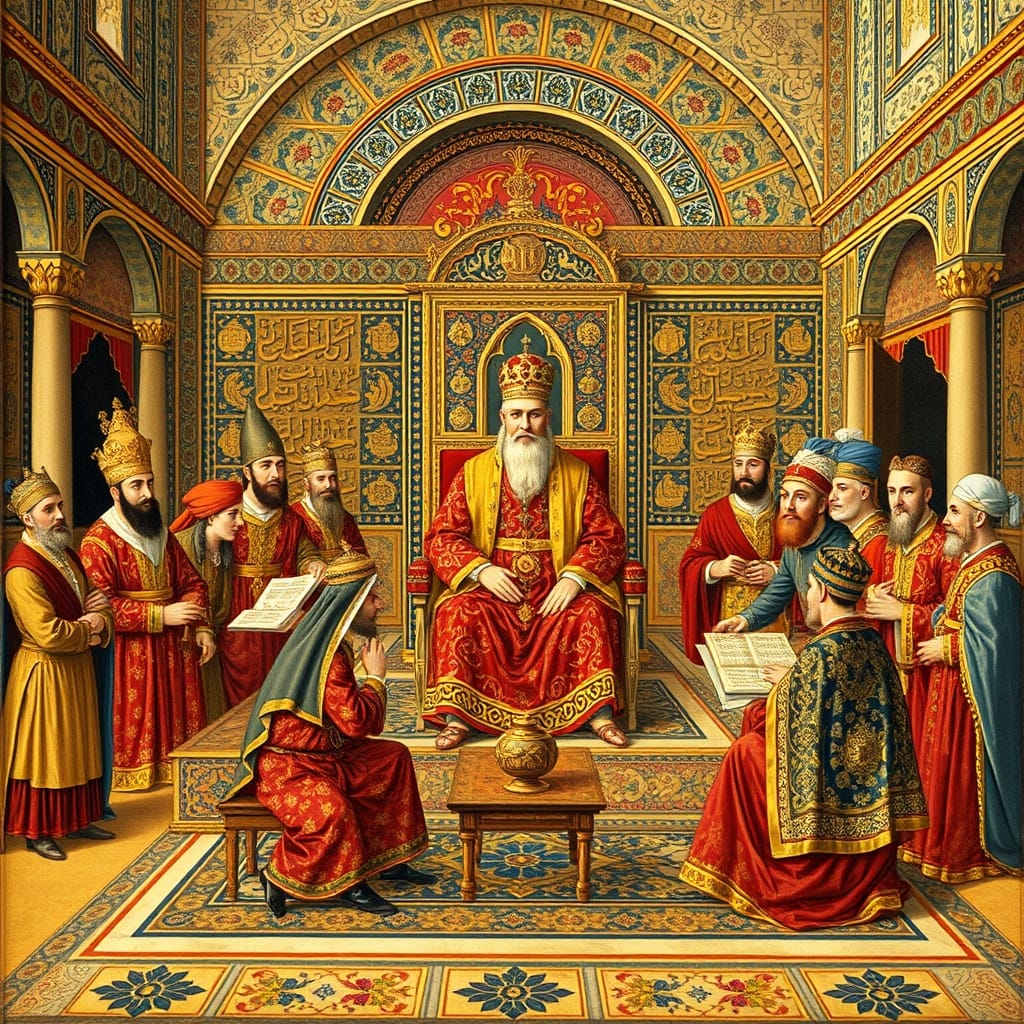
Under Murad III, the sultan’s style of governing from the palace became more visible. Like his father Selim II, the ruler did not lead the army on prolonged campaigns. Instead, he directed government through viziers, commanders-in-chief, and palace officials. This model did not mean that the sultan withdrew from politics.
Nurbanu Sultan and later Safiye Sultan were influential figures in relationships within the palace. Connections among ambassadors, senior officials, and members of the dynasty could affect decision-making processes. At the same time, the rules and power relations of Ottoman harem life cannot be considered separately from the political structure of the palace. Yet attributing every decision to harem influence would oversimplify the historical picture.
Caroline Finkel interprets this century not as a line of sharp decline but as part of a long transformation in which institutions adapted to new conditions. This perspective also makes the changes within the palace easier to understand. As the sultan’s public visibility diminished, dynastic authority did not disappear. On the contrary, the palace became a more complex center of governance and patronage.
Why Did the Distribution of Duties Become More Important Under Murad III?
The empire governed a vast geography, and multiple frontier zones were exerting pressure at the same time. Grand viziers, governors-general, and commanders-in-chief therefore assumed greater responsibility. While the center directed policy through imperial decrees and fiscal regulations, it allowed provincial officials broad scope in implementation. This was a natural consequence of the state’s size.
At the same time, the distribution of offices intensified competition around the palace. Groups formed that competed for posts, income, and influence. The increasing fluidity of appointments affected the structure of the bureaucracy. As a result, the idea that the classical order was fixed and unchanging became increasingly detached from reality.
)
The War with Iran and the Great Expansion on the Eastern Frontier
One of the most important foreign-policy developments of Murad III’s reign was the Ottoman-Safavid War that began in 1578. The Caucasus, Shirvan, Georgia, and Azerbaijan became theaters of prolonged conflict. Ottoman armies made significant advances. Within the long history of Ottoman-Iranian wars, this conflict marked one of the periods in which the empire’s eastern frontiers expanded the furthest.
The war ended in the Ottomans’ favor with the Treaty of Ferhat Pasha in 1590. The state gained claims to sovereignty over extensive territories in the Caucasus and Azerbaijan. Yet this success came at a very high cost. Maintaining troops on distant fronts, defending fortresses, and sustaining supply lines placed heavy pressure on the treasury.
A clear tension therefore emerged between military expansion and fiscal strength. Acquiring new territories did not always produce a regular increase in revenue. Moreover, the peace with the Safavids did not last. Under subsequent rulers, the eastern frontier would once again become a theater of war.
The War with Austria and New Pressure on the Western Front
Shortly after the eastern war ended, tensions increased on the western frontier. The conflict with the Habsburgs that began in 1593 and later became known as the “Long Turkish War” marked the final years of the sultan’s reign. The war created a broad front across Hungary and the Balkan borderlands. The struggle continued after the ruler’s death.
The war on the western front placed even greater strain on the state’s fiscal and military capacity. Fortress sieges, paid troops, transport, and munitions required major expenditure. Fighting in frontier regions also affected local economies. Thus, after the expansion achieved in the east, a new cycle of prolonged warfare began.
This picture shows that the changes of the period cannot be explained by palace politics alone. The empire’s vast geography required constant military preparedness. A revenue system that functioned in peacetime could not deliver the same effectiveness during long wars. The state therefore turned increasingly to new methods of taxation and finance.
Fiscal Order and the Akçe Crisis
In the late sixteenth century, the Ottoman economy was affected by broad price movements across Eurasia. American silver entering Europe, trade routes, and regional price increases all contributed to this process. Population growth and wartime expenditure also intensified domestic pressure. The economic transformation discussed by Halil İnalcık and Donald Quataert shows that these problems cannot be reduced to a single cause.
The reduction of the silver content of the akçe in the mid-1580s had serious consequences. Salaried soldiers were directly affected by the currency’s loss of purchasing power. The major military protest of 1589 demonstrated to the central administration the connection between fiscal stability and political stability. The event signaled that relations between the palace and the household troops had entered a new phase.
It would be incorrect, however, to explain the deterioration in the currency’s value solely as a result of poor administration. The war economy, flows of silver, and rising demand for cash all played a role. The state, in turn, tried to increase tax collection and cash revenues as a remedy. These measures laid the groundwork for fiscal practices that would become more pronounced in the following century.
Army, Timar, and Social Change
During the reign of Murad III, the structure of the army was also affected by changing military technology. As infantry armed with firearms became more important, the need for paid soldiers grew. Timariot cavalrymen remained important, but the demands of warfare could no longer be met through the timar system alone. The relative weight of forces paid from the central treasury therefore increased.
The growth in the number of household troops created new burdens on the budget. Meanwhile, temporary soldiers recruited in the provinces for wartime service could face employment problems in periods of peace. These tensions, which became more pronounced in the 1590s, were connected to the social conditions in which the Celali rebellions would later expand. Even so, it would be inaccurate to place the major Celali rebellions entirely within this reign.
When the different military components of the Ottoman army are considered together, the transformation becomes clearer. The system did not suddenly collapse; rather, it attempted to respond to changes in the nature of warfare. This effort to adapt created a need to reorganize both manpower and state revenues. In the end, military change accelerated fiscal and social transformation.
Cultural and Artistic Vitality at the Palace
Despite political and fiscal pressures, the reign of Murad III was a period of vigorous cultural production. The palace workshop produced important works that brought historiography and miniature painting together. Illustrated manuscripts prepared around Seyyid Lokman and Nakkaş Osman transformed the dynasty’s understanding of history into a visual language. The palace remained an important center of patronage for artists and writers.
The circumcision festival held in Istanbul in 1582 for Prince Mehmed is among the best-known examples of this cultural vitality. The festivities lasted for weeks and included artisan guilds, artists, military units, and foreign representatives. The festival was not merely a dynastic celebration. It was also a major public spectacle showcasing the occupational world of the capital and the representational power of the state.
Mimar Sinan also continued to serve as chief imperial architect for a significant part of the sultan’s reign and died in 1588. His late works embodied the mature style of classical Ottoman architecture. Book arts, calligraphy, and historiography also received palace patronage. This cultural production demonstrates that political problems and artistic vitality could coexist.
)
The Historical Significance of Murad III’s Reign
In older historiography, the late sixteenth century was often described using the concept of “stagnation.” This approach viewed changes after the reign of Suleiman the Magnificent as deviations from an earlier order regarded as ideal. Today, however, many historians find the concepts of transformation, adaptation, and restructuring more explanatory. This is because the state both fought major wars and expanded its institutions during the same period.
The problems of the era were real: inflation, currency depreciation, military costs, and competition for office created serious pressures. Yet the central bureaucracy continued to function, methods of tax collection changed, and the army expanded in response to new needs. This picture is more complex than a simple rise-and-decline model.
The debate over the Ottoman “stagnation period” should therefore be approached critically. Although “stagnation” offers a useful form of periodization for teaching purposes, it does not explain developments in every sphere at once. Culture and bureaucracy can expand during years of economic difficulty. Fiscal balances can deteriorate even as military expansion continues.
Ultimately, this reign was not an endpoint at which the empire’s classical structure disappeared, but a transitional phase toward a new order of governance and warfare. Murad III’s reign contained important precursors of the major transformations of the seventeenth century. For this reason, assessing the period solely through palace intrigue or military victories leaves the picture incomplete.
Conclusion
The reign of Murad III was one of the major turning points of change in Ottoman history. As the state expanded in the east, it entered a new prolonged war in the west; palace politics became more diverse, fiscal pressures increased, and the structure of the army changed. Despite this, institutions continued to function and cultural production remained vibrant. For this reason, it is more illuminating to understand the reign of Murad III as a period of complex transformation rather than decline.
Sources
- Bekir Kütükoğlu, TDV Encyclopedia of Islam, “Murad III” entry.
- Erhan Afyoncu, TDV Encyclopedia of Islam, “Sokollu Mehmed Pasha” entry.
- Halil İnalcık and Donald Quataert (eds.), An Economic and Social History of the Ottoman Empire.
- Caroline Finkel, Osman’s Dream: The Story of the Ottoman Empire 1300–1923.