The Balkan Wars were not merely a heavy military defeat for the Ottoman State; they marked a historic rupture that ended centuries of dominance in Rumelia, triggered mass migrations, caused massive territorial losses, and fundamentally reshaped the empire’s late-period politics.
Table of Contents
- Why Were the Balkan Wars Such a Major Turning Point?
- The Road to War: How Did Ottoman Rumelia Weaken?
- The First Balkan War and the Ottoman Collapse
- The Second Balkan War and the Recapture of Edirne
- The Consequences of the Balkan Wars for the Ottoman Empire
- Conclusion
- Sources
- Frequently Asked Questions
Why Were the Balkan Wars Such a Major Turning Point?
The Balkan Wars were a major turning point because they brought the Ottoman State’s historic presence in Europe to an almost complete end. From the 14th century onward, Rumelia had been one of the centers of Ottoman politics, military organization, settlement policy, and economic order. Cities such as Edirne, Salonica, Manastir (Bitola), Skopje, and Kosovo were not merely border regions; they were the pillars that carried the Ottoman identity in Europe.
As a result of these wars, the Ottoman State lost the vast majority of its Balkan territories. Centers such as Salonica, Manastir, Skopje, Ioannina, Shkodër, and Kosovo were lost. Edirne was first lost and then recaptured during the Second Balkan War. However, this recapture was not enough to reverse the great rupture.
Viewed through Halil İnalcık’s approach, which assesses Ottoman history through long-term institutions and geographical continuities, the loss of Rumelia was not merely a change on the map. The state’s military manpower, tax base, transportation lines, and psychological superiority were all shaken as well. For this reason, the Balkan Wars are regarded as one of the sharpest turning points marking the Ottoman Empire’s shift from its classical balance of conquest and defense into a phase of dissolution.
The Balkan Wars and the Loss of Rumelia
For the Ottomans, Rumelia was not an outlying region across from Anatolia but a geography of central importance from the very founding of the state. Although the founding process of the Ottoman State began in Anatolia, the Balkan conquests played a decisive role in the state’s transformation into an empire. From the time of Murad I (Hüdavendigâr) onward, the administrative and military order established in the Balkans fed the Ottoman Empire’s power in Europe.
This is why the defeat of 1912–1913 was not an ordinary loss of front. Ottoman society was forced to withdraw from cities and towns settled by Muslim-Turkish populations for centuries. The waves of refugees flowing from Rumelia to Anatolia also profoundly transformed the empire’s social structure.
In Ottoman memory, the Balkan defeat became the name not only of lost territories, but of abandoned cities, families forced onto the roads, and the collapse of an entire worldview.
The Road to War: How Did Ottoman Rumelia Weaken?
The Balkan Wars did not emerge overnight. Throughout the 19th century, nationalist movements in the Balkans had grown stronger, and Russia’s Pan-Slavist policies together with the interventions of European powers had weakened Ottoman authority. The idea of nationalism spread by the French Revolution increased demands for independence among Balkan peoples. This influence can be examined more broadly through the effects of the French Revolution on the Ottoman State.
The Russo-Ottoman War of 1877–1878 dealt a heavy blow to Ottoman power in the Balkans. After the Treaty of Berlin, Serbia, Montenegro, and Romania consolidated their independence, while Bulgaria gained autonomous status. These developments effectively narrowed Ottoman political authority in the Balkans. The Russo-Ottoman wars were decisive in turning the Balkan question into an international problem.
Nationalism and Alliances Before the Balkan Wars
Before the Balkan Wars, a foundation for an alliance against the Ottomans formed among Bulgaria, Serbia, Greece, and Montenegro. Although these states had conflicts of interest among themselves, they formed a temporary partnership aimed at driving the Ottomans out of the Balkans. Russian diplomacy also encouraged rapprochement, particularly among the Slavic states.
The Ottoman State, meanwhile, was preoccupied with the Italo-Turkish War (Tripolitanian War). Italy’s attack on Tripolitania in 1911 exhausted Ottoman military resources and presented the Balkan states with a favorable opportunity. The army’s modernization was incomplete, political divisions among officer corps had increased, and the central administration was worn down by internal crises.
As İsmail Hakkı Uzunçarşılı emphasizes in his assessments of Ottoman political history, the army’s involvement in politics and factionalism after the Second Constitutional Era were among the key factors that weakened its fighting capacity. Under these conditions, the Ottoman army could not mount an effective, simultaneous defense across wide fronts.
The Unpreparedness of the Ottoman Army
Although the Ottoman army looked large on paper, it faced serious problems in mobilization, logistics, unity of command, and communications. The training of reserve (redif) units was inadequate; transportation lines were weak; coordination between fronts could not be achieved. The historic organization of the Ottoman army had a long history, but the transition to the rapid deployment and command structure required by modern warfare had been painful.
These shortcomings allowed the Balkan armies to advance faster than expected. In particular, the Bulgarian army in Eastern Thrace, the Serbian army in Macedonia, and Greek forces along the Salonica-Epirus line put severe pressure on Ottoman defenses. As a result, in the early months of the war, the Ottoman State suffered a collapse that proved difficult to reverse.
The First Balkan War and the Ottoman Collapse
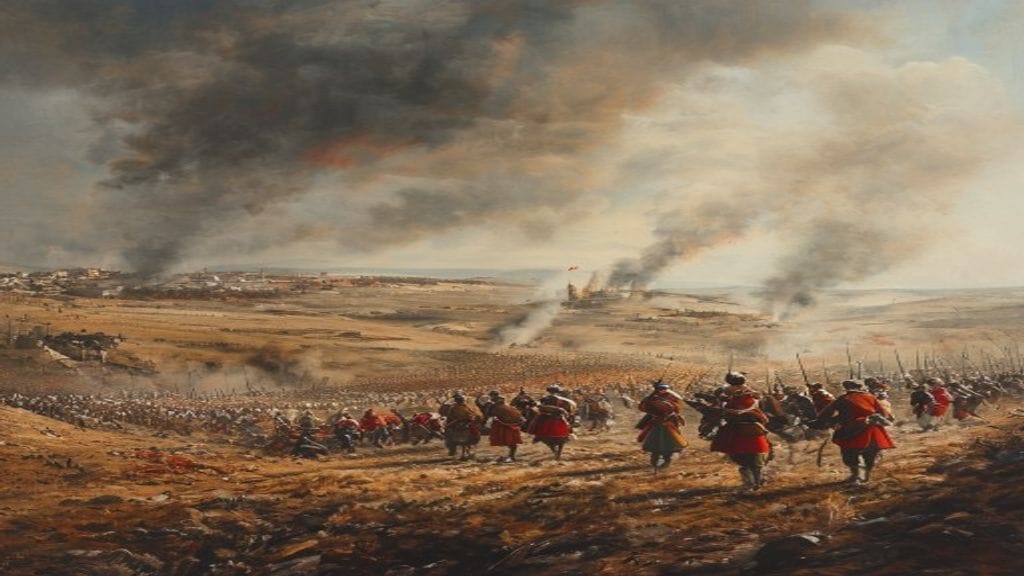
The First Balkan War began in October 1912 when Montenegro declared war on the Ottoman Empire; Bulgaria, Serbia, and Greece soon joined. The Ottoman State was forced to fight on four fronts at once. In a short time, heavy defeats occurred at critical centers such as Kırklareli, Lüleburgaz, Kumanovo, Manastir, and Salonica.
The surrender of Salonica to Greece in 1912 caused a major shock in Ottoman public opinion. The city was one of Rumelia’s most important ports and a symbol of Ottoman multicultural urban life. The loss of Salonica was not only a military blow but also an economic and psychological disaster.
With the defeats at Kumanovo and Manastir, Ottoman defenses in Macedonia collapsed. Edirne was besieged by Bulgarian forces. In Eastern Thrace, the Ottoman army withdrew all the way to the Çatalca line. The fact that Istanbul itself came under threat showed just how dangerous the war had become for the seat of the state.
Edirne and the Çatalca Line During the Balkan Wars
During the Balkan Wars, Edirne became one of the most symbolic centers of Ottoman resistance. The defense under the command of Şükrü Pasha continued for a long time, but the city fell into Bulgarian hands in March 1913. The fall of Edirne caused a deep collapse of morale in the Ottoman capital.
The Çatalca line was Istanbul’s final line of defense. The Bulgarian army’s advance to this line directly threatened the Ottoman capital. The danger facing the capital city of Istanbul made the scale of the Balkan disaster plainly clear. This picture stood in sharp contrast to earlier centuries when the Ottomans had been the advancing side in the Balkans; when one considers, for instance, the place of the Battle of Kosovo in Ottoman history, the 1912 retreat was perceived as far more painful in historical memory.
Caroline Finkel, treating Ottoman history within a long imperial narrative, points out that the Balkan defeats deepened the crisis of confidence in the empire’s final period. Indeed, these wars led Ottoman elites to reconsider not only military reforms but their entire political outlook on the state’s future.
The Second Balkan War and the Recapture of Edirne
After the first war, the Balkan states fell into disagreement over the division of the territories taken from the Ottomans. In particular, Bulgaria’s claims over Macedonia clashed with Serbia and Greece. The Second Balkan War, which began in June 1913, gave the Ottoman State a limited but real opportunity to maneuver.
Taking advantage of this opportunity, the Ottoman army recaptured Edirne in July 1913. This operation, in which Enver Bey played a prominent role, created a great boost in morale among the Ottoman public. However, the recapture of Edirne could not compensate for the overall territorial losses in the Balkans, since Macedonia, most of Albania, Kosovo, Salonica, and significant parts of Western Thrace remained outside Ottoman control.
The Treaties of London and Istanbul After the Balkan Wars
The treaties concluded after the Balkan Wars redefined the Ottoman State’s borders in the Balkans. Under the 1913 Treaty of London, the Enos–Midia line was accepted as the Ottoman-Bulgarian border. Later, following the Second Balkan War, the Treaty of Istanbul left Edirne and Kırklareli within Ottoman territory.
Yet these diplomatic corrections did not change the essential loss. The Ottoman State was no longer a decisive power in the Balkans. Albania’s independence process also severed the Ottoman Empire’s historic ties reaching to the Adriatic. These developments largely brought an end to the empire’s geopolitical weight in Europe.
The Consequences of the Balkan Wars for the Ottoman Empire
The Balkan Wars left multi-layered effects on the Ottoman State. These cannot be reduced merely to military defeat; they must also be assessed in terms of population movements, ideological transformation, foreign policy, economy, and state-society relations.
- Territorial loss: The Ottomans lost the vast majority of their extensive territories in Rumelia.
- Population movements: Hundreds of thousands of Muslim refugees migrated to Anatolia and Eastern Thrace.
- Need for military reform: Deficiencies in the army’s organization were exposed in stark terms.
- Political radicalization: The influence of the Committee of Union and Progress in government increased.
- Psychological collapse: The loss of Rumelia created deep trauma within Ottoman society.
Migrations and Social Trauma
The refugee movement from the Balkans to Anatolia was among the war’s most severe humanitarian consequences. Muslim Turks, Albanians, Bosnians, Pomaks, and other communities were displaced by war, oppression, hunger, and fear for their safety. Kemal Karpat’s studies on Ottoman population movements show that these migrations were among the primary processes that shaped the demographic structure of modern Turkey.
These migrations did not merely involve the transfer of population. They carried with them memory, pain, loss, and the search for a new homeland. Refugee neighborhoods formed in Anatolian cities, and the state had to grapple with problems of settlement and provisioning. Thus, even though the war ended on the battlefield, its social effects continued for many years.
Political Consequences and the Rise of the Unionist Cadres
The Balkan defeat also produced major consequences in Ottoman domestic politics. After the 1913 Raid on the Sublime Porte, the Committee of Union and Progress became far more dominant in government. The losses in the Balkans reinforced the idea that more centralized, more disciplined, and more nationalist policies were necessary for the state’s survival.
This process also weakened the ideal of Ottomanism. Having aimed in the 19th century to hold different communities together around a shared idea of citizenship, Ottomanism suffered a severe blow in the face of Balkan nationalist independence movements. Among the Ottoman intellectual movements, the Balkan disaster played a major role in strengthening trends such as Turkism and Islamism.
Military Lessons and the Road to World War I
The Balkan Wars clearly exposed the weaknesses of the Ottoman army under modern warfare conditions. Discord within the command structure, logistical inadequacy, lack of training, and political divisions were among the leading causes of the heavy defeat. These lessons made the influence of the German military mission and army reforms even more critical in the run-up to World War I.
Yet time for reform was short. The Ottoman State entered the world war in 1914 before it had fully healed the wounds of the Balkan defeat. In this respect, the Balkan Wars were not merely a disaster in their own right, but also a threshold that accelerated the Ottoman Empire’s path toward its final war. These wars hold a special place within the process of the Ottoman State’s collapse.
Conclusion
The Balkan Wars were one of the greatest turning points that largely ended the Ottoman State’s centuries-old presence in Rumelia, triggered mass migrations, altered political balances, and shaped the empire’s final period. These wars are remembered as a historic turning point at which the Ottomans lost not only territory, but memory, population, confidence, and their very vision of the future.
Sources
- Halil İnalcık, Devlet-i Aliyye.
- İsmail Hakkı Uzunçarşılı, Ottoman History (Osmanlı Tarihi).
- Caroline Finkel, Osman’s Dream.
- Kemal H. Karpat, Ottoman Population 1830–1914.
- TDV Encyclopedia of Islam, entry on the Balkan Wars.