The statesman who brought the term “cold war” into political language was Bernard Baruch. An American financier and presidential adviser, Baruch declared in a speech to the South Carolina legislature on 16 April 1947: “Let us not be deceived — we are today in the midst of a cold war.” The question is often confused with Winston Churchill; this article sets out the difference.
The short answer: Bernard Baruch (16 April 1947)
The first statesman to use the term formally in a speech was Bernard Baruch. He had headed the War Industries Board during the First World War and went on to advise a succession of American presidents from Wilson to Truman. The 1946 plan for international control of atomic energy submitted to the United Nations also bears his name.
The man who actually made the phrase stick was the journalist Walter Lippmann. That same year he gave a series of columns — and then a book — the title The Cold War, fixing the term permanently in the language.
Was there an earlier use?
Yes. The writer George Orwell used the phrase “cold war” in his essay “You and the Atomic Bomb”, published in 1945. Since Orwell was not a statesman, the expected answer in exam questions remains Baruch — but knowing that the term can be traced back to 1945 is not wrong; it is the complete answer.
Why is Churchill so often assumed?
Winston Churchill’s speech at Fulton, Missouri, on 5 March 1946 was the most widely echoed text of the period. In it he criticised Soviet control over Eastern Europe and said the continent had been divided in two.
That is exactly where the confusion comes from: in that speech Churchill did not say “cold war” but “iron curtain”. The two phrases describe the same period, yet they are not the same concept. In short, the speech that symbolised the era was Churchill’s; the speech that named the concept was Baruch’s.
| Person | Date | Phrase used | Role |
|---|---|---|---|
| George Orwell | 19 October 1945 | “cold war” | Writer |
| Winston Churchill | 5 March 1946 | “iron curtain” | Statesman |
| Bernard Baruch | 16 April 1947 | “cold war” | Statesman / adviser |
| Walter Lippmann | 1947 | “The Cold War” | Journalist |
What was the Cold War?
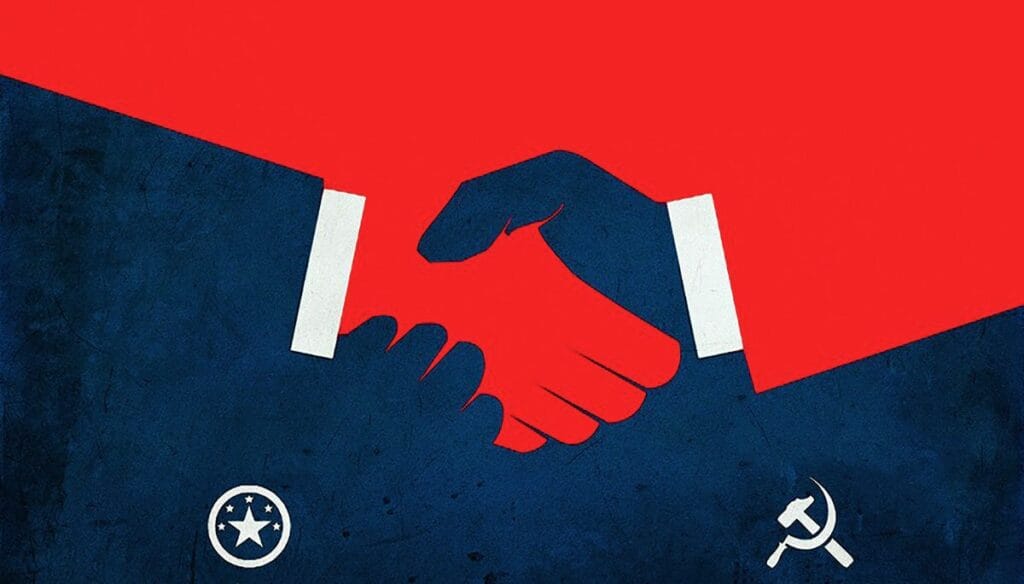
The Cold War was the political, military, economic and ideological struggle between the United States and the Soviet Union that followed the Second World War. The two sides never fought each other in a full-scale war; the rivalry ran instead through proxy conflicts, an arms race, espionage and propaganda.
Why was it called “cold”?
Because there was no direct hot conflict between the two powers. Weapons spoke in third countries, not between the superpowers themselves. Nuclear deterrence had made a direct war unaffordable for both.
Features of the Cold War era
- NATO was founded in 1949 and the Warsaw Pact in 1955; the world split into two blocs.
- The nuclear arms race began, producing a balance of mutual deterrence.
- The space race, from Sputnik to the Moon landing, turned into a contest of prestige.
- Korea (1950–1953) and Vietnam were fought as proxy conflicts.
- The Berlin crises and the Cuban Missile Crisis of 1962 were the tensest moments of the period.
- Espionage was institutionalised through the CIA and the KGB.
The period ran roughly from 1947 to 1991. Turkey stood within the Western bloc throughout and joined NATO in 1952.
The blocs: West and East
- Western bloc: formed under American leadership and covering the NATO countries; its economic arm was the Marshall Plan.
- Eastern bloc: shaped under Soviet leadership and made up of the Warsaw Pact states; its economic arm was COMECON.
Countries were usually forced to pick a side, and economic aid became a political instrument. The Non-Aligned Movement brought together the states that tried to stay outside this binary.
How did the Cold War end?
The era closed with the fall of the Berlin Wall in 1989 and the dissolution of the Soviet Union in 1991. The Eastern bloc collapsed, the United States became for a time the sole superpower, and the international balance was rebuilt.
Frequently asked questions
Who was the statesman who first used the term cold war?
Bernard Baruch. He used it in his speech to the South Carolina legislature on 16 April 1947.
Did Churchill use the phrase “cold war”?
No. In his 1946 Fulton speech Churchill used the phrase “iron curtain”. The two describe the same era but are different concepts.
Who really used the term first?
The earliest known use is in George Orwell’s essay of 1945. But Orwell was a writer, not a statesman; when a statesman is asked for, the answer is Baruch.
Which years does the Cold War cover?
The generally accepted range is 1947–1991: the Truman Doctrine (1947) is taken as the starting point and the dissolution of the Soviet Union (1991) as the end.
Sources
- Fahir Armaoğlu, 20. Yüzyıl Siyasî Tarihi (Political History of the 20th Century).
- John Lewis Gaddis, The Cold War: A New History.
- Oral Sander, Siyasi Tarih 1918–1994.
- Erik Jan Zürcher, Turkey: A Modern History.