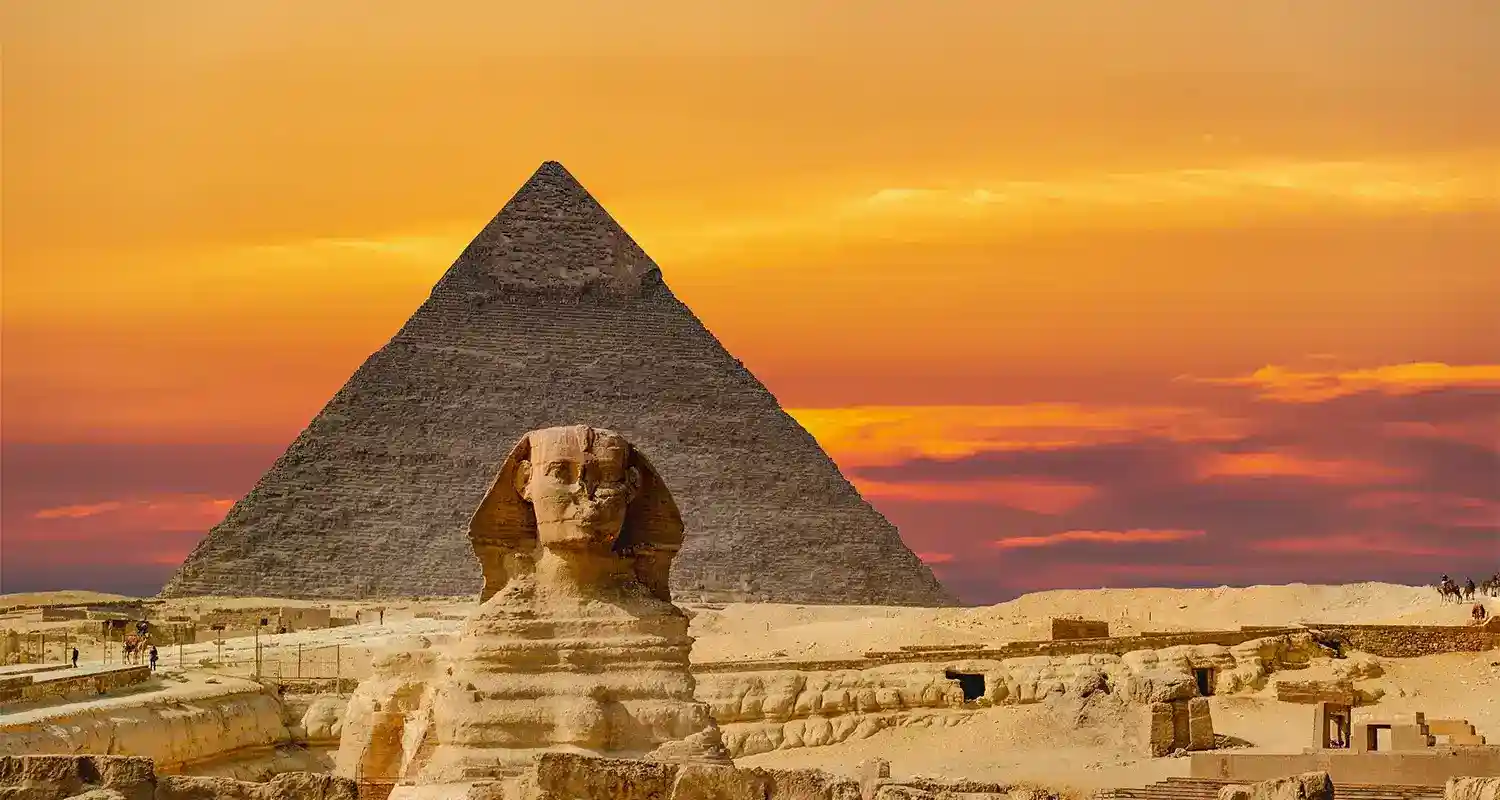
The answer to what the ancient Egyptians believed the world looked like is a flat earth with a sky arching over it like a dome. The ancient Egyptians imagined the earth as the god Geb and the sky as the star-studded goddess Nut. Between the two stood Shu, who represented the air. This whole order lay in the middle of Nun, an endless body of water.
Quick Summary
- The earth was imagined as a flat piece of land, and the sky as a dome bending over it.
- The earth god Geb, the sky goddess Nut and Shu, the air between them, represented this order.
- The world stood in the middle of Nun, the dark and boundless primeval water.
- The sun god Ra traveled by boat across the sky by day and through the underworld by night.
- The star Sirius heralded the Nile flood; the official calendar was based on 365 days.
Contents
- How was the world imagined?
- The creation story: from Nun to Geb and Nut
- The journey of the sun and the night
- Egypt at the center: black land and red land
- Observing the sky and the calendar
- Comparison with other civilizations
- Frequently asked questions
What Did the Ancient Egyptians Believe the World Looked Like?
The ancient Egyptians saw the land they lived on as a flat surface. Through the middle of this surface ran the Nile valley, with deserts and mountains stretching on either side. The sky was imagined as a dome or ceiling bending over the earth. In some accounts this ceiling was believed to rest on pillars or mountains at the four corners of the world.
The ancient Egyptians usually described this order through their gods. On the walls of temples and tombs the earth god Geb was drawn lying on the ground. The sky goddess Nut bent over him, resting her hands and feet on the two ends of the horizon. Nut’s body was covered with stars, and the air god Shu, standing between the two, held the sky up.
Today this picture is sometimes compared to a box whose floor is the earth and whose lid is the sky. For the ancient Egyptians, however, it was not just a matter of shape. Sky, earth and air were thought of as living gods, and the universe stood firm through their relationship.
The Story of the Celestial Cow
Another image used for the sky was that of a cow. In the “Book of the Heavenly Cow”, which also appears on the gilded shrine that surrounded the burial chamber of Pharaoh Tutankhamun, the sky is drawn as a giant cow whose belly is adorned with stars. The air god Shu supports the cow’s belly, and its four legs stand like the four pillars that hold up the sky. The boat of the sun also travels beneath this starry belly.
The Creation Story: From Nun to Geb and Nut
The most widespread creation story in Egypt belongs to Heliopolis, known as the City of the Sun. According to this story, in the beginning there was only Nun, a dark and boundless water. The creator god Atum appeared by himself on the first mound that rose from the waters. He then created Shu, who represented the air, and Tefnut, who represented moisture.
From Shu and Tefnut were born the earth god Geb and the sky goddess Nut. According to the story, Geb and Nut were tightly embraced. When Shu came between them and lifted Nut up, earth and sky were separated, and a space opened up for living beings. The children of Geb and Nut were Osiris, Isis, Seth and Nephthys.
This divine lineage was also connected to the pharaoh’s legitimacy. According to the entry “Firavun” in the TDV Encyclopedia of Islam, in Egyptian mythology the first king on earth was the earth god Geb. After him his son Osiris ruled the land, and when Osiris was killed the kingship passed to his son Horus. The encyclopedia notes that the pharaoh was regarded as both king and son of the god.
The Journey of the Sun and the Night
The sun stood at the center of how the ancient Egyptians imagined the universe. The sun god Ra traveled by boat across the sky from east to west during the day. In the evening he was swallowed by Nut on the western horizon and passed through her body during the night. In the morning he was reborn from Nut in the east; this scene is painted on many tomb ceilings.
The realm through which the night passed was also associated with the underworld, the Duat. Here the sun fought the forces of darkness and returned victorious every morning. Because the dead also traveled in this same world, the cycle of the sun was intertwined with belief in life after death. The importance given to tombs and pyramids also drew on this belief.
The importance of the sun sometimes led to religious reforms as well. According to the entry “Mısır” in the TDV Encyclopedia of Islam, Amenhotep IV (1375–1354 BC) wanted to bring solar monotheism to the country. He declared Aten, depicted as a sun disk, the only god and changed his own name to Akhenaten. This new religion, however, was abolished after his death.
Egypt at the Center: Black Land and Red Land
At the center of the ancient Egyptians’ map of the world was their own country. They called the land made fertile by the Nile floods “Kemet”, the black land. The deserts surrounding the valley they called “Deshret”, the red land. The black land represented order and life, while the red land represented chaos and danger.
The ancient Egyptians saw their country not as a single piece but as the “Two Lands”, made up of Upper and Lower Egypt. One of the pharaoh’s titles was “Lord of the Two Lands”. According to the TDV Encyclopedia of Islam, Djoser, a pharaoh of the Third Dynasty, moved the seat of government to Memphis, on the border between the two lands. This dual structure also fitted the idea of balance in the universe between earth and sky, black land and red land.
The Nile was the lifeline of this world. The entry “Nil” in the TDV Encyclopedia of Islam quotes the Greek historian Herodotus’ saying that “Egypt is the gift of the Nile”. The ancient Egyptians looked for the source of the flood that came every summer in the waters of Nun, which surrounded the universe. The flood was seen as a yearly repetition of creation.
Observing the Sky and the Calendar
The ancient Egyptians watched the sky closely, because the timing of agriculture depended on it. The official calendar consisted of twelve months of thirty days each, with five days added at the end of the year. The year thus lasted 365 days. It was divided into three seasons of four months each: the seasons of inundation, sowing and harvest.
There was also a mythological explanation for the five days added at the end of the year. According to the story related by the Greek writer Plutarch, it had been decreed that Nut could not give birth on any day of the year. Thoth, the god of wisdom, added to the year five extra days that he had won from the moon. Osiris, Horus, Seth, Isis and Nephthys were born on these five days.
The herald of the new year and of the flood was the star Sirius, which the Egyptians called Sopdet. The reappearance of Sirius at dawn after a long absence coincided with the time the Nile began to rise. According to the TDV Encyclopedia of Islam, the Ramesseum complex that Ramesses II had built at Thebes also included an astronomical observation room.
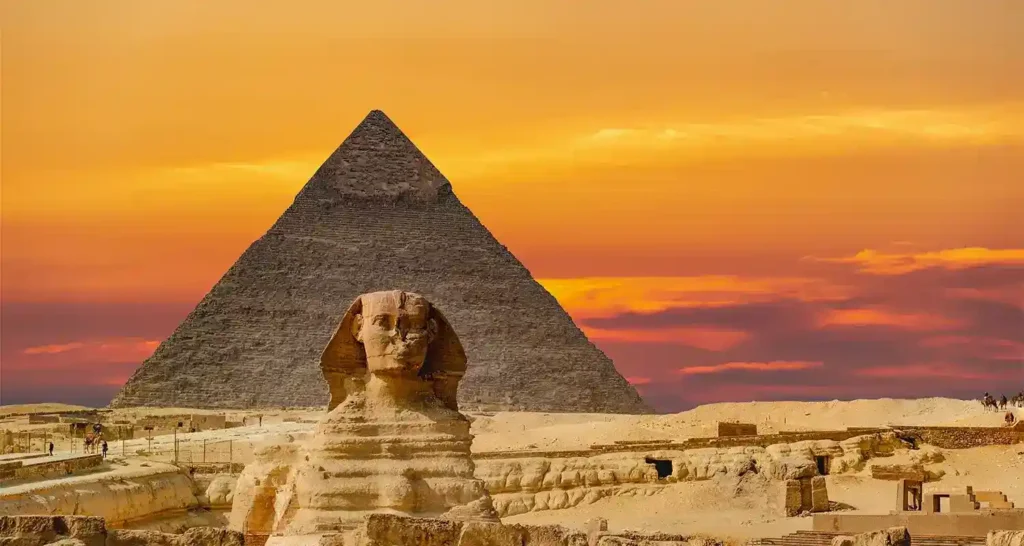
Knowledge of the sky was reflected in architecture as well. It is known that the sides of the great pyramids were aligned with the four cardinal directions with astonishing accuracy. We discussed the place of stars and constellations in Egyptian belief in our article on zodiac signs according to Egyptian mythology.
Comparison with Other Civilizations
The idea of a flat earth covered by a sky was not unique to Egypt in antiquity. Each civilization drew this picture according to its own geography and beliefs. You can find the similar Mesopotamian picture in our article on the Babylonian view of the world, and its Indian counterpart in our article on the ancient Indian picture of the world. For an example from the Americas, see our article on the Maya view of the world.
Interestingly, one of the first calculations to measure the earth as round was also made in Egypt. In the third century BC Eratosthenes, head of the Library of Alexandria, started from the different angles of the sun at Alexandria and Aswan. With this method he calculated the circumference of the earth with remarkable accuracy. Thus, on the same soil, the idea of a flat, domed world began to give way to scientific measurement.
Frequently Asked Questions
What did the ancient Egyptians believe the world looked like?
They likened it to a flat earth with a sky arching over it like a dome. The earth was thought of as the god Geb, the sky as the goddess Nut, and the air between them as the god Shu.
Who are Nut and Geb?
Nut is the sky goddess whose body is covered with stars. Geb is the earth god and, according to the myth, is regarded as the first king on earth. The two were separated by the air god Shu.
According to the ancient Egyptians, who held up the sky?
In the myth the air god Shu held up the sky. In some accounts the sky was imagined as a ceiling resting on pillars or mountains at the four corners of the world.
How many days did the Egyptian calendar have?
The official calendar had 365 days. Five days were added at the end of the year to twelve months of thirty days each.
Conclusion
The answer to what the ancient Egyptians believed the world looked like is a flat earth covered by a dome of sky. They described this order through gods such as Geb, Nut and Shu and linked the sun’s daily rebirth to the cycle of life. The calendar and sky observation that developed alongside these beliefs also influenced later civilizations.
Sources
- TDV Encyclopedia of Islam, entry “Firavun” (Pharaoh)
- TDV Encyclopedia of Islam, entry “Nil” (Nile)
- TDV Encyclopedia of Islam, entry “Mısır” (Egypt)
- James P. Allen, Genesis in Egypt: The Philosophy of Ancient Egyptian Creation Accounts, New Haven 1988.
- Richard H. Wilkinson, The Complete Gods and Goddesses of Ancient Egypt, London 2003.





1 thought on “What Did the Ancient Egyptians Believe the World Looked Like?”