What did the Maya believe the world looked like? The short answer: in Maya belief the earth was imagined as the back of a giant crocodile or turtle floating on the primordial sea. This earth was a four-cornered plane, and each corner was represented by a colour. At the centre rose a sacred tree that linked heaven and the underworld.
Quick Summary
- The earth was likened to the back of a giant crocodile or turtle.
- The world was divided into four directions, each associated with a colour: east red, north white, west black, south yellow.
- The universe consisted of thirteen layers of heaven, the earth and Xibalba, the nine-layered underworld.
- The ceiba tree at the centre connected these three levels.
- The Maya calendar was based on the combination of two cycles of 260 and 365 days.
Contents
- The short answer
- Who were the Maya?
- The layers of the universe
- The world tree
- Creation in the Popol Vuh
- Astronomy and the calendar
- Temples and codices
- Comparison with other civilizations
- Frequently asked questions
What Did the Maya Believe the World Looked Like?
In Maya cosmology the earth was imagined as the back of a giant reptile floating on the primordial ocean. In some accounts this creature appears as a crocodile, in others as a turtle. According to some interpretations, the mountains and hills were the ridges on the back of this giant animal. This image reflects the belief that the land was a living and sacred being.
The horizontal order of the world, on the other hand, was likened to a four-cornered plane. Each corner corresponded to a direction, and each direction to a colour: east was red (chak), north white (sak), west black (ek’) and south yellow (k’an). The colour of the centre was green or blue-green (yax). This order of directions and colours was used in ceremonies, in the calendar and in prophecies.
At the four corners of the sky stood gods called Bacabs, who held it up. The Bacabs were thought of as four brothers, each placed in one direction and associated with that direction’s colour. Some researchers compare the Maya universe to a four-cornered house or a maize field. That is why the answer to the question of what the Maya believed the world looked like is not a single shape but several images that complement one another.
Who Were the Maya?
Maya civilization developed in what is now southern Mexico, Guatemala, Belize and western Honduras. According to the TDV Encyclopedia of Islam, America is a continent that was the cradle of ancient civilizations such as the Maya, the Aztecs and the Incas. According to the encyclopedia, migrations from the south and wars between the 7th and 9th centuries led to the collapse of the civilization of the Classic period. In the 10th century the Toltecs entered the Yucatán region, and Maya culture continued in new centres in the north.
How Many Layers Did the Maya Universe Have?
According to Maya belief, the universe consisted of three main levels: heaven, earth and the underworld. Heaven was divided into thirteen layers and the underworld into nine. The underworld was called Xibalba and was associated with the gods of death. The sun was thought to set each evening and descend into the underworld, and to be reborn in the east in the morning.
In this order, caves and the natural wells called cenotes were regarded as gateways to the underworld. For this reason the cenotes of Yucatán became important places of offering. The Sacred Cenote at Chichén Itzá is the best-known example. The jade, ceramics and remains of incense recovered from the well are traces of these offerings.
The Belief in the World Tree
At the centre of the universe stood the sacred ceiba tree, called “yax che” in the Maya language. The tree’s roots reached down into the underworld, its trunk rose on the earth and its branches stretched up to heaven. The tree was thus regarded as an axis connecting the three levels of the universe. A coloured tree was also believed to stand in each of the four directions. The famous relief in the Temple of the Cross at Palenque shows this world tree in the form of a cross.
The Creation of the World in the Popol Vuh
The Maya understanding of creation is best known from the text called the Popol Vuh. The work contains the narratives of the K’iche’ people of Guatemala and was written down in Latin letters in the 16th century. The oldest known copy today was made by the priest Francisco Ximénez at the beginning of the 18th century. According to the narrative, the gods first raised the earth out of the water and the void. To create humans they first tried mud, then wood; in the end they made humans from maize.
The most famous part of the Popol Vuh is the story of the Hero Twins. The twins, Hunahpu and Xbalanque, play the ball game against the lords of Xibalba and escape their traps. At the end of the story the twins rise into the sky and become the Sun and the Moon. This narrative symbolizes the struggle between the sky and the underworld. The ball courts in Maya cities are also often interpreted as a passage between these two worlds.
This narrative shows the central place of maize in Maya life. Maize was both the staple food and a sacred plant. The belief that humans were created from maize establishes a deep bond between the land and people. This bond also showed itself in the calendar.
How Did the Maya Study the Sky?
According to the TDV Encyclopedia of Islam, the Maya, who had adopted hieroglyphic writing, began the civilization of the Classic period in the 3rd century AD, and this civilization lasted until the 9th century. In this period observation of the sky reached an advanced level. The movements of the planet Venus and eclipses of the Moon and Sun were followed carefully. The Venus tables in the Dresden Codex are the best-known example of this knowledge.
The Maya calendar was based on interlocking cycles. The Maya used the 260-day sacred calendar (Tzolk’in) together with the 365-day solar calendar (Haab’). It took 52 years for the two cycles to coincide on the same day again. According to the TDV Encyclopedia of Islam, solar calendars are based on one complete revolution of the earth around the sun.
Each day in the sacred calendar was named by combining a number from 1 to 13 with one of twenty day names. The Haab’ consisted of eighteen months of twenty days each and five days added at the end of the year. These five days, called Wayeb, were considered unlucky. The visible cycle of Venus, about 584 days long, had also been calculated with great accuracy.
The Haab’ calendar consisted of 365 whole days and had no leap year. According to the encyclopedia, the ancient Egyptian calendar also had 365 whole days; in this respect the two calendars resemble each other. Maya scholars also developed a number system based on twenty that used zero. In this system a dot represented one, a bar five and a sign in the shape of a shell zero. The calendar called the Long Count counted dates from a starting point in 3114 BC.
The claim that the world would end in 2012 also arose from a misinterpretation of this calendar. A great cycle of the Long Count was completed on 21 December 2012. Maya texts, however, contain no information that this would be an apocalypse.
Temples and Codices
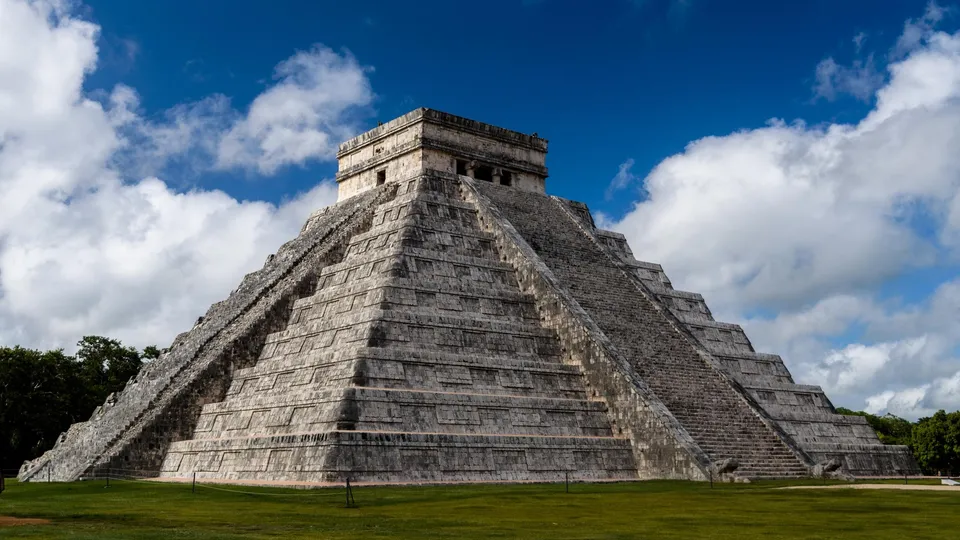
Great cities such as Tikal, Palenque and Copán were important centres of the Classic period. Maya temples also reflected the Maya understanding of the universe. Pyramids were thought of as sacred mountains reaching up to the layers of heaven. At the Pyramid of Kukulcán at Chichén Itzá, the shadow that falls on the steps at the spring and autumn equinoxes resembles a descending serpent. This design shows that buildings were planned according to celestial events.
An important part of Maya knowledge was kept in books called codices. After the Spanish conquest most of these books were burned; in 1562 Bishop Diego de Landa had a large number of codices burned at Maní. Only four Maya codices have survived to the present day. According to the TDV Encyclopedia of Islam, after this period the religions of the indigenous civilizations largely gave way to Christianity.
Comparison with Other Civilizations
The idea of a flat, four-cornered world is common among ancient civilizations. In Babylonian, Egyptian and Indian beliefs, too, the world was often thought of as a flat area or as a structure carried by a being. This similarity shows the common features of early, observation-based ideas of the universe. For comparison, see our articles on the Babylonian view of the world and the ancient Egyptians’ view of the world. We discussed the Indian conception in our article on the ancient Indians.
Frequently Asked Questions
What did the Maya believe the world looked like?
They likened the earth to the back of a giant crocodile or turtle floating in the primordial sea. They also thought of the world as a four-cornered, four-coloured plane.
Why are different answers given to the question of what the Maya believed the world looked like?
Because there is no single image in Maya belief. The sources speak of complementary images such as the crocodile, the turtle, the four-cornered plane and the world tree.
What is Xibalba?
It is the nine-layered underworld in Maya belief. It was associated with the gods of death.
How many days did the Maya calendar have?
There were two main cycles: the 260-day sacred calendar and the 365-day solar calendar.
Conclusion
The answer to the question of what the Maya believed the world looked like is not a single shape. The earth was imagined as the back of a giant crocodile, as a four-cornered and four-coloured plane, and as a layered universe with a sacred tree at its centre. This conception was intertwined with the Maya calendar and astronomy. Although most of the codices have been lost, this understanding of the universe can still be traced through the Popol Vuh and the temples.
Sources
- TDV Encyclopedia of Islam, entry “Amerika” (America)
- TDV Encyclopedia of Islam, entry “Takvim” (calendar)
- Michael D. Coe, The Maya.
- Karl Taube, Aztec and Maya Myths.