The most common answer to the question of where the first city settlements in the world were founded is Mesopotamia. In this region between the Tigris and the Euphrates, the Sumerians founded cities such as Uruk and Ur in the 4th millennium BC. The TDV Encyclopedia of Islam, however, notes that Çatalhöyük near Konya was an urban settlement going back to around 6800 BC.
Quick Summary
- The most common answer is Mesopotamia; Sumerian cities such as Uruk, Ur and Lagash are among the oldest.
- According to the TDV Encyclopedia of Islam, Çatalhöyük is an urban settlement going back to around 6800 BC.
- The first cities arose where agriculture had developed, near water and at the crossing of routes.
- The Nile valley and the Indus basin were also centres of early urbanization.
- Writing, written laws and state organization developed together with cities.
Contents
- The short answer
- What is a city?
- Mesopotamia and the Sumerian cities
- Çatalhöyük
- Egypt, the Indus and Jericho
- Aleppo
- Common features of the first cities
- How did the first cities emerge?
- Frequently asked questions
Where Were the First City Settlements in the World Founded?
The short answer points to two places. Classical accounts look for the first cities in Mesopotamia, especially in the Sumerian region of present-day southern Iraq. New archaeological research, on the other hand, highlights much older settlements such as Çatalhöyük in Anatolia. The answer changes according to the meaning given to the word “city”.
According to the TDV Encyclopedia of Islam, some sources write that the first urbanization began in Syria, Palestine, Egypt and Mesopotamia from around 4400 BC. According to the encyclopedia, however, new research has shown that Çatalhöyük, 52 km south-east of Konya, was an urban settlement going back to around 6800 BC.
What Is a City, and How Does It Differ from a Village?
According to the TDV Encyclopedia of Islam, a city is a large centre of settlement where most of the working-age population is engaged in occupations such as trade, industry and administration. The Turkish word şehir comes from the Persian root shahr. In Turkish the words kent, of Sogdian origin, and balık, which also means “fortress, palace”, were used for city. In Arabic the words madina, balda and misr are common.
This definition is important when discussing the first cities. Being large does not by itself make a settlement a city. Archaeologists usually look at the division of labour, monumental buildings, trade and administrative organization. By these criteria the line between large villages and the first cities is not always clear.
Mesopotamia and the Sumerian Cities
Mesopotamia means “between two rivers” and refers to the region between the Tigris and the Euphrates. Most of the region lies within the borders of Iraq today. The soil, made fertile by floods, yielded abundant crops thanks to irrigation canals. This abundance made possible the rise of the first cities, able to feed a large population.
The Sumerians of southern Mesopotamia founded city-states such as Uruk, Ur, Lagash and Eridu. In the 4th millennium BC Uruk became one of the largest settlements of its age. The first examples of cuneiform writing also appeared in this region towards the end of the 4th millennium BC. At the centre of the cities rose stepped temple towers called ziggurats.
The TDV Encyclopedia of Islam’s entry on Babylon also points to this Sumerian heritage. According to the encyclopedia, the first name of Babylon was the Sumerian Ka-dingir-ra, meaning “gate of god”. In the 24th century BC Sargon of Akkad destroyed the Sumerian city-states and founded the Akkadian Empire. Babylon later enjoyed brilliant ages under Hammurabi and the Chaldeans.
According to the encyclopedia, the city’s history lasted at least 2,000 years. The Old Babylonian Kingdom ruled from 1894 to 1595 BC, and the Chaldean or Neo-Babylonian Kingdom from 626 to 539 BC. The Chaldean ruler Nebuchadnezzar II built the Hanging Gardens, counted among the Seven Wonders of the World. In 539 BC the city fell to the Persian king Cyrus.
We described this region’s conception of the universe in our article What Did the Babylonians Think the World Looked Like?
Was Çatalhöyük the World’s First City?
The TDV Encyclopedia of Islam describes Çatalhöyük as an urban settlement going back to around 6800 BC. On this mound in the Konya Plain the houses were built adjoining one another. There were no streets; the houses were entered through openings in the roofs. The wall paintings and reliefs reveal a rich world of belief and art.
Some researchers regard Çatalhöyük as a large village rather than a city. This is because there is no trace there of a palace, a separate temple district or a distinct ruling class. Even so, the fact that thousands of people lived in the same place for centuries shows the level that settled life had reached. Çatalhöyük was added to the UNESCO World Heritage List in 2012.
An even older example in Anatolia is Göbeklitepe. This site near Şanlıurfa is not a city but a monumental ceremonial complex built by hunter-gatherers. Even so, it is of great importance for understanding the transition to settled life.
Egypt, the Indus and Jericho
The Nile valley is also one of the centres of early urbanization. According to the TDV Encyclopedia of Islam, Manetho writes that the person who united Lower and Upper Egypt was Menes (Narmer), king of Thinis. Pharaoh Djoser of the 3rd dynasty moved the centre of government from Thinis to Memphis. Around 2650 BC he had the first step pyramid built at Saqqara. According to the encyclopedia, the name “Egypt” in Western languages is also thought to derive from Hikuptah, the ancient Egyptian name of Memphis.
We discussed the Egyptians’ conception of the universe in our article What Did the Ancient Egyptians Believe the World Looked Like?
According to the TDV Encyclopedia of Islam, in India the first settled life began at the beginning of the 7th millennium BC at Mehrgarh in the Indus basin. This culture gave rise to the Harappan civilization, which enjoyed its most brilliant period between 2300 and 1700 BC. According to the encyclopedia, Harappa and Mohenjo-Daro had an approach to town planning that still inspires admiration today. The script of this civilization, however, has still not been deciphered.
Jericho in Palestine is regarded as one of the oldest continuously inhabited places of settlement. Its stone tower and walls from the Neolithic period show that a need for common defence arose here at a very early date. We also described the Indian world’s conception of the universe in our article What Did the Ancient Indians Believe the World Resembled?
Aleppo: A City Thousands of Years Old
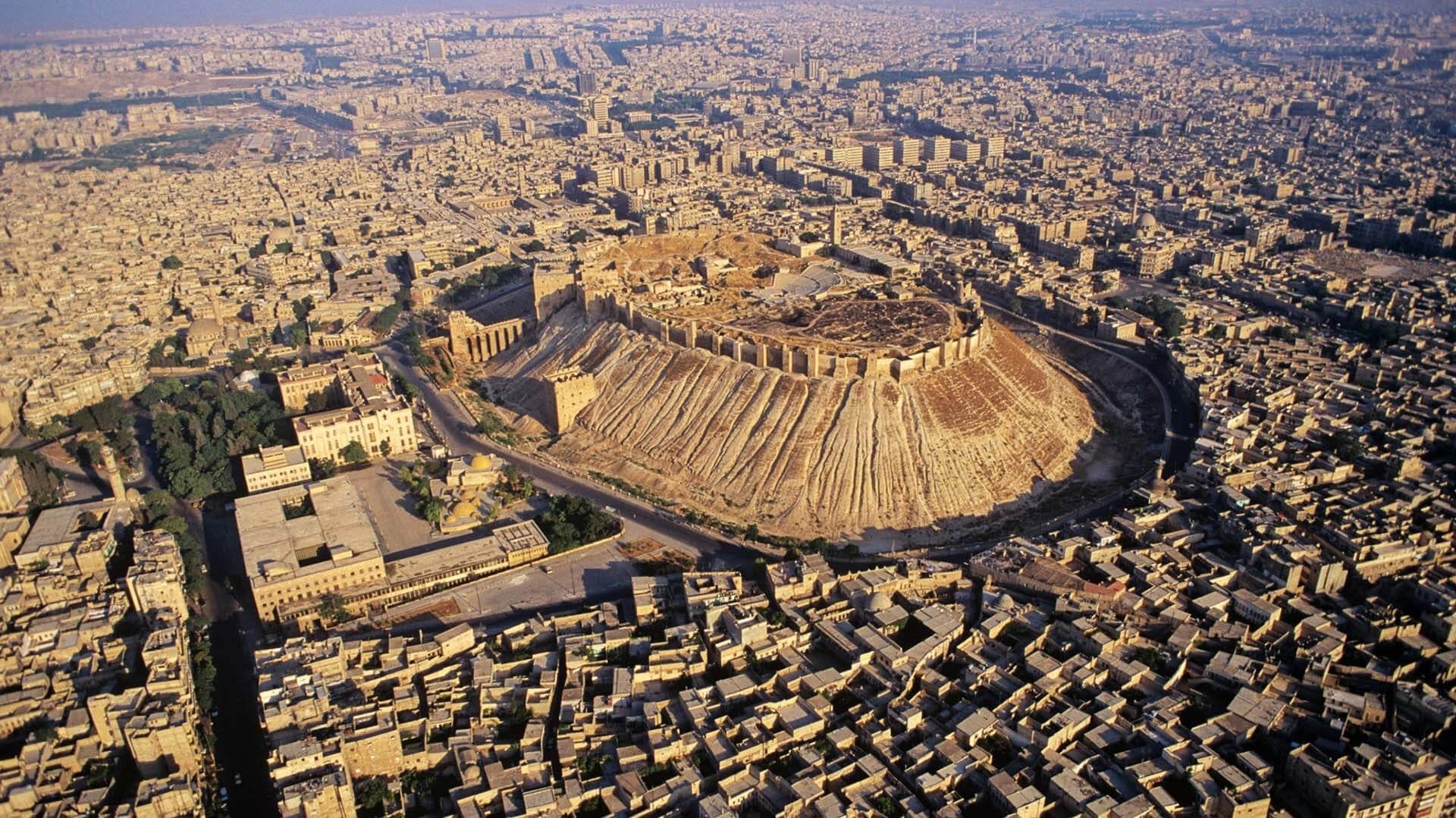
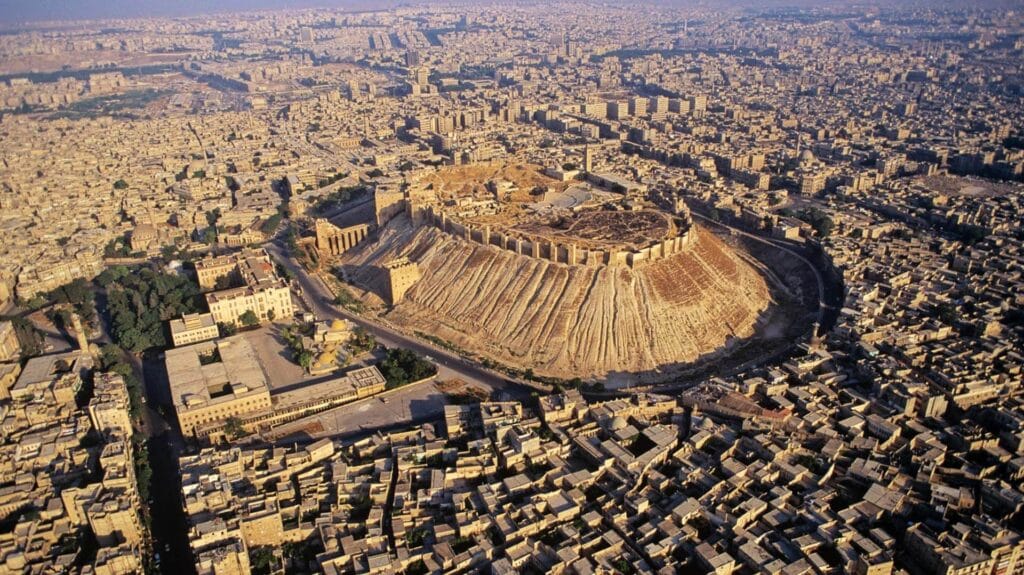
Aleppo, shown in the image, is also one of the oldest cities in the world. According to the TDV Encyclopedia of Islam, the city was founded at the crossroads of the main routes leading from Anatolia to Mesopotamia and from the Mediterranean to Iran. Its name first appears in the form Halaba in Akkadian tablets of the 3rd millennium BC. In the 18th century BC it was the capital of the Kingdom of Yamhad. According to the encyclopedia, the city also owed its importance in antiquity to being the cult centre of the storm god Adad.
According to the encyclopedia, Aleppo later became one of the most important provincial centres of the Hittite Empire and then came under Assyrian rule. In the Hellenistic period it was rebuilt under the name Beroia. The story of Aleppo shows how trade routes determined the fate of a city.
Common Features of the First Cities
- Proximity to water: Riverbanks provided opportunities for irrigation and transport.
- Agricultural surplus: Surplus produce fed craftsmen and administrators who were not farmers.
- Temple and palace: Religious and administrative buildings stood at the centre of the city.
- Walls: Cities that grew rich needed defence.
- Trade: Cities at the crossing of routes became marketplaces.
Writing was also born in this environment. The need to keep records of produce, taxes and temple property led to the development of cuneiform writing in Mesopotamia. Hammurabi, the Babylonian ruler famous for his laws, is a symbol of the period in which city life was bound by written rules.
How Did the First Cities Emerge?
Hunter-gatherer communities were constantly on the move in search of food. With the development of agriculture and stockbreeding, people began to stay in the same place for long periods. This great change is called the Neolithic Revolution, and it took place at different times in different regions. As villages grew, so did the need for a division of labour, trade and administration.
Cities are the product of this accumulation. As the population became denser, different occupations such as potter, weaver, merchant, priest and soldier emerged. Administrators and rules were needed to run common affairs. In this way the foundations of the first states were also laid in cities.
Frequently Asked Questions
Where were the first city settlements in the world founded, in brief?
The most common answer is Mesopotamia. According to the TDV Encyclopedia of Islam, Çatalhöyük in Anatolia is also an urban settlement going back to around 6800 BC.
Why is Çatalhöyük mentioned in discussions of the first city settlements?
It is mentioned because it was a very old and populous settlement. However, some researchers count it as a large village rather than a city.
Which is the world’s first city?
There is no single answer. The Sumerian city of Uruk is usually named as one of the first true cities.
Where is Mesopotamia?
It lies between the Tigris and the Euphrates. Most of it is within the borders of Iraq today.
Why were the first cities founded on riverbanks?
Water was needed for agriculture, irrigation and transport. The alluvium carried by the rivers also made the soil fertile.
Conclusion
The most common answer to the question of where the first city settlements in the world were founded is Mesopotamia. The Sumerian cities such as Uruk and Ur began city life in the true sense, together with writing and state organization. Nevertheless, Çatalhöyük, Jericho, the Nile valley and the Indus basin are also important links in early urbanization. The first cities were born where agricultural surplus, trade and the division of labour came together.