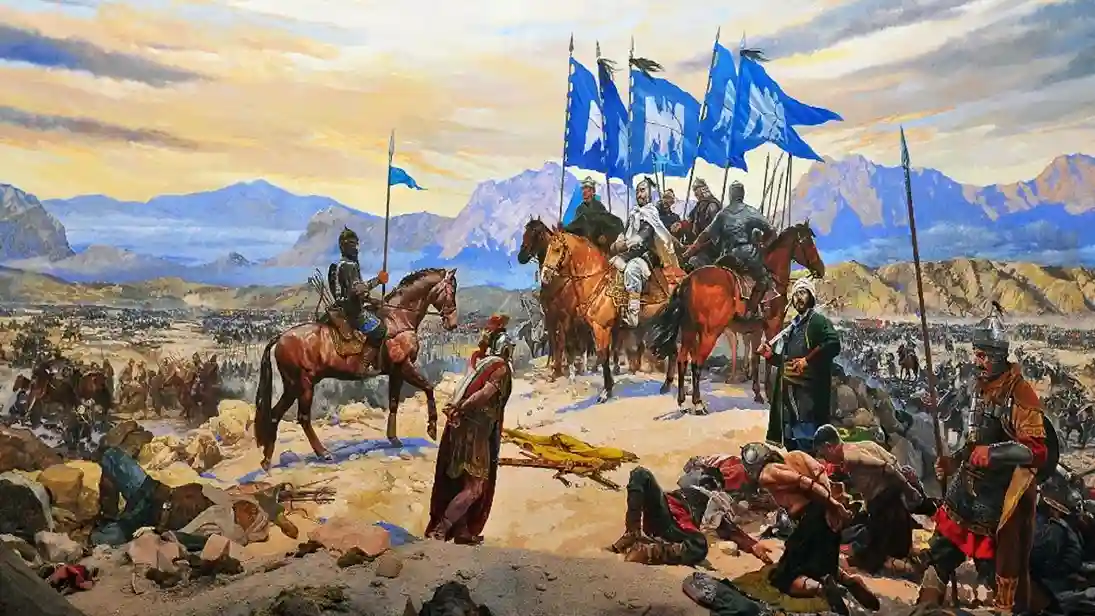
The wars of the Great Seljuk Empire tell how a nomadic community turned, in less than a century, into a state stretching from Central Asia to Anatolia. Dandanakan marked the birth of the state, Pasin and Manzikert the opening of the gates of Anatolia, and Katvan and the Oghuz revolt its disintegration. In this article we examine each war with its dates, opponents and consequences.
Quick Summary
- The Battle of Dandanakan (1040) was won against the Ghaznavids and founded the state.
- The Battle of Pasin (1048) was the first important pitched battle fought against Byzantium.
- The Battle of Manzikert (1071) opened the gates of Anatolia to the Turks.
- The defeat at Katvan (1141) severely shook the state’s power in the east.
- In the Oghuz revolt of 1153 Sultan Sanjar was taken prisoner, and the state went into collapse.
Contents
- Chronological table of the wars
- The Battle of Dandanakan
- The Battle of Pasin
- The entry into Baghdad
- The Battle of Manzikert
- The reign of Malik-Shah
- Sanjar’s campaigns
- The Battle of Katvan
- The Oghuz revolt and the end
- Why the army succeeded
- The question of the Crusades
- Frequently asked questions
The Wars of the Great Seljuk Empire: A Chronological Table
The table below summarizes the main conflicts that determined the fate of the state. The dates are based on the relevant entries of the TDV Encyclopedia of Islam.
| War | Date | Opponent | Result |
|---|---|---|---|
| Dandanakan | 1040 | Ghaznavids | Founding of the Seljuk state |
| Pasin | 1048 | Byzantium | First important victory over Byzantium |
| Conquest of Ani | 1064 | Byzantium | Opening toward the Caucasus and Eastern Anatolia |
| Manzikert | 1071 | Byzantium | The gates of Anatolia opened |
| Katvan | 1141 | Kara Khitai | Heavy defeat in the east |
| Oghuz revolt | 1153 | Oghuz | Capture of Sultan Sanjar |
The Battle of Dandanakan (1040): The Birth of the State
The TDV Encyclopedia of Islam defines the Battle of Dandanakan as the battle fought between the Seljuks and the Ghaznavids in 431 AH (1040), which brought about the founding of the Seljuk state. Dandanakan lay on an important trade route between Sarakhs and Merv, in the territory of present-day Turkmenistan.
Before the battle, the Seljuks, led by the beys Tughril and Chaghri, had been waging a long struggle against Ghaznavid rule in Khorasan. At Dandanakan the army of the Ghaznavid ruler Mas‘ud was defeated. With this victory Khorasan passed to the Seljuks, and an independent state emerged.
For information on the administrative structure of the Ghaznavid state, see our article on the title of viziers among the Ghaznavids.
The Battle of Pasin (1048): The First Reckoning with Byzantium
After the state was founded, Seljuk raids turned toward Eastern Anatolia. According to the TDV Encyclopedia of Islam, Tughril Bey sent Ibrahim Yinal to the region, accompanied by Kutalmish. After conquering Erzurum, the Seljuk army inflicted a heavy defeat on the Byzantine army on the plain of Pasin (440 AH/1048).
Many prisoners and much booty were taken in this battle. At the request of the Byzantine emperor, Tughril Bey released the Georgian prince among the prisoners without ransom. This gesture showed that the Seljuks were now a power that maintained diplomatic relations with the empire in the region.
The Entry into Baghdad (1055) and the Protection of the Caliphate
The wars of the Great Seljuk Empire were not confined to the frontiers. According to the TDV Encyclopedia of Islam, in 447 AH (1055) Tughril Bey entered Baghdad at the invitation of the Abbasid caliph al-Qa’im bi-Amr Allah. This ended the influence of the Buyids, who had kept the caliphate under pressure.
This development gave the Seljuks broad legitimacy in the Islamic world. The sultans were now seen as the protectors of the caliphate. For the background of the Abbasid caliphate, take a look at our article on the Abbasid period.
The Battle of Manzikert (1071)
Alp Arslan, who succeeded Tughril Bey, increased the pressure on the Byzantine frontier. According to the TDV Encyclopedia of Islam, Ani, the most strongly fortified city of the region, was taken on 16 August 1064 after a long siege. In 1070 the fortresses of Manzikert (Malazgirt) and Erciş were seized.
Romanos Diogenes, who came to the Byzantine throne in 1068, wanted to halt this advance. On 13 March 1071 the emperor set out on campaign with a large army. The two armies met on the plain of Manzikert on Friday, 26 August 1071. According to the TDV Encyclopedia of Islam, this Seljuk victory opened the gates of Anatolia to the Turks.
The Place of Manzikert among the Wars of the Great Seljuk Empire
Unlike the earlier wars, Manzikert was not a border clash but a pitched battle against the main Byzantine army. The Byzantine emperor was taken prisoner and released under a treaty. For the causes of the battle and the preparations for it, you can read our article on the cause of the Battle of Manzikert.
The Reign of Malik-Shah: The Peak and the Expansion of the Borders
The reign of Alp Arslan’s son Malik-Shah (1072–1092) is the period in which the state reached its widest borders. The bureaucracy run by the vizier Nizam al-Mulk made the administration of this vast territory possible. In this period campaigns were conducted in regions stretching from Transoxiana to Syria.
In 1092, however, the deaths first of Nizam al-Mulk and shortly afterwards of Malik-Shah shook the state. Struggles for the throne began, and central authority weakened. For the background of this period, see our article Who killed Malik-Shah?
Sanjar’s Campaigns against Ghazna and Khwarazm
Sanjar’s campaigns also hold an important place among the wars of the Great Seljuk Empire. Before becoming sultan, Sanjar had already led important campaigns as malik (governor) of Khorasan. According to the TDV Encyclopedia of Islam, he defeated the numerically superior Ghaznavid army and, entering Ghazna on 25 February 1117, proclaimed Bahram Shah sultan of the Ghaznavids. In this way, except for the lands held by the Lahore branch, the Ghaznavid realm came under Seljuk rule.
The Khwarazmshahs remained dependent on Sanjar until 1135 and took part in his campaigns. Over time, however, the Khwarazmshah Atsiz sought independence. According to the encyclopedia, in 1147 Sanjar set out on his third Khwarazm campaign and took the fortress of Hazarasp after a two-month siege. When Atsiz asked for forgiveness, Sanjar pardoned him once again in 1148.
The Battle of Katvan (1141): A Heavy Defeat in the East
Sanjar, the last powerful ruler of the dynasty, long managed to preserve the unity of the state. In the east, however, the Kara Khitai under the leadership of Yelü Dashi grew stronger. According to the TDV Encyclopedia of Islam, the Seljuk army suffered a heavy defeat on the Katvan steppe on 9 September 1141.
In this battle Sanjar lost about 30,000 men and was able to withdraw to Termez with 300 horsemen. His wife Terken Hatun and his leading emirs were taken prisoner. The defeat at Katvan largely ended Seljuk influence in Transoxiana and, according to the encyclopedia, prepared the ground for the collapse of the state.
The Oghuz Revolt (1153) and the End of the State
The final blow to the state came from the Oghuz tribes within it. A dispute that arose over taxation and administration turned into war. According to the TDV Encyclopedia of Islam, Sanjar was defeated and taken prisoner in the clash of April 1153.
The Oghuz kept the sultan with them and for a while continued to recognize him as ruler in name. Although Sanjar escaped from captivity, he could not restore his authority and died in 1157. He was buried in the mausoleum he had built in Merv, called the Dar al-Akhira. According to the encyclopedia, Sanjar was a ruler who patronized men of letters, poets and scholars. With his death the Great Seljuk state effectively came to an end.
Why Was the Seljuk Army So Successful?
In most of these wars the Seljuks won with armies that were not numerically superior. Several common factors lay behind this. These factors arose from the combination of the steppe tradition of warfare with the institutions of settled states.
The first factor was mobility. The mounted archers who formed the core of the army could move much faster than their heavily armored opponents. According to the sources, the tactic of feigned retreat, which scattered the enemy and then encircled him, was a frequently used method that came from the steppe tradition.
The second factor was the financing of the army. The iqta system, which became widespread in the time of Nizam al-Mulk, tied the soldiers’ livelihood to revenues from land. This arrangement made it possible to support a large cavalry force without straining the central treasury. Alongside the sultan there were also salaried household troops in permanent service.
The third factor was the energy of the Turkmen tribes on the frontiers. These tribes pressed the Byzantine frontier with raids and wore the region down before the pitched battles. The wave of migration toward Anatolia after Manzikert was a continuation of this dynamic. Within a short time the Seljuk Sultanate of Rum emerged in Anatolia.
Were the Crusades Fought against the Great Seljuks?
There is a common confusion on this point. When the First Crusade began in 1096, the Great Seljuk state was divided by struggles for the throne following Malik-Shah’s death. The powers that actually faced the crusader armies in Anatolia were the Seljuks of Rum and the Turkish emirates in Syria.
It is therefore not correct to add the Crusades directly to the list of the wars of the Great Seljuk Empire. We discussed the distinction between the different branches of the Seljuk dynasty more broadly in our article on the Seljuk wars.
Frequently Asked Questions
What were the wars of the Great Seljuk Empire?
The main ones were the battles of Dandanakan (1040), Pasin (1048), Manzikert (1071) and Katvan (1141). The Oghuz revolt of 1153 was also a conflict that brought about the end of the state.
With which battle was the Great Seljuk state founded?
It was founded with the Battle of Dandanakan in 1040. In this battle the Ghaznavids were defeated and Khorasan passed to the Seljuks.
Which of the wars of the Great Seljuk Empire led to its collapse?
The defeat at Katvan shook its power in the east, and the Oghuz revolt of 1153 drove the state into collapse with the capture of Sanjar.
Conclusion
The wars of the Great Seljuk Empire clearly show the rise and fall of a state. The process that began with Dandanakan reached its peak at Manzikert. With Katvan and the Oghuz revolt, the disintegration accelerated. The most lasting result of these wars was that Anatolia became a Turkish homeland.
Sources
- TDV Encyclopedia of Islam, entry “Dandanakan Savaşı” (Battle of Dandanakan)
- TDV Encyclopedia of Islam, entry “Tuğrul Bey”
- TDV Encyclopedia of Islam, entry “Alparslan”
- TDV Encyclopedia of Islam, entry “Sencer” (Sanjar)
- Osman Turan, Selçuklular Tarihi ve Türk-İslâm Medeniyeti (History of the Seljuks and Turkish-Islamic Civilization, in Turkish).
- Erdoğan Merçil, Müslüman-Türk Devletleri Tarihi (History of the Muslim Turkish States, in Turkish).

1 thought on “The Wars of the Great Seljuk Empire”