The Göktürk Epic is the collective name for the cycle of legends recounting the origins of the Göktürks and their rebuilding of a state after coming to the brink of extinction. It is not a single text: two separate narratives — the Bozkurt (Grey Wolf) Legend and the Ergenekon Legend — are gathered under this heading. We take them one at a time, with their sources.
The short answer: two legends, one theme
| Legend | What it tells | Central motif | Where it survives |
|---|---|---|---|
| Bozkurt Legend | The Turkic line reborn from a she-wolf | The she-wolf (Asena) | Chinese annals — Zhoushu, Suishu |
| Ergenekon Legend | Escape from a sealed valley by melting an iron mountain | Iron mountain, blacksmith, guiding wolf | Rashid al-Din, Jami’ al-Tawarikh; Abu al-Ghazi Bahadur Khan |
Their shared theme is the same: rebirth after annihilation. That is why most sources tell them together, and why “the Göktürk Epic” is usually understood to mean both at once.
The Bozkurt Legend: the line reborn
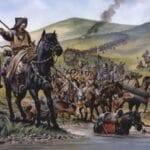
According to the narrative, a Turkic tribe is almost wholly destroyed in an enemy raid. The only survivor is a child whose arms and legs have been cut off and who is thrown into a marsh. A she-wolf finds the child, feeds him and raises him.
When the enemy learns the child has survived and kills him, the wolf flees to the Altai Mountains and there gives birth to ten sons in a cave. Their descendants multiply over time; from among them the Ashina family rises and founds the Göktürk dynasty.
The legend is more than a folk tale: the golden wolf’s head carried on the banners of the Göktürk khagans shows that the narrative served as the dynasty’s official claim of descent. For the political history of the Göktürks, see the Göktürk flag.
The Ergenekon Legend: melting the iron mountain
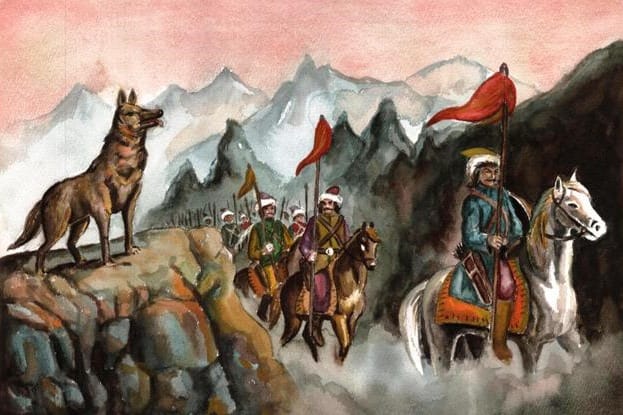
The Ergenekon narrative tells the second stage, the one that follows catastrophe. After a heavy defeat the Turks take refuge in a valley ringed by sheer mountains, with no way in or out. The valley is called Ergenekon.
- There the Turks multiply and grow strong over four hundred years.
- When the valley no longer holds the population, a way out is sought.
- A master blacksmith notices a slope of the mountain veined with iron.
- Fires are lit with seventy bellows, the iron mountain is melted and a pass is opened.
- At the exit a grey wolf shows the way; here the two narratives join.
In Turkic tradition the day of the escape is associated with Nevruz, and the ritual striking of iron is part of that commemoration.
What does the wolf motif mean?
In the Turkic epic tradition the wolf performs two distinct functions. In the Bozkurt Legend it is an ancestor: it secures the survival of the line. In Ergenekon, and in the Epic of Oghuz Khagan, it is a guide: it shows the army the road.
This double role explains why the motif proved so durable. The wolf stands for both origin and direction — where a people came from and where it is going.
Who were the Göktürks?
The Göktürks were the first political formation to use the name “Türk” as the name of a state. Founded in 552 under Bumin Khagan, it soon dominated much of Central Asia. After falling under Chinese rule in 630, it was re-established in 682 by Kutluk Khagan.
The Orkhon Inscriptions, raised for Bilge Khagan, Kültigin and the vizier Tonyukuk, are the oldest known long texts in Turkish. In them the epics’ theme of rebirth is told again — this time in the language of history: how the state was lost and how it was taken back.
The epic’s place in Turkic culture
Epics are not historical documents in a literal sense, yet they transmit the worldview of the period in which they were told. The Göktürk legends record three things: that independence was held to be the central value, that the dynasty grounded its legitimacy in a sacred claim of descent, and that ironworking was seen as a saving craft in steppe society.
Frequently asked questions
What does the Göktürk Epic tell in brief?
It tells how a Turkic people on the edge of extinction was reborn through a she-wolf and, after escaping from Ergenekon, founded a state once more.
Are the Göktürk Epic and the Ergenekon Legend the same?
Not the same, but part of the same cycle. The Bozkurt Legend tells of the origin of the line, the Ergenekon Legend of the escape from the valley. Together they form the Göktürk epic tradition.
What is the name of the wolf in the legend?
In the sources the she-wolf is called Asena. The same root is linked to Ashina, the name of the Göktürk dynasty.
Which day is the escape from Ergenekon linked to?
Tradition links it to 21 March, that is to Nevruz. The ceremonial striking of iron continues as a commemoration of that escape.
In which sources does the Göktürk Epic appear?
The Bozkurt narrative survives in the Chinese annals (Zhoushu, Suishu), while the Ergenekon narrative has reached us through Rashid al-Din’s Jami’ al-Tawarikh and Abu al-Ghazi Bahadur Khan’s Shajara-i Turk.
Sources
- İbrahim Kafesoğlu, Türk Millî Kültürü (Turkish National Culture).
- Bahaeddin Ögel, Türk Mitolojisi (Turkish Mythology).
- Abu al-Ghazi Bahadur Khan, Shajara-i Turk.
- Talat Tekin, A Grammar of Orkhon Turkic.
- TDV Encyclopaedia of Islam (DİA), entries “Göktürkler” and “Ergenekon”.