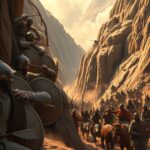
The army that defeated Napoleon at Acre was the Ottoman garrison under the command of Cezzar Ahmed Pasha. According to the TDV Encyclopedia of Islam, the siege began in March 1799. The British fleet helped the defenders, and there was also a Nizam-ı Cedid unit in the fortress. Bonaparte was forced to lift the siege and withdraw on 20 May 1799.
Quick Summary
- Acre was defended by Cezzar Ahmed Pasha, governor of Sidon and Damascus.
- The siege began on 18 March 1799, and the first assaults were made on 19–20 March.
- The British fleet and the soldiers of the Nizam-ı Cedid supported the defence.
- The French army lifted the siege on 20 May.
- This failure frustrated Napoleon’s plans in the East.
Contents
- The short answer
- The French expedition to Egypt
- Cezzar Ahmed Pasha
- The course of the siege
- Consequences
- Cezzar’s last years
- Acre’s place in history
- Frequently asked questions
Which Army Defeated Napoleon at Acre?
The short answer is the Ottoman forces of Cezzar Ahmed Pasha at Acre. According to the TDV Encyclopedia of Islam, Cezzar had been appointed serasker, or commander-in-chief, of Egypt because he knew Egypt very well. Among the forces at Acre there was also a unit belonging to the newly founded Nizam-ı Cedid army. The British fleet also helped the defence from the sea. The defence was therefore a joint success of Ottoman soldiers and British sailors.
The Nizam-ı Cedid was the new-style army founded by Selim III in 1793. The unit at Acre was facing one of this army’s first tests. Some Western accounts attribute the victory to the British alone. Yet, according to the encyclopedia, the main burden of the defence was borne by Cezzar and his garrison, while the British helped from the sea.
Why Did the French Come to Egypt?
In 1798 France wanted to occupy Egypt in order to establish itself in the Eastern Mediterranean and threaten Britain’s route to India. Napoleon Bonaparte’s army landed at Alexandria on 1 July 1798 and soon reached Cairo. However, on 1 August 1798 the British admiral Nelson destroyed the French fleet at Aboukir. This defeat largely cut the French army in Egypt off from the sea.
According to the TDV Encyclopedia of Islam, the Ottoman government, which reacted strongly to the occupation of Egypt, appointed Cezzar serasker of Egypt. It also decided to send him troops and supplies. The Ottoman state declared war on France and formed an alliance with Britain and Russia. Thus France, an old friend, soon passed into the enemy camp. We discussed the background of the period in our article on the effects of the French Revolution.
Who Was Cezzar Ahmed Pasha?
According to the TDV Encyclopedia of Islam, Cezzar Ahmed Pasha was a Bosnian; his date of birth is given as 1720, 1722 or 1735. He entered the service of Hekimoğlu Ali Pasha, governor of Bosnia, and went with him to Egypt in 1756. According to the encyclopedia, he is said to have received the nickname Cezzar, meaning “camel butcher”, during his wars with the Bedouin. Even in Selim III’s handwritten decrees his name appears simply as Cezzar or Cezzar Pasha.
According to the encyclopedia, when Zahir al-Umar, who had rebelled in the region, was eliminated in 1775, he was appointed governor of Sidon with the rank of vizier. In 1780 he became governor of Damascus. For about thirty years he governed this turbulent region from Acre. He took control of trade in Acre, Sidon and Beirut and monopolized the trade in cotton, grain and silk. According to the encyclopedia, this economic power was also the key to his political power.
According to the encyclopedia, in Egypt he attached himself first to the emir of the pilgrimage, Salih al-Qasimi, and then to Bulutkapan Ali Bey. He became one of Ali Bey’s eighteen personal mamluks. He later moved to Syria and served as mütesellim, or deputy governor, of Beirut. With his mamluks, who were Bosnians, Albanians and North Africans, he built up a powerful military force.
According to the encyclopedia, his commercial activities disturbed the French, and the French ambassador in Istanbul complained about him to Selim III. Relations improved somewhat in 1782–1785, in the time of the consul Renaudot. The French occupation of Egypt, however, completely destroyed this rapprochement.

How Did the Siege of Acre Unfold?
According to the encyclopedia, Napoleon Bonaparte, hemmed in in Egypt, decided to advance into Syria and take Acre, which was regarded as the key to the region. On the way the French army captured El-Arish, Gaza and Jaffa. At Jaffa a large number of prisoners who had surrendered were killed. According to the TDV Encyclopedia of Islam, the siege began on 18 March 1799, and the first assaults were made on 19–20 March.
The most important support of the defence was that the fortress was supplied from the sea. The ships of the British commodore Sidney Smith captured a large part of the siege guns that the French were bringing by sea. As a result the French could not bombard the fortress with enough heavy artillery. Phélippeaux, a royalist French engineer officer who had fled the Revolution, also served in the defence. According to the encyclopedia, new military forces were also sent from Istanbul with the fleet.
The French assaulted the walls again and again, but every attack was repulsed. According to the encyclopedia, Bonaparte lifted the siege on 20 May, some time after the arrival of relief forces. During the siege, which lasted about two months, an outbreak of plague also took its toll on the French army. The length of the siege also worsened the French shortage of provisions and ammunition.
What Were the Consequences of the Siege?
According to the encyclopedia, the French failure caused great rejoicing in Istanbul. Various gifts were sent to Cezzar and to those of his men who had distinguished themselves in the fighting. This success also strengthened hopes that Egypt could be recovered. Napoleon returned to Egypt and in August 1799 left his army and went to France. The French army in Egypt withdrew from the region in 1801.
Napoleon is reported to have said later that if he had been able to take Acre, his destiny in the East would have been entirely different. This remark shows the place the siege held in his dreams. According to some historians, Acre became an insurmountable wall in the way of French plans to reach the East by way of Syria.
The siege also affected relations between Cezzar and Istanbul. According to the encyclopedia, Selim III was worried that Egypt would be seized by Cezzar. For this reason the grand vizier Yusuf Ziya Pasha was sent to Egypt with his army. According to the encyclopedia, Yusuf Ziya Pasha wrote in a report to the capital that once the Egyptian business was over, he would finish off Cezzar as well.
According to the encyclopedia, the government had earlier also considered appointing him to Bosnia. But it gave up the idea because he was seen as the only person who could keep the region under control. When the French army withdrew from Egypt in 1801, Ottoman and British forces acted together.
Cezzar’s Last Years
According to the encyclopedia, Cezzar seized Jaffa in 1802; although this move was regarded as rebellion, he was pardoned because of the Wahhabi danger. He was then given the posts of serasker of the Hejaz and governor of Damascus. According to the encyclopedia, Cezzar Ahmed Pasha died in Acre on 23 April 1804. In Acre he built six mosques, one of them bearing his own name, two markets and many khans and baths, and thoroughly repaired the walls.
According to the encyclopedia, Western sources portray him as an extremely cruel man. This harsh administration, however, allowed him to keep order in a turbulent region for a long time. He also made Acre one of the strongest fortresses in the region. According to the encyclopedia, he tried to strengthen his authority by commissioning treatises describing his activities and his justice.
Acre’s Place in History
According to the TDV Encyclopedia of Islam, Acre is an old port city located today within the borders of Israel, north of the Bay of Haifa. Because it was the headquarters of the Knights of St John in the Crusader period, it was also known as Saint-Jean d’Acre. According to the encyclopedia, it joined the Ottoman lands together with Syria in the time of Selim I. With the permission of Suleiman the Magnificent the French established a trading centre there. In 1832 the city was besieged for six months by İbrahim Pasha, son of Muhammad Ali Pasha, governor of Egypt.
According to the encyclopedia, Acre was conquered in 636, in the time of Caliph Umar. Under Muawiya the region’s second-largest shipyard after Alexandria was founded here; the expeditions to Cyprus in 649 and to Rhodes in 654 set out from Acre. The city fell to the Crusaders in 1104 and was recaptured by Saladin in 1187. According to the encyclopedia, in 1291 the Mamluk sultan al-Ashraf put an end to Crusader rule in Palestine here.
We discussed the later history of the region in our article Did Palestine betray the Ottomans?
Frequently Asked Questions
Who defeated Napoleon at Acre?
The Ottoman garrison under the command of Cezzar Ahmed Pasha defended the fortress with the support of the British fleet.
When was the siege of Acre?
It took place between March and May 1799 and lasted about two months. The French lifted the siege on 20 May.
Why could Napoleon not take Acre?
The strong defence, the British capture of the siege guns, the relief forces that arrived and an epidemic were the main reasons.
Where is Acre today?
According to the TDV Encyclopedia of Islam, it lies within the borders of Israel, 15 km north of Haifa. Its historic old city is still surrounded by walls today.
What is the Nizam-ı Cedid?
It is the new-style army founded by Selim III in 1793. According to the TDV Encyclopedia of Islam, a unit of this army took part in the defence of Acre.
What does Cezzar mean?
It means “butcher” in Arabic. According to the TDV Encyclopedia of Islam, the nickname is said to have been used in the sense of “camel butcher”.
Conclusion
The army that defeated Napoleon at Acre was the Ottoman garrison under the command of Cezzar Ahmed Pasha. The support of the British fleet, the soldiers of the Nizam-ı Cedid and the fortress’s strong defence stopped the French advance. This failure in the spring of 1799 put an end to Bonaparte’s plans in the East. Napoleon’s defeat before Acre is regarded as one of the remarkable defensive successes of Ottoman history.