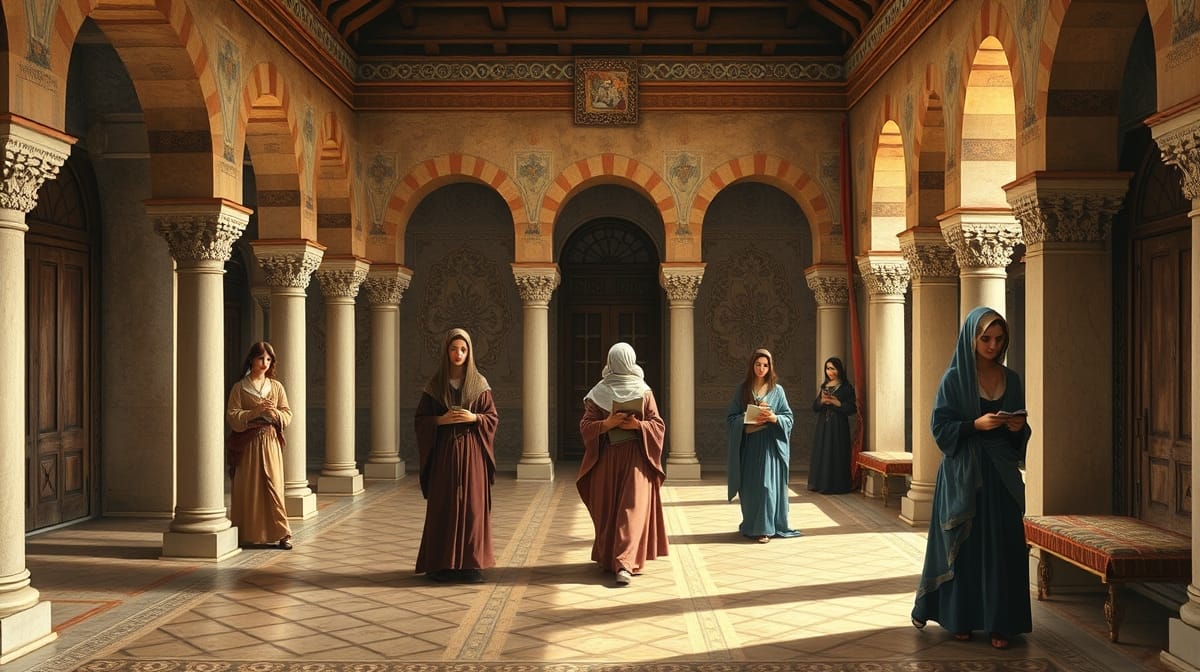
Harem Life in the Ottoman palace was not merely the sultan’s private quarters; it was a closed yet orderly institution where women received education, lived within a hierarchy, were trained in palace manners, and played a role in the continuity of the ruling dynasty.
Contents
- What Is Harem Life?
- The Place of the Harem in the Ottoman Palace
- Daily Order, Education, and Hierarchy
- Rules, Privacy, and Palace Etiquette
- Myths and Facts
- Conclusion
- Sources
- Frequently Asked Questions
)
What Is Harem Life?
For many readers trying to understand Ottoman history, the harem is often a subject overshadowed by novels, paintings, and the accounts of Western travelers. Yet Harem Life, in its literal sense, rests on the idea of a “protected, private area with restricted access.” In Islamic societies, the concept of the harem was not confined to the palace alone; it formed part of a broader understanding of privacy that referred to the private living space of family members within homes.
The harem in the Ottoman palace was a far more institutionalized form of this general meaning. In Topkapi Palace, the harem was the private section where the sultan’s mother, wives, concubines, children, female officials, and certain service groups lived. As Ismail Hakki Uzuncarsili emphasized in his studies on palace organization, the harem was not merely a place where family life continued; it was also one of the important institutions of the palace order.
The first point to note here is this: the harem should not be understood as a “chamber of pleasure and entertainment” in the modern sense. This perception is largely the product of Europe-centered orientalist depictions. In reality, the harem had a structure intertwined with education, discipline, ceremony, kinship, dynastic politics, and the palace economy. In this respect, it may be regarded as one of the most closed yet most influential spaces within the Ottoman](https://osmanlitarihi.tr/en/social-structure-of-the-ottoman-empire/%22>Ottoman) social structure.
Although the harem appeared mysterious from the outside, from within it was a palace institution with firm rules, a clear division of duties, and a hierarchy.
The Meaning of the Word Harem and Its Historical Context
The word “harem” comes from the Arabic root “haram” and is associated with meanings such as inviolable, protected, and worthy of respect. In Ottoman usage, the word especially described the private living sphere of members of the dynasty. Therefore, when speaking of Harem Life, one should understand not only a closed place where women lived, but also a palace system founded on privacy and family order.
In Islamic urban culture, privacy was part of family honor, social order, and religious sensitivities. The Ottomans institutionalized this understanding on the scale of the palace. This turned the harem from an ordinary domestic space into a special institution connected with state protocol.
The Place of the Harem in the Ottoman Palace
In Topkapi Palace, the harem section had an architectural arrangement close to the sultan’s private apartments yet separated from the outer courtyards. Just as the Enderun, the Imperial Council, and the outer services in the palace were bound by certain rules, the harem also operated according to its own internal order. Understanding this order shows that the Ottoman palace did not consist solely of a male bureaucracy.
The highest position in the harem usually belonged to the Valide Sultan. As the sultan’s mother, the valide sultan stood at the head of the hierarchy within the harem, especially in the classical period. Below her were the hasekis, kadinefendis, ikbals, kalfas, concubines, and service staff. This structure did not function with the same rigidity in every period; it changed over time according to the preferences of the sultans and the general politics of the palace.
According to Halil Inalcik, the Ottoman dynastic system had a character that did not completely separate state order from family order. In this respect, the area where the sultan’s family lived was not only the center of private life, but also of dynastic continuity. The birth and upbringing of princes in particular gave the harem institution political significance.
The Valide Sultan and Her Power Within Harem Life
The position of the valide sultan within Harem Life is one of the most important examples showing that palace women were not merely passive figures. The valide sultan was influential in matters such as maintaining order in the harem, educating concubines, conducting ceremonies, and representing the sultan’s family.
It is known that, especially in the 16th and 17th centuries, some valide sultans were able to establish contact with statesmen, sponsor charitable works, and wield influence in palace circles. However, this does not mean that all women of the harem directly governed politics. Historical reality presents a more measured picture that varied according to individuals and periods.
For a broader framework on the names of Ottoman women and their cultural reflections around the palace, studies on Ottoman](https://osmanlitarihi.tr/en/ottoman-female-names/%22>Ottoman) female names may also be useful for understanding social memory.
)
Daily Order, Education, and Hierarchy
Daily life in the harem was not an unrestrained order of entertainment, as is often imagined. The women living in the palace were bound by set hours, duties, educational programs, and ceremonial rules. Talented concubines could be trained in music, sewing, embroidery, manners, religious knowledge, literacy, and palace etiquette.
Suraiya Faroqhi’s assessments of Ottoman daily life show that there were strong links between palace culture and urban culture. The understanding of refinement seen in the harem was also connected to the elite domestic education tradition of the period. On the scale of the palace, however, this education was much stricter, more hierarchical, and more controlled.
Concubines could come to the harem in different ways; after receiving education there, they might remain in palace service or leave the palace through suitable marriages. This point shows that the widespread belief that every woman in the harem remained in the same status for life is not accurate. While some rose within the palace, others were married to state officials and became part of the outside world.
Harem Life and Educational Discipline
In terms of Harem Life, education was one of the institution’s most important aspects, at least as significant as privacy. Kalfas supervised the conduct of newly arrived concubines and taught them how to speak in the palace, how to walk, and how to behave at particular ceremonies. This education was not merely the transfer of knowledge; it was also a process of acquiring a palace identity.
Music and the fine arts could also have a place in harem education. Instruments such as the oud, tanbur, and qanun, as well as arts such as poetry, calligraphy, and embroidery, were part of palace culture. Nevertheless, one should not assume that every concubine was an artist. Duties varied according to talent, need, and hierarchical position.
Hierarchy: From Concubine to Kalfa
At the lowest level of the harem were newly arrived concubines. Over time, women who completed their education and gained trust could rise to the rank of kalfa and take responsibility for certain rooms or areas of service. Higher-ranking women served close to the sultan’s family, and some established kinship ties with the dynasty.
This hierarchy resembled the general bureaucratic logic of the Ottoman palace. Just as young male devshirme recruits were educated in the Enderun and prepared for state service, women in the harem were trained within palace discipline. Of course, the duties and social functions of the two institutions were different; yet there were similarities in terms of discipline, education, and the idea of advancement.
Rules, Privacy, and Palace Etiquette
The rules of the harem were based on privacy, security, and protocol. Entry to and exit from the harem section were strictly controlled. It was not normal for men from outside the palace to enter this area. The harem eunuchs played an important role in this security order. The Chief Black Eunuch, in particular, undertook a critical duty between the harem and the other sections of the palace.
The aim of these rules was not merely to separate women from the outside world. It was also to protect the sultan’s family, the dynastic line, and the reputation of the palace. Since dynastic legitimacy held great importance in Ottoman political culture, the private sphere of the sultan’s family was regarded as a matter of state security.
- Privacy: The harem was a private area that only a limited number of people could enter.
- Hierarchy: There was a clear order among the valide sultan, kadinefendis, kalfas, and concubines.
- Education: Training could be provided in areas such as palace etiquette, religious knowledge, handicrafts, and music.
- Protocol: Specific rules were applied during ceremonies such as holidays, births, marriages, and funerals.
Within this framework, Harem Life was not only private life behind closed doors, but also a refined part of Ottoman palace protocol. These rules within the palace order should be considered together with the other institutions of the state. For example, from the perspective of law and family order, topics such as the](https://osmanlitarihi.tr/en/the-first-ottoman-law-regulating-marriage-and-divorce/%22>the) first Ottoman law regulating marriage and divorce also help us understand social norms outside the harem.
Birth, Marriage, and Dynastic Continuity
The princes and sultanas born in the harem were of great importance for the future of the Ottoman dynasty. The mothers of princes could gain prestige within the harem according to the position of their children. Daughters of the dynasty were often married to distinguished statesmen, helping to establish ties between the dynasty and the ruling class.
Pregnancy, birth, and child care required special preparations in palace circles. To understand the social background of this subject, information on the](https://osmanlitarihi.tr/en/how-was-pregnancy-understood-in-the-ottoman-empire/%22>the) Ottoman understanding of pregnancy also complements the harem context.
[IMAGE: 3]
Myths and Facts
The most widespread myth about the Ottoman harem is the claim that it was merely a center of pleasure and intrigue. This perception was largely shaped by the imagination of European writers who had no direct access to the Ottoman palace. Orientalist paintings often portrayed harem women as exotic and passive figures far removed from historical reality.
As can also be seen in Caroline Finkel’s general narrative of Ottoman history, palace life was not independent of political, military, and social processes. The harem was only a private stage of these processes. Rivalries, ceremonies, and relationships certainly existed there; however, exaggerating them and reducing the entire institution to gossip and intrigue is a historical oversimplification.
Myth: The Harem Was an Unlimited Space of Entertainment
This claim does not correspond to historical sources. Music, entertainment, and ceremonies could be present in the harem, but discipline, education, and service stood at the center of daily order. Most women performed specific duties, lived according to palace etiquette, and moved within a strict hierarchy.
Fact: Harem Life Was an Ordered Palace System
The soundest approach to Harem Life is to treat it as part of the Ottoman palace organization. The position of women there was shaped by proximity to the sultan, the authority of the valide sultan, birth, education, and service relationships. Not everyone in the harem had the same power; there were major differences between statuses.
Another myth is the idea that the women living in the harem were completely cut off from the world. Their direct participation in public life was limited; however, they could establish indirect ties with society through charitable foundations, marriage connections, ceremonies, and relationships within the palace. Valide sultans and dynastic women in particular left lasting marks on urban life by commissioning works such as mosques, soup kitchens, fountains, and schools.
In this respect, the harem should be considered together with Ottoman urban culture and palace architecture. Readers who wish to learn about palace symbols, tughras, and dynastic representation may also consult the content titled the](https://osmanlitarihi.tr/en/the-meaning-of-the-ottoman-tughra/%22>the) meaning of the Ottoman tughra.
The Connection Between the Harem and Ottoman Society
Although the harem was located within the palace, it was not entirely separate from Ottoman society. The fact that some women raised in the palace married state officials, carried out charitable foundation activities, and left traces in urban life demonstrates this connection. In addition, the rules of manners, decorum, and privacy practiced in the harem bore similarities to the domestic culture seen in elite Ottoman families of the period.
For this reason, when examining Harem Life, one must look not only at the sultan’s family, but also at Ottoman society’s understanding of family, women, education, and privacy. The institutionalization of the harem was specific to the palace; yet the values that nourished it came from a broader Islamic-Ottoman cultural world.
As the social structure, wars, reforms, and palace order changed over time, the harem likewise underwent transformation. Especially in the 19th century, the relocation of palace life to new settings such as Dolmabahce and Yildiz changed the classical Topkapi-centered understanding of the harem. This process should be assessed together with Ottoman modernization. For example, later developments such as Ottoman](https://osmanlitarihi.tr/en/democratization-movements-in-the-ottoman-empire/%22>Ottoman) democratization movements show how the relationship between palace and society came to differ.
Conclusion
Harem Life in the Ottoman palace was not merely the mysterious and romanticized world described by myths; it was a historical institution founded on privacy, education, hierarchy, family order, and dynastic continuity. To understand the real picture, one must rely not on orientalist fantasies, but on the Ottoman palace organization and the assessments of reliable historians.
Sources
- Halil Inalcik, The Ottoman Empire: The Classical Age.
- Ismail Hakki Uzuncarsili, Ottoman State Palace Organization.
- Caroline Finkel, Osman’s Dream.
- Suraiya Faroqhi, Subjects of the Sultan: Culture and Daily Life in the Ottoman Empire.
- TDV Encyclopedia of Islam, Harem entry.